




Tianjin SWKS Technology & Development Co.,Ltd is one of the most reliable manufacturers and suppliers of custom pa66 industrial hydraulic manifold protective cover in China. If you're going to buy bulk cheap custom pa66 industrial hydraulic manifold protective cover, welcome to get quotation from our factory. Quality products and low price are available.
Custom PA66 Industrial Hydraulic Manifold Protective Cover
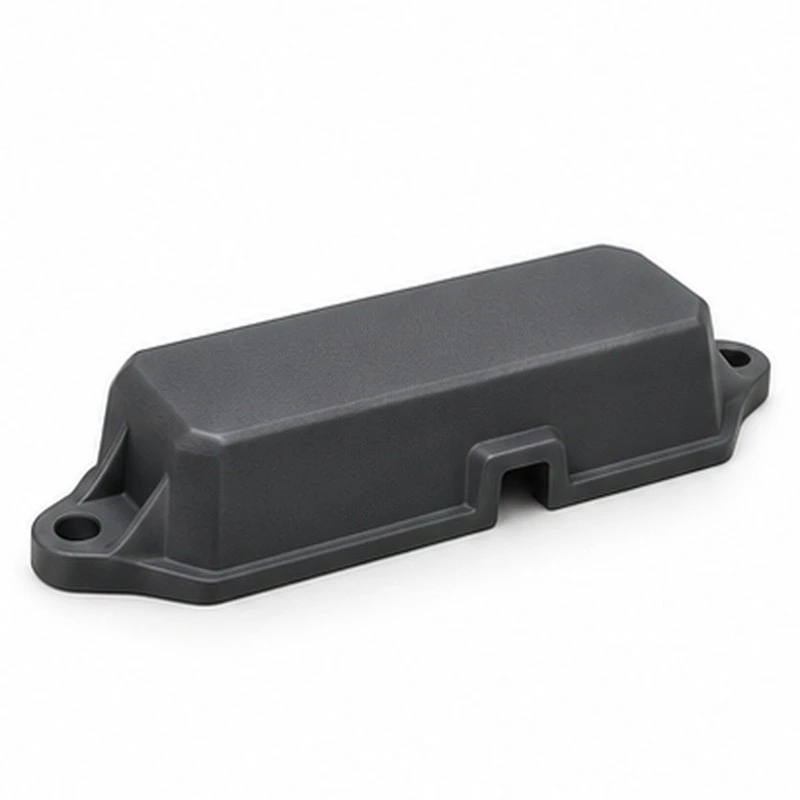
This custom PA66 cover shields selected exterior areas of a hydraulic manifold from routine contact and contamination. The reference cover has a shallow protective cavity, fastening ears and internal relief. It is specified as a removable exterior cover over the block. The photographs are generated examples for drawing review. Production geometry is confirmed through the approved project drawing.
Define what the cover protects
A hydraulic block cover needs a clearly described job. An exterior cap can shield a row of coils, connectors or labels from incidental contact and dirt. A service cover may instead be meant to come off regularly when a technician needs to see a port or replace a valve. Start the drawing review by marking the area that needs protection and the areas that have to remain open. The preferred arrangement may be a short local cover if the open ports and the service label must stay exposed. A longer cover may be practical when the same cover can serve multiple block layouts and the hose routes leave sufficient removal space.
The illustrated PA66 component is a shallow molded shell with mounting ears. Its proposed use is outside the manifold. The pressure passages, plugs and fittings belong to the metal block and its connected hydraulic system. Show any separate shield or guard in the assembly section so there is no uncertainty about which component has what purpose. No sealing or pressure rating is assigned to the illustrated cover. If the equipment specification includes personnel protection, identify the required protection, the relevant risk assessment and the tests for the installed equipment.
Manufacturing scope
| Material | PA66 |
| Process | Custom injection molding |
| Application | industrial hydraulic power packs, valve blocks and machinery service zones |
| Mating components | machined manifold block, mounting screws, connected hose fittings and identifying labels |
| Drawing formats | STP, STEP, IGS and dimensioned drawing |
| Inspection and validation | installed fit, tool access, retention and the planned fluid and temperature exposure review |
Review a real block layout and hose route
A manifold model that contains only the drilled metal body is an incomplete reference for a cover that has to fit around installed connections. In the drawing package include the valves, their electrical plugs, the elbows or adaptors, any tube that projects near the cover and the fasteners used to attach it. Check the largest combination allowed under the machine variants. Import the cord connection if it changes the space available near a coil. A cable that appears flexible in a model still needs room for its plug body and for access to its release feature.
Check the removal envelope as well as the installed envelope. For a machine with a frame panel next to the block it may be impossible to lift the cover straight off even though the fully assembled parts do not touch. Show the intended removal motion on the drawing. If the shell has to tip or slide while clearing an elbow, identify the actual obstruction separately from the minimum clearance around the component. A fixed air gap at one section does not establish access along the rest of the removal path.

Put fixing details on the mating drawing
Locate the mounting holes from stable faces of the metal block or a separate bracket. Ask what will happen when the holes and fastening seats fall at opposite limits. A user should not have to twist the cover to start both screws. Fastener head geometry, washers and any intended metal sleeve or stop should be shown in section. Indicate if a fastener will be reused from the previous cover so the tooling review can confirm clearance around its head and tool.
Avoid relying on the appearance of the mounting ear to decide where it should close against the block. The underside may sit on a machined pad, a spacer or a flange. Document which location is intended to react the load. The drawing can also call out a condition in which the screw seats but the molded shell remains free of unwanted contact with the fittings. For repeated service, check that the fasteners can be reached with the approved tools and that the shell aligns without being pushed against hoses.
Choose a PA66 grade around the actual environment
The cover may see occasional drops of hydraulic fluid, routine wipe-downs, heat from adjacent components and changes in humidity around the equipment. Ask for the fluid identification and the cleaner rather than describing the requirement as general oil resistance. Define whether contact is a brief splash, a wet film that stays in place, or immersion during some operating state. The grade review can then be based on the relevant media and an agreed exposure procedure. Operating and storage conditions are separate inputs if the unit is transported or stored in a substantially different environment.
Review the way the samples will be conditioned before measuring hole pitch and shell dimensions. A conditioned sample and a sample recently removed from the mold need not represent the same assembly state. If dimensional acceptance uses a conditioned part, record how it was prepared and when it was measured. Include color, additive and surface finish requirements in the request if they are important to the machine appearance, part marking or internal procurement specifications. Identify the owner of the test protocol and how any material substitution will be approved.
Plan molded rib and relief geometry
A shallow shell can appear smooth from above while still needing underside ribs to control local deflection. Define the surface that locates it on the block. Compare the intended rib pattern with coil and fitting envelopes, especially around the opening that provides service access. Any tooling proposal that moves a rib or adds draft should be checked against this envelope before the change is accepted. Make a distinction between a cosmetic opening at the edge and a relief where nearby hardware has to pass during removal.
Approval should account for the corner transitions connecting the shell and the mounting ears. Ask the tool designer to identify the parting line and probable molded witness locations, including those on the ear bearing surfaces. If a prominent face carries a label, identify the flat zone and the direction of the printed information. A visual sample should be reviewed under the conditions agreed with the buyer. Hose labels, port identifiers and hazard markings on the installed machine should remain visible where specified.

Confirm the service operation on pilot samples
For the first set of molded samples, trial the cover on a representative manifold with the widest fittings and actual wiring. Begin with a loose position check, seat the cover using the planned fasteners and evaluate any force required to align it. Open and reinstall it using the service sequence. Note which tool is needed and whether it can approach the fastener normally. Inspect for signs of concentrated contact around the hose relief and mounting ears. A photograph of the fitted cover, along with the correct block revision, makes it easier to reproduce and review a fit problem.
If the cover is meant to prevent splash accumulation in a particular area, define how that will be tested by the equipment owner. For a cover that must stay quiet on a running machine, observe it under the applicable equipment operating profile. Record movement or noise with the planned fastener and mounting stack. If a sample must pass an environmental requirement before dimensional review, carry out the exposure first and note the elapsed time before final checks. Keep fit results separate from tests of hydraulic function and qualification of the complete guarding arrangement.
What to send with the RFQ
Prepare the cover model, block assembly and a dimensioned drawing of the fastening areas. Identify the desired PA66 grade or supply the operating envelope for grade selection. State which configurations the same cover must serve and show the service tools or access space the installation needs. Indicate whether the mold is new, whether a sample exists and the expected pilot and production quantities. Include the logo or label drawing only if it affects shape, finish or the space needed on the cover.
If a blocking item remains unresolved, describe it in the RFQ so the supplier can quote on stated assumptions. Common examples are a new hose routing that has not yet been approved or a potential change to the mounting hardware. If both cover and block drawings are evolving, agree on the revision to use for the initial sample and the procedure for submitting changed files. Keep the approved drawing together with the accepted sample and dimensional report so later orders refer to the same fit and service conditions.
On multiple manifold variants, make a matrix that lists valve layout, fittings fitted on each side, fastener stack and access direction. Supply a physical reference for the most crowded variant where available. Check the assembly with the full set of optional coils and electrical connectors, because the model with the longest block is not always the model with the tightest clearance. Record the approved mounting orientation so the same part can be picked correctly for service.
See our plastic injection parts and Custom PA66 Industrial Hydraulic Manifold Port Insert.
Send your drawing and request a quotation at amanda@tjswks.com.
Hot Tags: custom pa66 industrial hydraulic manifold protective cover, China, suppliers, manufacturers, factory, bulk, cheap, low price, quotation, colored plastic injection parts, Low Price PP Machine Parts, plastic rubber machinery parts, Plastic Speaker Casing Housing Cover Shell, simple plastic injection parts, Soft Tooling Injection Molding


