


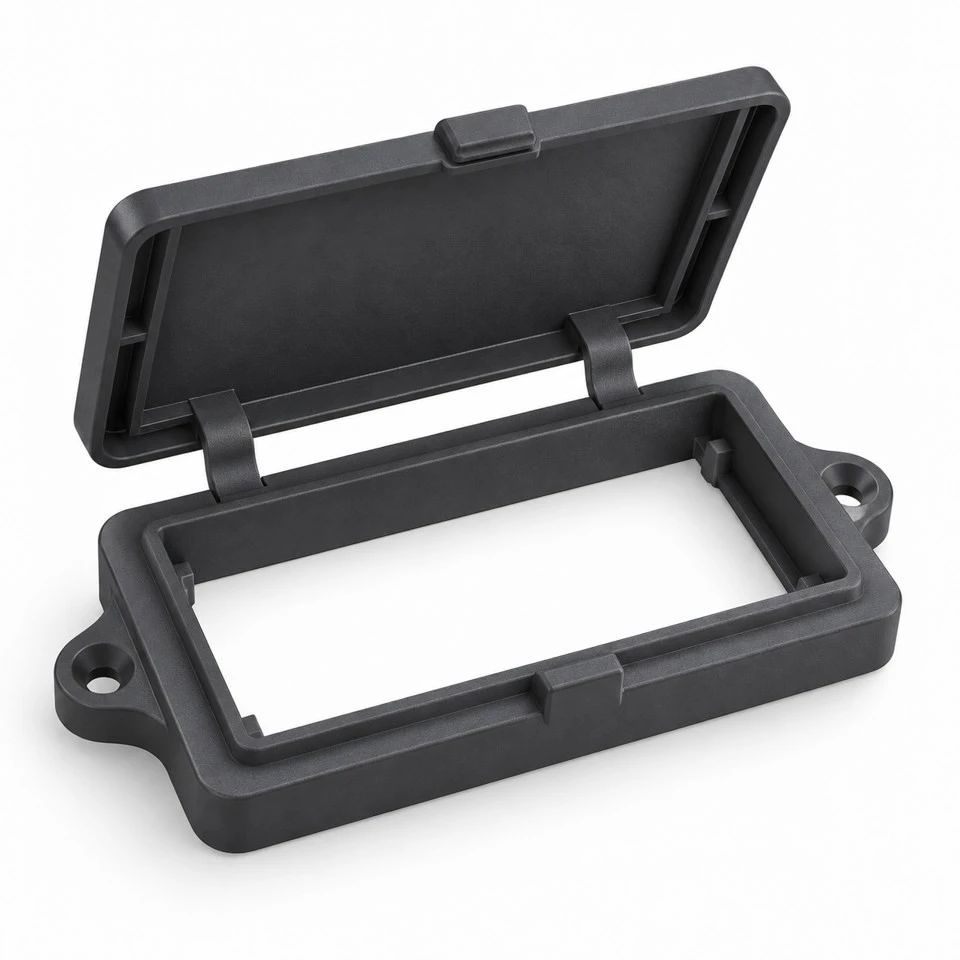


Tianjin SWKS Technology & Development Co.,Ltd is one of the most reliable manufacturers and suppliers of custom pp living hinge protective cover in China. If you're going to buy bulk cheap custom pp living hinge protective cover, welcome to get quotation from our factory. Quality products and low price are available.
How can a captive protective cover simplify routine equipment access?
A custom PP living hinge protective cover combines a mounting frame, flexible hinge and closing lid in one molded component. The lid remains attached when an operator opens the access point, helping reduce loose parts around the equipment. This design can be developed for inspection openings, adjustment points, recessed controls or service compartments where a removable cap would be inconvenient. The illustrated rectangular design includes side mounting ears and a front finger tab, but the opening shape and attachment arrangement are defined by the customer's application.
SWKS accepts custom injection molding inquiries based on drawings or reference samples. This page shows a design concept rather than a standard stocked size. Overall dimensions, mounting details, color and resin grade are confirmed during project review. The photographs are custom product illustrations; production geometry follows the approved drawing and sample. A protective cover should be evaluated together with the surrounding panel, the component being accessed and the operator's hand movement, because these interfaces determine whether the finished assembly is practical to use.
What makes the living hinge different from a separate hinge assembly?
A living hinge uses a flexible section of plastic to connect the lid and frame. It does not require a separate metal pin to form the pivot. For a suitable application, this can reduce assembly steps and keep the opening mechanism within a single molded part. The flexible section must be designed as a working feature rather than as an incidental thin wall. Its thickness, transitions and relationship to the adjacent rigid sections influence how the lid bends during opening and closing.
The hinge and the latch serve different functions. The hinge keeps the lid captive and allows movement, while the latch provides the intended closed position. A cover that bends easily may still require changes to the latch geometry, and a secure latch does not establish hinge durability. These features should therefore have separate acceptance checks. Where a fixed opening stop is required, it must also be specified: the flexible web alone should not be assumed to limit movement safely under an excessive hand load.

Which material information is needed for a PP hinged cover?
Polypropylene is the material proposed for this product family, with the exact grade selected for the intended hinge and enclosure requirements. The broader material list in our service introduction describes our custom molding service; it does not mean that every listed resin can be substituted directly in this living hinge design. Changing the polymer can require a different hinge concept, wall geometry or manufacturing approach. Please identify any mandatory resin designation in the inquiry instead of specifying only a general plastic name.
Material review should include operating temperature, indoor or outdoor exposure, cleaning products, expected opening frequency and any appearance requirements. If a project requires food contact documentation, flame performance or another compliance condition, provide the applicable requirement before quotation. Such properties depend on the selected grade and the finished design and are not implied by the product illustration. Color masterbatch and other additives also belong in the agreed material specification so that sampling and subsequent production use a consistent material definition.
How should the panel opening and mounting interface be specified?
The panel cutout is a primary reference for this cover. Please provide its length, width, corner radii and thickness, together with the position of nearby components. The mounting flange must overlap the opening as intended without obstructing the accessible area. A cover that fits the nominal cutout can still interfere with a connector, a recessed screw or an internal cable, so a section view or assembly model is especially useful. The mounting surface should also be identified as flat, curved or stepped.
For a screw-mounted version, the drawing should define hole spacing, fastener type, head clearance and the support beneath each mounting ear. Tightening conditions need to suit the complete assembly. Unsupported plastic ears should not be expected to compensate for a distorted panel. If the customer prefers snap-in attachment, the panel thickness range and retention requirements need a separate review. We can discuss these alternatives during quotation, but the selected mounting method must be settled before final tooling geometry is released.
How much clearance does the lid need when it opens?
Opening clearance is determined by the movement of the entire lid, including its rim, finger tab and any reinforcing features. A simple top view may hide interference that occurs halfway through the motion. An assembly model should show adjacent walls, wiring, labels and neighboring covers in their installed positions. Please state the minimum useful opening angle and the direction in which the operator approaches the tab. This helps establish whether the lid actually clears the service operation it is intended to support.
Hand access is equally important. A tab sized for bare fingers may be inconvenient when gloves are required, and a recessed installation can make an otherwise accessible latch difficult to reach. The requested opening force should be considered with the available grip and the expected operating position. During sample evaluation, open the cover on the real assembly rather than holding the loose part in the hand. That check can reveal mounting distortion or clearance problems that are not apparent from an isolated sample.

How are latch engagement and the closed position defined?
The front latch needs a clear functional target. Some applications prioritize easy repeated access, while others need greater resistance to accidental opening. Please describe the intended use and any measurable opening or retention force requirement. Latch engagement is affected by the relationship between the lid, frame and hinge, so it should be assessed after installation. A change to the panel attachment can alter frame shape and influence the way the latch engages, even if the individual molded dimensions remain within their agreed limits.
Define whether the closed lid should sit flush with the frame, overlap it or remain slightly raised. The permitted visible gap and any allowable movement should be documented on the drawing or an approved appearance sample. This illustrated cover is not assigned an ingress protection rating. If water or dust sealing is required, the sealing interface, compression control and complete assembly test must be developed specifically for that purpose. A snap closure by itself does not establish a watertight or dust-tight enclosure.
What should be reviewed before injection mold manufacture?
The tooling review should consider the rigid frame, lid and flexible hinge as a connected molding problem. Relevant topics include fill direction, gate location, wall transitions, parting line position, ejection and the space needed to form the latch. Areas that are difficult to fill or release may require changes before tooling begins. Cosmetic preferences should be discussed at the same stage so that gate marks, ejector witness marks and parting lines are placed where they are acceptable to the customer.
Draft angles and surface texture also need to be coordinated. A textured outer face may suit the equipment appearance, while mating or flexing areas may require a different surface definition. Avoid assigning a decorative finish indiscriminately to every face. Drawing revisions resulting from the review should be recorded clearly and approved before they become the manufacturing reference. If the inquiry begins with a sample instead of a CAD model, dimensions and functional features should be confirmed rather than copied from wear or damage on the reference part.
How should samples be checked for hinge performance?
Hinge evaluation should reflect the actual service conditions. Specify the opening angle, cycling speed, number of cycles, temperature and any dwell in the open or closed position. The test should also identify how the frame is supported and what constitutes failure, such as visible cracking, loss of attachment or an unacceptable change in operation. There is no universal cycle-life promise for every custom cover: a meaningful target must be connected to the chosen resin, geometry and agreed test method.
Sample checks should include more than repeated bending. Verify the mounting fit, latch action, closed gap and clearance around adjacent parts. Record which drawing revision and material were used for the tested sample. If environmental conditioning or cleaning exposure is part of the application, evaluate those conditions before approving the design for regular supply. When a change is made to the hinge, latch or material, decide which previous checks need to be repeated so that approval applies to the actual production configuration.
Which dimensions and appearance features should be controlled?
Useful inspection references include the mounting-hole pattern, usable aperture, flange seating surface, closed lid position and latch engagement features. State critical tolerances individually instead of applying an unnecessarily tight tolerance to every dimension. Flexible features may need a defined measuring position and support fixture to obtain repeatable results. The drawing should distinguish measurements taken with the lid open from measurements taken with it closed, and it should state whether inspection occurs on the loose component or on a representative mounting panel.
Appearance criteria can address color, texture, flash, obvious damage and acceptable witness marks. A customer-approved sample or photographs can help communicate these requirements, especially around the visible lid face and the finger tab. If traceability, inspection reports or special packaging labels are needed, include them with the purchasing requirements. These items affect how the order is prepared and should be agreed before production rather than added after finished parts have already been packed.
What packing and quotation details help the project move forward?
Packing should protect the flexible connection and prevent unnecessary loading of the latch during storage and transport. The preferred shipping position, open or closed, should be agreed after sample review. Parts should not be forced into a stack that twists the mounting frame or bends the lid beyond its intended movement. Where visible surfaces are important, separators or individual protection can be considered. Pack quantity and carton requirements should reflect both surface protection and the customer's assembly-line handling needs.
For quotation, send a STP, STEP or IGS model together with a dimensioned drawing when available. Include expected order quantity, annual demand, material requirements, color, installation details and the service conditions described above. Indicate whether the project is a new design, a replacement for an existing cover or a modification of a current assembly. Please also identify the features that must remain unchanged and those that can be adjusted during manufacturing review. This allows tooling and part pricing to be based on a clearly defined scope.
To discuss a custom PP living hinge protective cover, send your drawing and application information for review. The inquiry can then address the mounting interface, opening movement, latch requirement and sample approval plan together, helping avoid an attractive cover that does not fit the intended equipment.
Contact: amanda@tjswks.com
Hot Tags: custom pp living hinge protective cover, China, suppliers, manufacturers, factory, bulk, cheap, low price, quotation, pp cold resistant parts, pp electrically insulating parts, pp hard parts, pp moisture resistant parts, pp plastic cutting parts, pp plastic polishing parts


