


Tianjin SWKS Technology & Development Co.,Ltd is one of the most reliable manufacturers and suppliers of custom hydraulic rod piston wiper and guide seals in China. If you're going to buy bulk cheap custom hydraulic rod piston wiper and guide seals, welcome to get quotation from our factory. Quality products and low price are available.
Custom Hydraulic Rod, Piston, Wiper and Guide Seals
Tianjin SWKS Technology & Development Co., Ltd. supplies hydraulic sealing components for industrial cylinders, mobile equipment, presses, machine tools and related fluid-power assemblies. This product range brings together pressure seals, contamination-exclusion profiles and guide elements so buyers can identify the components required for a complete cylinder arrangement.
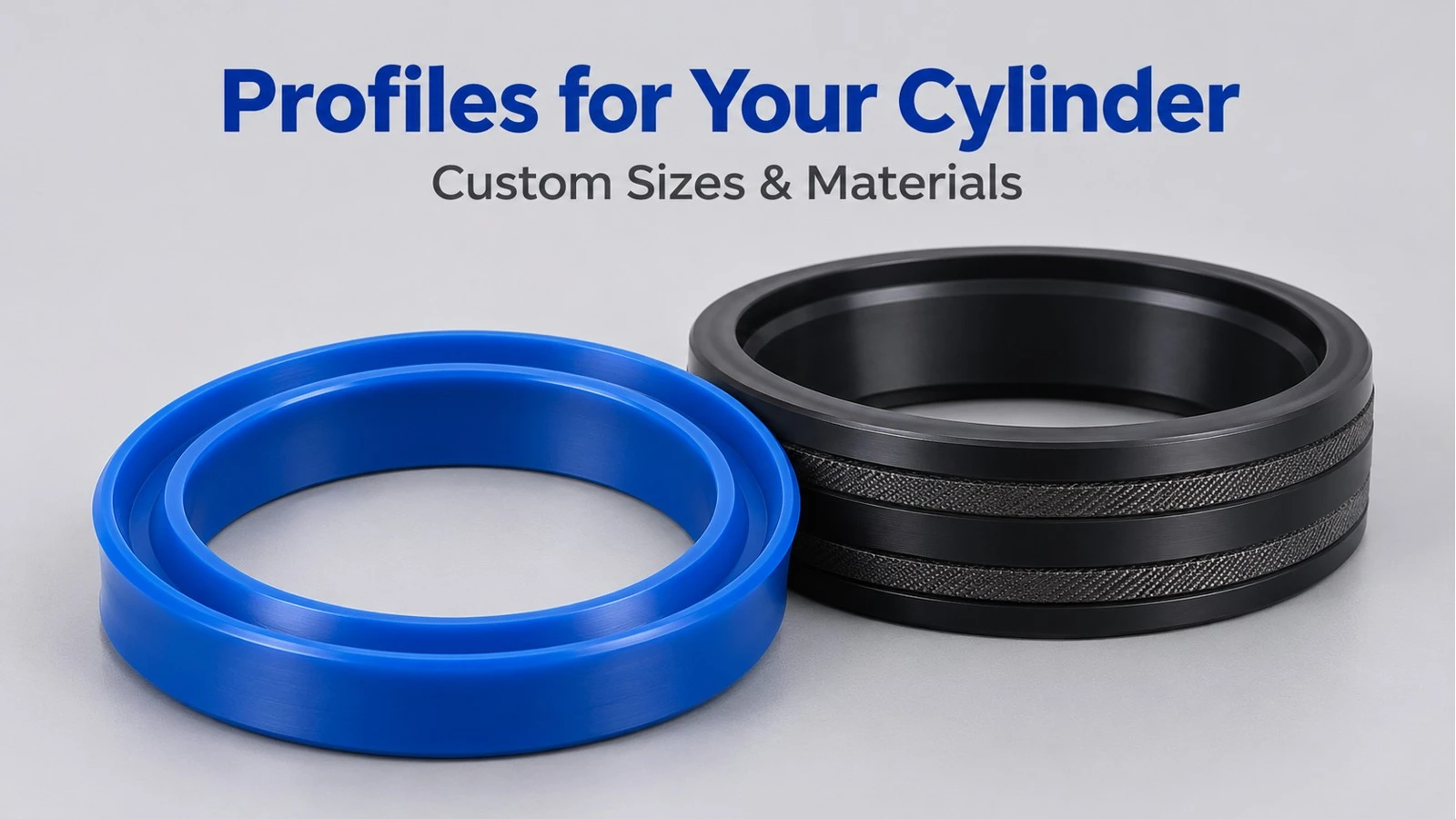
Seals can be reviewed from technical drawings, dimensions, samples or an existing profile reference. The final manufacturing specification includes the complete geometry, material and operating requirements. Product images show representative configurations; color and visual similarity alone do not identify a seal compound or confirm interchangeability.
Contents
- Rod Seal Models
- Piston Seal Models
- Symmetric and Packing Profiles
- Wiper and Scraper Models
- Guide Ring and Wear Strip Models
- Rotary and Shaft Seal Families
- Excavator and Mobile Hydraulic Profiles
- Mining Hydraulic Support Profiles
- Spring Energized Profile References
- Materials, Selection and Ordering

Rod Seal Models
A rod seal limits fluid leakage along the moving rod as it passes through the cylinder head. The working lip, supporting heel and any energizer or back-up element perform different tasks. The profile should be assessed with the rod surface, extrusion clearance and the surrounding buffer and wiper arrangement. A material change can also change friction and the pressure response of the complete sealing system.
| Model / Family | Product Configuration | Selection Notes |
|---|---|---|
| GSJ / GSW | Stepped composite rod seals | PTFE sealing element with NBR or FKM energizer, depending on configuration. |
| GSI / GSR | Rectangular composite rod seals | Low-friction radial sealing configurations for drawing-defined rod grooves. |
| RDDR | Compact rod sealing family | Thin-section arrangement for limited installation space. |
| GTDI | Twin-lip coaxial rod seal | Combined static and dynamic sealing arrangement. |
| GGDI | Composite rod seal | Multi-component construction with support elements as specified. |
| OMSS | Heavy-duty step-seal family | Rod configuration reviewed for loaded cylinder service. |
| Yxd | Rod Y-ring | Directional lip seal; confirm orientation and groove. |
| RY | Rod U-cup | Elastomer or polyurethane U-profile selected by compound and duty. |
| RYZ / RYF | Twin-lip U-cup / supported twin-lip U-cup | RYF incorporates an anti-extrusion support configuration. |
| PYA / RYJ / RYB | Compact U-cup families | Small-section versions, including twin-lip and supported arrangements. |
| RYL | U-cup with return-flow feature | Profile considered where the cylinder design calls for return flow. |
| RYS | U-cup for specified step-seal groove | Review against the actual housing groove rather than model name alone. |
Piston Seal Models
Piston seals separate pressure chambers and help the cylinder develop force with controlled internal leakage. Single-acting and double-acting arrangements have different profile requirements. The bore condition, piston guidance and pressure reversal pattern should be supplied with the drawing. For a multi-element set, the sealing ring, energizer and supporting rings must be reviewed together rather than mixed from unrelated configurations.
| Model / Family | Product Configuration | Selection Notes |
|---|---|---|
| GSF / GSP | Rectangular composite piston seals | PTFE-based sealing ring with an elastomer energizer; compound selected for service. |
| GSD | Stepped piston seal | Directional profile for a matching piston groove. |
| PDDP | Compact piston family | Thin-section composite arrangement for compact equipment. |
| AQ / AQF | Profiled composite piston seals | AQF uses the twin-energizer configuration identified in the range. |
| GDKK / GKDF | Compact multi-element piston assemblies | Sealing, support and guiding elements specified as a matched set. |
| OMKES / OMKS | Heavy-duty composite piston families | Review the individual profile and support arrangement for the cylinder. |
| GGDA | Composite piston seal | Multi-component configuration for drawing-defined cylinder assemblies. |
| YxD / PY | Piston Y-ring / piston U-cup | Lip profiles selected by bore, groove and pressure direction. |
| PHD / PHDP | Composite piston sealing assemblies | Application-specific packages used in mobile and heavy-duty cylinders. |
| KDAS | Compact piston seal set | Combination of sealing and support elements for the specified groove. |
| TDA | Composite piston family | Material and section confirmed for the required cylinder duty. |
Symmetric and Packing Profiles
Symmetric seals can serve different radial positions when the selected profile is designed for that duty. V-packing assemblies use several components to create the intended contact and support relationship. Installation space, gland adjustment and the movement direction should be checked before a proposed replacement is accepted. Similar outside dimensions do not establish that two sealing profiles operate in the same way.
| Model / Family | Product Configuration | Selection Notes |
|---|---|---|
| UNS | Symmetric U-cup family | Rod or piston use according to the approved profile and installation. |
| VTC | V-packing assembly | Stacked packing configuration with supporting elements, selected for the housing and adjustment method. |
Wiper and Scraper Models
Wipers remove contaminants from the rod before they reach the main sealing system. Their task is different from that of a pressure-retaining rod seal. An effective selection considers dirt exposure, the required scraping action and the lubrication film needed by the cylinder. Wiper retention and clearance must also allow the rod to move without unintended lip inversion or interference.
| Model / Family | Product Configuration | Selection Notes |
|---|---|---|
| GSZ / GSZL | Composite wipers | Standard and compact section families with polymer scraping elements and energizers. |
| DPE / DPR | Twin-energizer composite wipers | Different profile arrangements for the specified rod and gland. |
| ADA | Saddle-profile wiper | Scraper geometry for the matching housing seat. |
| DPS | Rod scraper family | Lip and heel dimensions confirmed from the groove. |
| DRH / LBH | Wiper profile families | Compound and section selected for contamination, movement and housing conditions. |
Guide Ring and Wear Strip Models
Guide rings and wear strips support lateral loads and help maintain alignment between metal components. They are not substitutes for pressure seals. Material, bearing area, running clearance and the assembly gap should be established using the real side loading and cylinder geometry. Split rings and strips cut to length can be considered where the approved installation method calls for them.
| Model / Family | Product Configuration | Selection Notes |
|---|---|---|
| GST | Wear strip / guide ring family | PTFE, UHMW-PE or fabric-reinforced phenolic options reviewed for the application. |
| GFI | Rod guide ring | Bearing and locating interface for the rod assembly. |
| GFAI | Rod guide ring with scraping lip | Combined guide profile with the additional lip specified in the drawing. |
| GFA | Piston guide ring | Guide element for the bore-side assembly. |
Rotary and Shaft Seal Families
Rotary sealing requires attention to shaft speed, surface condition, eccentricity and frictional heat. A reciprocating seal should not be selected for continuous rotation solely because it fits the same diameter. The distinction between a pressure-retaining rotary seal, a conventional shaft oil seal and a V-ring exclusion seal is important when describing an existing part or preparing an inquiry.
| Model / Family | Product Configuration | Selection Notes |
|---|---|---|
| GNS / GRS | Composite rotary seal families | Bore-side and shaft-side arrangements for rotary or oscillating interfaces. |
| RDA / RDI | Supported rotary combinations | Composite profiles with additional supporting components as specified. |
| VA / VS | Elastomer V-ring face seals | Axial face-contact exclusion configurations for rotating shafts. |
| Radial shaft oil seals | Metal-cased or supported lip seals | Case, lip, spring and rubber compound specified for the shaft and housing. |
| Fabric-reinforced oil seals | Reinforced shaft sealing configurations | Review installation, housing retention and operating duty individually. |

Excavator and Mobile Hydraulic Profiles
Mobile cylinders often encounter pressure changes, contaminated surroundings and external side loading. The complete seal stack should be identified before proposing replacement parts. Supply the cylinder dimensions or equipment reference together with samples, because one cylinder can contain multiple seals with different duties and similar-looking profiles. Buffer, rod seal, wiper and guide positions should be recorded separately.
| Model / Family | Product Configuration | Selection Notes |
|---|---|---|
| SPGO / SPGW / SPG | Piston seal families | Composite bore-side profiles, including supported and heavy-duty arrangements. |
| SPNO / SPN / SPNS | Rod seal families | Rod-side composite profiles configured for the cylinder groove. |
| HBY / HBTS | Buffer ring families | Positioned within the specified rod sealing system to manage the relevant pressure duty. |
| KZT | Contamination-control ring | PTFE-based protective ring for the matching cylinder arrangement. |
Mining Hydraulic Support Profiles
Mining-support sealing must be matched to the actual hydraulic fluid, including any water-based or fire-resistant formulation. A seal suitable for a mineral-oil cylinder is not automatically suitable for another fluid chemistry. The support designer should define the duty, acceptance tests and any applicable equipment requirements. Model references are used for profile identification and do not independently establish certification or an operating rating.
| Model / Family | Product Configuration | Selection Notes |
|---|---|---|
| G / SH / BMG | Piston sealing families | Composite profiles for the defined hydraulic support cylinder. |
| WL | Y-profile piston or static seal | Installation and material follow the actual support arrangement. |
| NL / BMN | Rod sealing families | Multi-component configurations reviewed against the support cylinder duty. |
| JF / WP | Wiper families | Contamination exclusion for the relevant rod and gland. |
| JMF / JMFZ | Dumbbell-section static seal families | Static profile geometry and compound confirmed by drawing. |
| GS / GT | Guide and retaining element families | POM-based guide or retaining arrangements as specified. |
Spring Energized Profile References
A PTFE jacket with a metal energizer offers a separate design route from an elastomer-energized composite seal. Spring geometry, alloy and jacket compound are selected with the groove and service conditions. The standard, extended and flanged families require their corresponding groove space. Related construction details are available on our spring energized seal product page.
| Model / Family | Product Configuration | Selection Notes |
|---|---|---|
| PTUS / PTAS / PTBS | Standard-heel profiles | Symmetric, rod and piston arrangements, respectively. |
| PTUE / PTAE / PTBE | Extended-heel profiles | Extended symmetric, rod and piston arrangements. |
| PTUF / PTAF | Flanged-heel profiles | Equal-lip and unequal-lip shaft configurations; confirm the actual drawing. |
| PTC / PTD | Axial face profiles | Internally and externally pressurized face-seal arrangements. |
See our custom PTFE spring energized seals for further discussion of spring types, jacket materials and rod, piston, rotary and face sealing arrangements.
Materials, Selection and Ordering
Material options include NBR, FKM, HNBR, polyurethane, PTFE and filled PTFE, with engineering polymers or fabric-reinforced materials for the support and guiding elements. Each component within a composite set can use a different material. The selection therefore needs to describe the complete assembly, including energizers, back-up rings and wear elements, rather than only the visible sealing ring.
| Material Group | Typical Role | Information Needed for Selection |
|---|---|---|
| NBR / FKM / HNBR | Sealing lips, energizers and static sealing elements | Fluid identity, temperature, movement and compound requirements |
| Polyurethane / PU | U-cups, wipers and selected hydraulic seal profiles | Fluid compatibility, temperature, pressure duty and extrusion gap |
| PTFE / Filled PTFE | Low-friction sliding rings, composite seals and spring energized jackets | Filler formulation, counterface, lubrication and contact conditions |
| POM / PA / TPE | Selected support, anti-extrusion and composite assembly elements | Load, clearance, fluid exposure and complete profile drawing |
| UHMW-PE / Fabric-reinforced phenolic | Guide rings and wear strips | Bearing area, side loading, speed and running clearance |
Pressure, temperature and speed are evaluated together. A catalog maximum for one material or profile is not a universal rating for every product with a similar model name. Please provide normal and peak pressure, the temperature range, fluid type and concentration, stroke, speed, frequency, lubrication and the required leakage behavior. These details help establish an appropriate combination of profile and compound.
Dimensional review should include rod diameter, bore diameter, groove root diameter, groove width and depth, lead-in, radii and extrusion clearance. For a rotary interface, also provide shaft runout and rotational speed. Drawings should identify the critical sealing surfaces and the required measurement condition. Existing part codes assist identification, but the actual groove and mating surfaces determine whether a proposed replacement can be used.
Custom Production and Inspection
Depending on the selected component, production can involve molded elastomer or polyurethane profiles, machined polymer rings, cut wear strips and assembly of composite seal sets. SWKS reviews the required profile and production route before quotation. Samples can support dimensional and assembly approval, while the customer defines the functional testing needed for the completed equipment.
Inspection can cover the critical diameters, section dimensions, lip edges, energizer fit, back-up-ring position and visual condition. Components should be protected from distortion, sharp-edge damage and contamination during handling. For a complete repair package, the parts list and quantities can be organized by cylinder position to reduce confusion during assembly.
Browse our Rubber Seal range for related sealing products. If you need assistance identifying an existing seal, send a clear section drawing or photographs together with the measured dimensions. Include the order quantity, target material, equipment application and any required documentation so the quotation can address the actual project.
Welcome to send an inquiry to Tianjin SWKS Technology & Development Co., Ltd. Email your model list, drawings, dimensions, quantities and working conditions to amanda@tjswks.com, or contact 0086-15222707659. We will review the suitable hydraulic seal profiles and material options for your application.
Hot Tags: custom hydraulic rod piston wiper and guide seals, China, suppliers, manufacturers, factory, bulk, cheap, low price, quotation, rubber seal for conveyor belts, rubber seal for electrical enclosures, rubber seal for oil refineries, rubber seal for paper processing machines, rubber seal for tablets, rubber seal for windows


