


Tianjin SWKS Technology & Development Co.,Ltd is one of the most reliable manufacturers and suppliers of pom industrial conveyor chain guide rail insert in China. If you're going to buy bulk cheap pom industrial conveyor chain guide rail insert, welcome to get quotation from our factory. Quality products and low price are available.
POM Conveyor Chain Guide Rail Inserts for Custom Industrial Equipment
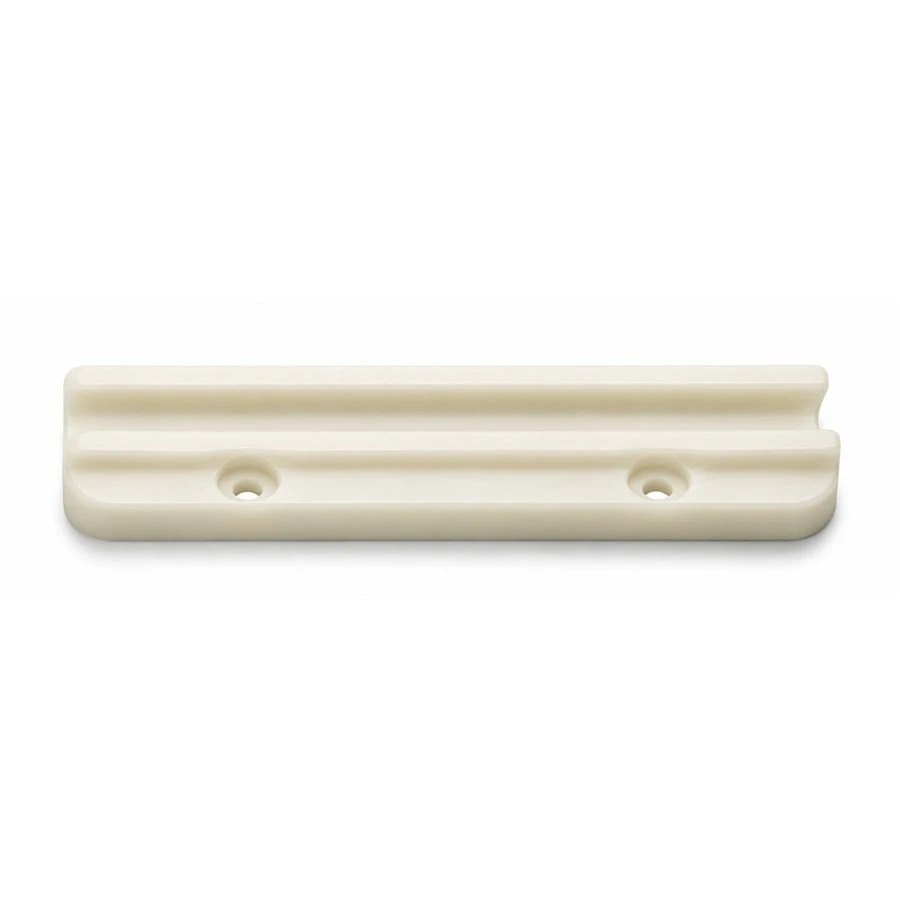
A conveyor chain guide rail insert provides a replaceable polymer contact surface between a moving chain and its supporting structure. SWKS offers custom injection molding for POM guide inserts developed around the customer's chain geometry, mounting arrangement and operating conditions. The illustrated component is a representative design concept with a recessed running channel and mounting positions beside the contact path. Final geometry, resin grade and acceptance requirements are established from an approved drawing. Send your STEP model or sample details to amanda@tjswks.com for a manufacturing review.
This product is intended for equipment builders seeking a molded wear component rather than a complete conveyor assembly. A short insert may support a transition, protect a local contact area or provide a replaceable section within a longer track. Its function depends on how the chain is supported and restrained in the machine. The insert must therefore be reviewed together with the adjacent guide sections, chain links, fasteners and backing rail, rather than specified by its outside dimensions alone.
Defining the Running Channel and Chain Contact
The running channel should match the actual chain contact envelope. Link plates, pins, attachment brackets and joining links can occupy different widths as the chain travels. A drawing based only on nominal roller width may overlook these moving features. During development, identify the surfaces that intentionally contact the insert and those that require clearance. Provide the maximum chain width, direction of movement, supporting span and any side loading expected during normal operation.
Channel entry geometry also deserves attention. A smooth lead-in can help a chain pass from an adjacent guide section without meeting an abrupt edge. The entry shape should be coordinated with the chain approach angle and the installed height of the next component. Where several inserts form a continuous track, define allowable step between sections and check that the joint does not catch a link or attachment. Chamfers and radii remain drawing-controlled features rather than assumptions made during production.
Project Specification and Customization
| Item | Project requirement |
|---|---|
| Product | Custom industrial conveyor chain guide rail insert |
| Primary material | POM; exact grade and color confirmed before tooling |
| Manufacturing process | Injection molding, subject to geometry and tooling review |
| Running profile | Channel width, depth, entry radius and contact length to approved drawing |
| Mounting | Through holes, recessed holes, slots or other agreed retaining features |
| Critical characteristics | Contact profile, mounting pitch, installed height, straightness and joint alignment |
| Drawing formats | STP, STEP and IGS; a dimensioned drawing is needed for tolerances |
| Production approval | Drawing review, trial samples and agreed inspection criteria |
| Quantity and quotation | Based on part geometry, resin, tooling and expected order volume |
No universal load rating, speed limit or service life is implied by this table. Those values depend on the selected grade, contact pressure, chain condition, temperature and duty cycle. Buyers should state the operating envelope and any required validation method at the quotation stage. This allows tooling and sample checks to focus on the dimensions and surfaces that determine performance in the actual conveyor.
Material Selection for the Intended Duty
POM is a candidate for this type of mechanical guide, but the resin should be selected for the complete application. Review continuous and peak temperatures, the contacting chain material, lubrication arrangements, cleaning agents and exposure duration. A grade intended for one environment should not be assumed suitable for every chemical or temperature combination. If the conveyor operates near a process bath or cleaning station, provide the fluid identity, concentration and cleaning cycle for review.
Special requirements must be specified separately. Food contact, antistatic behavior, flame retardancy, traceability and restrictions on additives require a suitable grade and supporting documentation. A natural or white appearance does not establish food-contact compliance. Likewise, a dark color does not establish electrical conductivity. Material substitutions during production should follow an agreed approval process so that a visually similar resin is not accepted in place of the specified material.
Where an existing insert is being replaced, a worn sample is useful for understanding installation but may no longer show the original profile. Supply an unworn reference, equipment drawing or mating chain information whenever possible. Record where wear occurs and whether the failure mode is grooving, edge chipping, mounting damage or deformation. These observations help distinguish a material question from an alignment or operating issue. Related plastic injection parts can be developed as separate components when an assembly needs additional supports or retainers.

Mounting Features and Assembly Clearance
The mounting arrangement should locate the insert without distorting its running surface. Define the contact face against the backing rail, the fastener type and the required recess depth. A screw head that projects into a chain envelope can become an interference point, so its installed position must be considered along with the molded hole geometry. Fastener torque should be established by the equipment designer and verified on the assembled component rather than copied from a metal bracket specification.
Longer guide sections may need an arrangement that accommodates dimensional change while maintaining alignment. Whether a locating hole, slot or other feature is appropriate depends on the assembly layout and the required restraint. Do not clamp a component into a warped position simply to match an inaccurate backing rail. Check the rail condition, support spacing and joint height first. The sample review should include installation on the actual support or a representative assembly fixture.
For a replacement project, provide photographs showing how the insert is accessed and removed. A technically acceptable shape may still be inconvenient if a technician cannot reach its fasteners. Service clearance, the direction of removal and identification of the correct replacement part can be considered during design review. Any marking should be placed away from the working track and approved before it is added to the mold.
Injection Molding Review Before Tool Construction
A molded guide insert requires a review of wall transitions, ribs, hole bosses and the direction in which the part leaves the tool. Excess material around a recess can influence the final shape, while abrupt section changes can complicate filling and cooling. Tooling review should identify the contact surface as a functional area and place gates, ejector marks and parting lines where they will not create unacceptable interference with the chain.
The feasibility discussion should also separate molded dimensions from dimensions that may require a secondary operation. If a mounting feature or long contact profile has a particularly demanding requirement, confirm the achievable process route before committing to a tolerance. Prototype measurements and first tool trials provide information for refinement. The production drawing should then capture the approved geometry and any agreed inspection condition, including how the part is supported during measurement.
Order quantity affects the tooling discussion. A development project with a small initial release may have different priorities from a recurring production program. Provide the expected sample quantity, first order quantity and estimated annual usage. SWKS can review the drawing and discuss an appropriate quotation basis; tooling cost, cavity arrangement and delivery schedule are confirmed for the individual project rather than treated as fixed catalog terms.

Inspection and Trial Assembly
Inspection should begin with the datums used by the machine assembly. Useful checks can include mounting pitch, running height, channel width, recess depth, flatness against the support and alignment at the entry and exit. The inspection plan should identify the genuinely critical features instead of applying the same tight tolerance to every edge. If the chain-contact profile needs a dedicated gauge, agree its geometry and acceptance method before production sampling.
Visual inspection should look for flash, sharp edges, incomplete filling and damage in the running channel. Gate remnants or burrs near the chain envelope need particular attention. Packaging should keep the functional surfaces from rubbing against sharp fasteners or other components during transport. A dimensional report can document agreed measurements, while a sample approval record connects those measurements to the drawing revision supplied by the buyer.
Trial operation remains the buyer's opportunity to confirm the component within the complete machine. Check startup behavior, running noise, tracking, temperature near the contact zone and wear after a representative operating period. Include loaded and unloaded conditions where both occur in service. If a trial shows concentrated wear on one edge, examine chain alignment and backing geometry before changing the resin. Record the trial conditions so that later batches are evaluated against the same basis.
Information Needed for an Accurate Quotation
Please provide a 3D model, dimensioned drawing, material preference, required color and order quantity. For a chain guide insert, include the chain type or mating dimensions, contact length, operating temperature, speed and duty cycle. State whether the insert is for a new machine or an existing installation. If a physical sample is the starting point, indicate which dimensions are original and which areas have worn during use.
List documentation and packaging requirements with the initial enquiry. Material evidence, inspection reports, part identification, individual wrapping and sample approval procedures should be agreed before the production plan is finalized. This makes the quotation clearer and helps avoid discovering an essential acceptance requirement only after tooling has been built. Supporting molded items may also be discussed through the SWKS custom plastic manufacturing website.
Frequently Asked Questions
Can you manufacture the insert from a physical sample?
A sample can support a feasibility review, especially when accompanied by mating-chain information and installation photographs. Worn contact surfaces should be identified. The final geometry and tolerances need an approved drawing before tooling and production are confirmed.
Are the displayed dimensions and performance values standard?
This is a custom manufacturing product. The images illustrate a possible configuration and are not a dimensional specification. Dimensions, resin grade, load conditions and acceptance tests are confirmed for each application.
Can the mounting holes or channel profile be changed?
Yes, those features can be reviewed as part of a custom design. Changes must be assessed for molding feasibility, assembly clearance and their effect on the supporting structure. A revised model helps establish the tooling and quotation implications.
How are production samples approved?
Approval should combine the agreed dimensional checks with an assembly or operating trial appropriate to the equipment. Buyers should define the drawing revision and functional acceptance criteria, then retain an approved reference for the production program.
Request a Custom POM Chain Guide Insert
Send your drawing, chain-interface details and required quantity for a project review. We welcome your enquiry: amanda@tjswks.com.
Hot Tags: pom industrial conveyor chain guide rail insert, China, suppliers, manufacturers, factory, bulk, cheap, low price, quotation, Cheap PA6 PA66 Nylon Parts, plastic injection parts for electronics, Plastic Speaker Casing Housing Cover Shell, polypropylene plastic, POM machine parts, PP Plastic Injection Molding Automotive Parts


