




Tianjin SWKS Technology & Development Co.,Ltd is one of the most reliable manufacturers and suppliers of pom industrial automatic valve actuator drive segment in China. If you're going to buy bulk cheap pom industrial automatic valve actuator drive segment, welcome to get quotation from our factory. Quality products and low price are available.
Custom POM Drive Segments for Automatic Valve Actuator Mechanisms
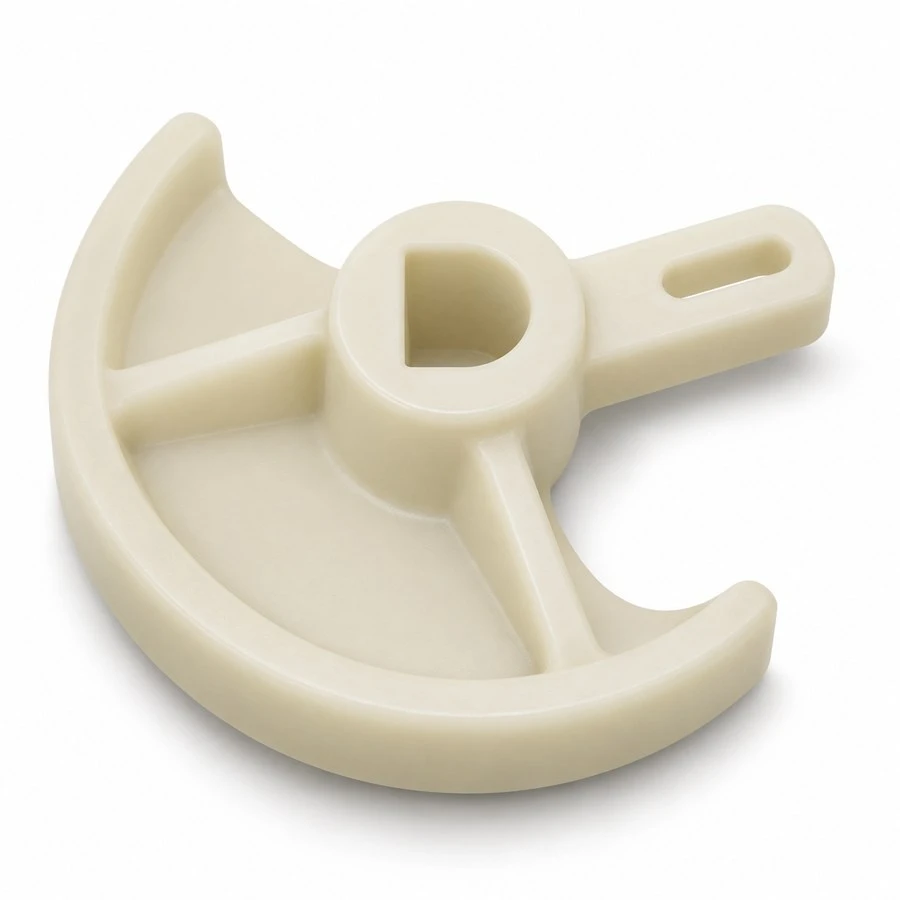
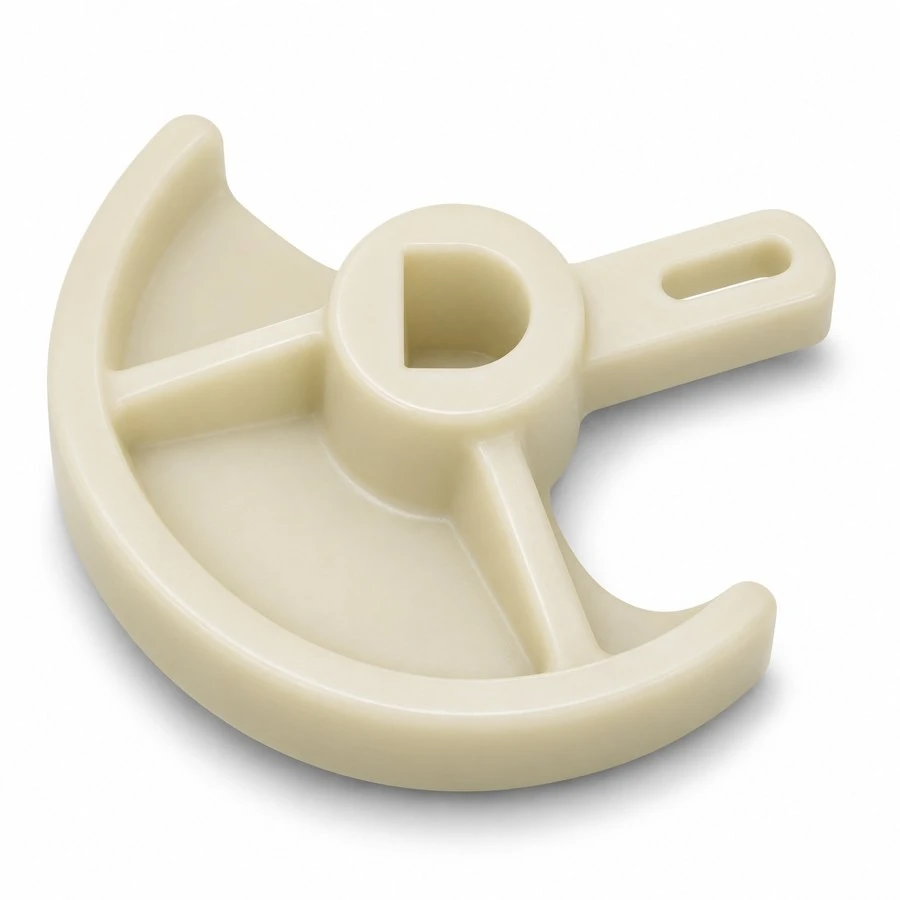
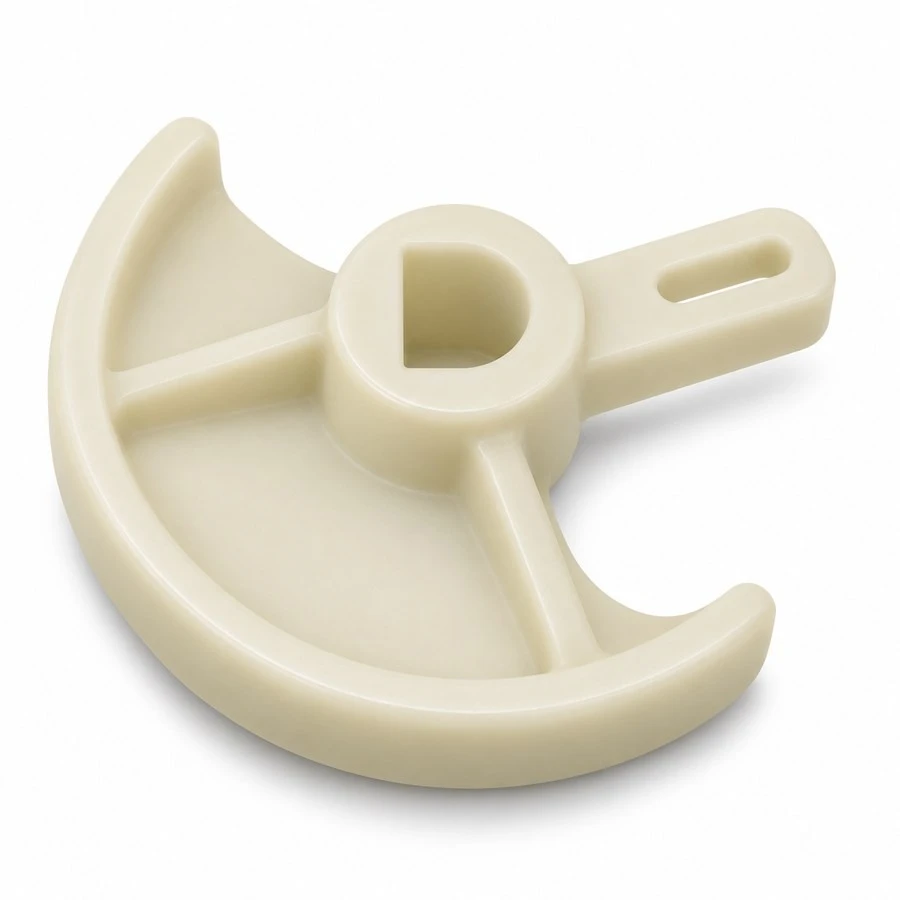
The drive segment inside a valve actuator links a defined rotary movement to another element of the mechanism. Unlike a plain shaft coupling, a segment can incorporate a partial circular profile, a slotted arm or an offset connection that determines how movement is transferred within a limited envelope. SWKS offers custom injection molding for POM actuator drive segments based on approved customer geometry. The illustrated part is a representative concept, with a smooth crescent profile, reinforced hub and slotted drive arm. Send drawings and application details to amanda@tjswks.com for review.
This listing concerns the molded mechanical component only. Its purpose, allowable torque and operating life must be defined within the complete actuator. The segment does not establish the pressure rating, shutoff performance or operating classification of the valve. When requesting a quotation, identify the drive interfaces, the intended angular movement and the role of the part in the mechanism. Those details provide a clearer manufacturing basis than an outside diameter and material name alone.
Start With the Motion Path
A segment is usually developed around a specific motion relationship. The input may act through a keyed hub, while an arm, pin or adjacent component receives the output movement. The drawing should show both interfaces and their angular relationship. Specify the reference position used when the actuator is assembled and the direction of movement. If the same part can be installed in more than one orientation, establish how the correct position is identified during assembly.
The slot deserves separate attention because its length, width and end shape can influence the movement of a mating pin. Provide the pin diameter, permitted travel and clearance requirement. An intentionally sliding interface should not be treated as a clamped joint. Conversely, a connection intended to hold position may need a different geometry and verification method. A simple assembly model or drawing of the surrounding mechanism helps reveal these differences before tooling decisions are made.
Custom Manufacturing Specification
| Characteristic | Confirmation basis |
|---|---|
| Component | Industrial automatic valve actuator drive segment |
| Candidate polymer | POM; grade, color and additives to project approval |
| Process | Custom injection molding after design feasibility review |
| Input interface | D-shaped, keyed or other customer-defined hub geometry |
| Output feature | Slotted arm, pin seat or specified mating profile |
| Controlled relationship | Hub axis, arm orientation, slot position and axial seating |
| Load information | Running, breakaway, reversal and abnormal-load conditions supplied by buyer |
| Approval | Dimensional sample review and actuator assembly trial |
| Order details | Sample quantity, initial order and forecast annual demand |
The table is a quotation framework, not a statement of standard dimensions or tested performance. A part that fits one actuator may not suit another unit with a similar appearance. Provide the drawing revision and identify whether dimensions refer to the free component or to the installed assembly. Where a mating shaft is available, its own dimensional limits should be included in the interface review.
Hub Geometry and Rotational Fit
The central hub locates the component and transmits movement. Its shape should be assessed together with the shaft profile and the required assembly method. A D-shaped opening needs a controlled flat position relative to the arm. A keyed interface needs the key geometry and seating arrangement. The drawing should establish the datum axis, axial stop and rotational reference so that inspection measures the relationship that matters in the actuator.
Fit should be specified with the intended load path in mind. Clearance may be necessary for assembly, but excessive free movement can affect the position of a connected mechanism. An interference arrangement, if intended, requires review of the resin, hub wall and assembly procedure. It should not be introduced by tightening a fastener until movement disappears. Trial samples should be checked on representative mating hardware to confirm both assembly effort and the movement allowed by the design.
When the original component is damaged, record the location and appearance of the damage before measuring it. A split near the hub, a worn slot or a distorted arm may indicate different operating conditions. A replacement drawing should distinguish the original design from wear or deformation. An intact reference sample is especially useful when the angular relationship is difficult to recover from the damaged part.

Reviewing POM for the Actuator Environment
Material selection should consider the conditions inside the actuator enclosure. Provide the expected temperature range, operating frequency, lubricant identity and any exposure to cleaning agents or process vapors. If the segment is enclosed near a motor or other heat source, the local component temperature can differ from ambient air. State the conditions expected at the part rather than relying only on the installation location of the equipment.
The exact resin grade is part of the specification. A change in additives or reinforcement can influence molding behavior and the way a part responds in its assembly. If a particular grade is already approved, identify it in the quotation request. If material selection remains open, describe the functional requirements so that candidate options can be discussed. No general claim of chemical compatibility, flame resistance or certification applies to every POM formulation.
Qualification should reflect the actuator duty. A lightly loaded positioning mechanism and a component exposed to repeated breakaway events may require different validation. Provide the expected cycles, dwell periods and reversal pattern where available. For related housings, spacers or supporting components, see our custom plastic injection parts. Each item should retain its own drawing and acceptance requirements.
Arm, Rib and Segment Design Review
The arm and ribs connect the hub to the working region. Review their intersections, wall transitions and available clearance before the mold is designed. A rib that fits the free part may interfere with a cover or adjacent moving component during the stroke. Clearance should therefore be checked throughout the operating movement, including the tolerance extremes of the surrounding parts. Assembly models can be useful for showing this relationship.
The curved outside edge should also have a defined purpose. It may provide clearance, a contact path or simply the external boundary of a compact segment. These functions should not be confused. If the edge is a functional contact surface, state its profile and finish requirements. If it is only a clearance envelope, explain which areas are critical and which may accept normal molding variation. This keeps the production review focused on functional geometry.
Parting lines, gate locations and ejector contact areas need consideration around the slot and hub. A small molding remnant in a pin path can affect movement even when the overall part looks acceptable. During tooling review, identify the surfaces that must remain free of raised features. Any planned secondary finishing should be included in the quotation and inspection plan rather than introduced informally after sampling.

Sample Validation in the Complete Actuator
A dimensional report confirms selected characteristics, but it cannot replace an assembly trial. Install samples using the intended shaft, pin, retainers and cover. Check the neutral or reference position first, then move through the complete stroke. Confirm that the slotted arm does not bottom unexpectedly and that the segment does not rub against the housing. Record the assembly sequence so that later production checks use the same method.
Operating trials should include the conditions defined by the equipment designer. Depending on the application, these may include reversal, repeated cycling, startup after a dwell and the specified external load. The component should be assessed together with the actuator control settings and mechanical stops. An unexplained overload should be investigated before it is treated as a normal service condition for the molded part.
Where angular position is important, agree how it will be measured and what reference will be used. A visual check of the arm alone may not capture free movement elsewhere in the mechanism. Identify whether the acceptance criterion concerns the segment itself, the actuator output or the final valve position. These are related measurements, but they are not interchangeable.
Production Inspection and Handling
Useful inspection characteristics include the hub profile, slot width, arm-to-hub orientation, seating-face condition and overall axial thickness. The customer drawing should identify critical datums and tolerances. If a dedicated shaft or pin gauge is used, define its limits and how the result is interpreted. Inspection equipment and sampling arrangements are confirmed for the project before recurring production begins.
Visual checks should cover flash in the socket, sharp remnants at the slot ends, incomplete filling and damage to the ribs. Components should be handled so that the thin arm or curved rim is not used as a lifting point for a packed bundle. Packaging can be adapted to prevent repeated contact between functional surfaces. If traceability markings are needed, their location and format should be approved away from mating or sliding areas.
Changes should be controlled through drawing revisions. A small movement of the slot or hub flat may be easy to overlook in a photograph while being significant to assembly. Supply a revised model and identify the changed features when requesting a modification. Keeping the approved sample, dimensional report and drawing revision together creates a practical reference for later orders.
Quotation and Development Information
For a complete enquiry, provide the 3D model, dimensioned drawing, desired POM grade or material requirements, color, sample quantity and production quantity. Include a mating-shaft drawing, pin details and the required stroke where these determine the design. Explain whether tooling already exists, whether the component is new or a replacement, and which features have caused difficulty in the current assembly.
Tooling cost and lead time depend on the geometry, cavity plan, material and approval work. They are quoted after review rather than fixed by this listing. Additional requirements such as dimensional reports, material documentation or special packaging should be stated at the beginning. Visit SWKS custom manufacturing services for a broader view of our project scope.
Frequently Asked Questions
Is this a complete valve actuator?
No. This page describes a custom molded drive segment for integration into an actuator designed and validated by the equipment manufacturer. Electrical controls, the housing, shaft hardware and the valve are separate items.
Can the slot and hub be changed?
Yes. Provide the mating geometry and required motion relationship. Changes are reviewed for tooling feasibility, clearance and inspection before a revised quotation or sample is confirmed.
Can you quote from photographs?
Photographs help identify the configuration, but a production quotation normally needs dimensions, material and quantity. A physical sample can support drawing development when its condition and worn areas are clearly identified.
Send Your Actuator Drive Segment Enquiry
We welcome your enquiry with drawings, mating-part details and quantities: amanda@tjswks.com.
Hot Tags: pom industrial automatic valve actuator drive segment, China, suppliers, manufacturers, factory, bulk, cheap, low price, quotation, ABS Enclosure Plastic Injection Molding Part Nylon Parts, Cheap PA6 PA66 Nylon Parts, household plastic injection parts, Micro ABS Injection Molding Part, opaque plastic injection parts, Soft Tooling Injection Molding


