


Table of Contents
- Define What the Moving Part Must Do
- Use POM as One Candidate for Precision Motion
- Evaluate PA66 With Its Moisture Condition
- Compare Other Plastics Against a Defined Requirement
- Review the Contact Pair and Wear Evidence
- Account for Temperature, Chemicals and Cleaning
- Connect Grade Selection to Injection Molding
- Validate the Shortlist in the Machine
- Prepare a Material Selection RFQ
A practical guide to selecting POM, PA66 and other engineering plastics for industrial gears, rollers and sliding parts, covering duty, wear, conditioning, molding and validation.
Define What the Moving Part Must Do
An industrial gear transmits torque, a roller supports or guides a moving item, and a sliding component locates or carries a surface through a stroke. Begin material selection by describing that function in the machine. Record typical and peak loads, speed, starting conditions, dwell time and the acceptable change in position over the intended service interval. Include the mating surface and what happens when the equipment encounters a blockage or changes direction. Two parts made from the same polymer can have very different service lives when their geometry and duty are different.
A useful selection brief describes the symptoms a new design should address. Is the gear losing registration, is the roller developing a flat contact area, or is the slide wearing only at its exit? Photograph the part in its installed position before removing it. Preserve an unworn reference if one exists. This makes the material discussion specific to a working interface and helps identify changes in mounting, alignment or maintenance that should be investigated with the component itself.
For the geometry behind a material decision, see our industrial gear and cam design guide.
Use POM as One Candidate for Precision Motion
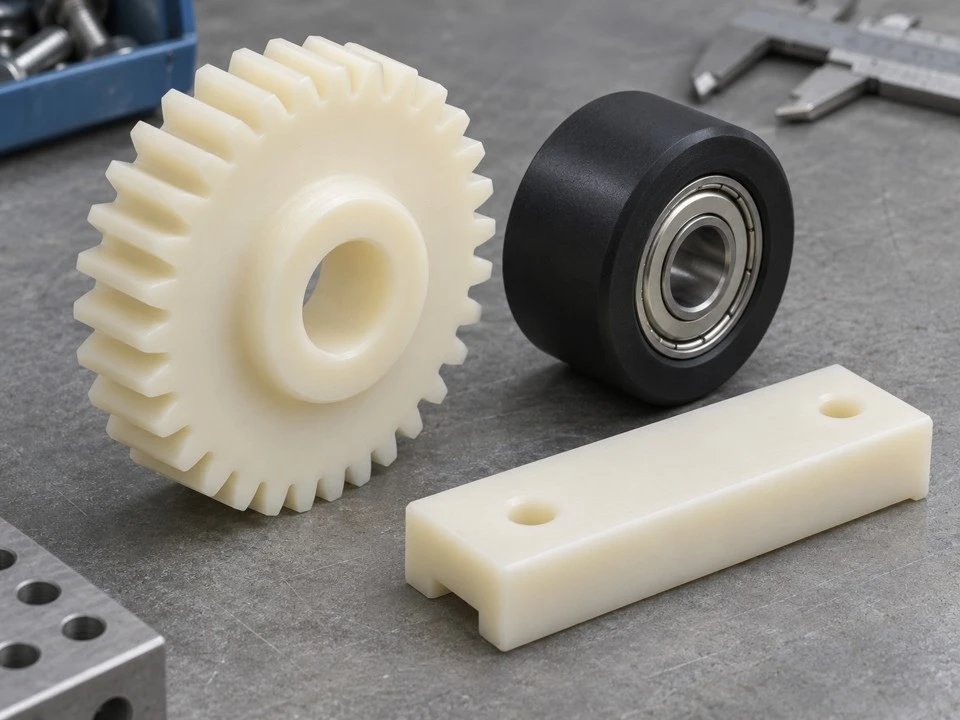
Acetal, or POM, is widely considered for gears and sliding components because suitable grades combine sliding performance with useful dimensional stability. Its lower moisture sensitivity compared with common nylons can be relevant when a close fit has to remain consistent through humidity changes. The selection still depends on the exact grade, temperature, chemical exposure and contact conditions. An unfilled POM and a modified wear grade have different specifications. Ask for data for the proposed resin and identify the condition in which those data were measured.
For a gear, relate the material to the tooth profile, bore and mating pinion. For a sliding shoe, relate it to the contact band, support and travel direction. A change that improves one characteristic can alter stiffness, shrinkage or another interface. Set a short list of required properties and rank them by the consequences of missing the target. A material can be a good candidate for evaluation while its use in a particular mechanism still requires drawing review and a representative machine trial.
Illustrative rendering for technical discussion.
Evaluate PA66 With Its Moisture Condition
PA66 and other polyamide grades are used in industrial motion applications where their particular combination of strength, toughness and wear behavior suits the assembly. Moisture uptake can change dimensions and mechanical response, so the part condition needs to be part of the design and inspection discussion. A dry molded gear and a conditioned gear can give different bore or mesh measurements. Specify which condition applies to incoming inspection, assembly and performance trials. Compare suppliers using the same grade designation and defined test state.
The practical question is how the assembly behaves through the moisture range it actually encounters. Identify storage before assembly, exposure during running and any washing operation. If a part is installed dry and later conditions in service, the fit should be evaluated through that transition. Keep the mating gear, shaft and bracket in the assessment. Reinforcement and other modifications can change the material response, so a generic nylon family name provides only the starting point for a specification.
Compare Other Plastics Against a Defined Requirement
Other engineering polymers can enter the shortlist when the operating envelope calls for them. PBT may be considered where a particular grade's mechanical and dimensional behavior fits the project. Higher performance materials such as PPS or PEEK may be evaluated for demanding heat or chemical conditions. Each option needs grade data and a review of the available molding process. Start by defining the condition that the current candidate cannot meet, then ask whether a different grade, contact geometry or polymer family addresses that condition.
For a wide roller or replaceable wear guide, the contact surface may need a property that differs from the supporting hub. The design team can evaluate a multi material construction where it suits the equipment, while accounting for the additional joint and manufacturing steps. Confirm what SWKS can process and validate for the specific material before fixing it on the purchase drawing. Compare the proposed solution over its expected use, including tooling, inspection, replacement access and the consequences of a stoppage.
| Candidate or interface | Why it enters the shortlist | What to verify |
|---|---|---|
| POM grade | Sliding behavior and dimensions for precision motion | Mating material, temperature, chemical exposure and finished part fit |
| PA66 grade | Mechanical response appropriate to the assembly | Dry and conditioned state, dimensional change and representative duty |
| Modified wear grade | A targeted change in friction or wear | Both contacting surfaces and the effect of the formulation on molding |
| PBT, PPS or PEEK candidate | A property requirement beyond the current shortlist | Grade data, application trial and the supplier's processing capability |
| Gear, roller or slide assembly | The installed relationship sets performance | Alignment, support, clearances, actual loads and acceptance criteria |
Review the Contact Pair and Wear Evidence
Friction and wear describe an interaction between surfaces. The other member's material, roughness, alignment and cleanliness belong in the selection brief. A smooth shaft, a hardened rail and a molded link can produce different contact conditions against a plastic. Identify whether lubrication is intended and whether it is maintained throughout the duty cycle. Fillers and lubricating additives can change the behavior of the contact pair. Their usefulness must be checked against the actual counterface and operating environment.
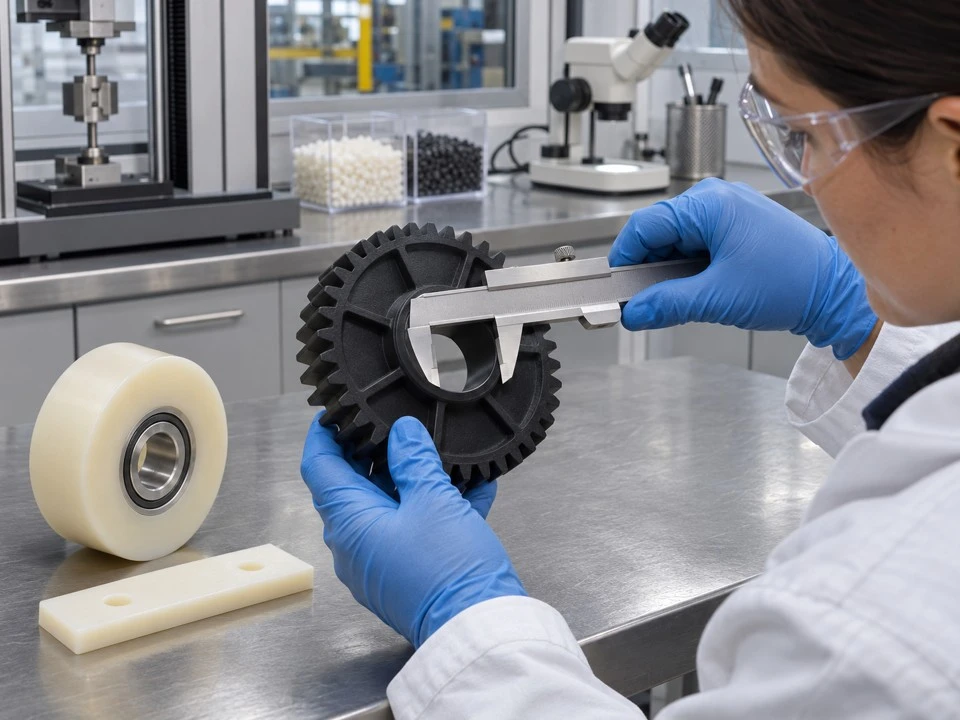
A screening test can compare candidate grades using representative samples, but record what the method measures. A dry sliding coupon result has limited application to a gear with changing contact geometry and lubrication. Inspect both surfaces after the run. A polymer can appear relatively intact while the mating member shows wear. Report loss of material, change in motion or surface condition using an agreed method. Where noise matters, define the measurement condition so the comparison is reproducible between the original assembly and the proposed change.
Our guide to low friction molded wear parts discusses related sliding interfaces.
Account for Temperature, Chemicals and Cleaning
The part may experience heat from the surrounding equipment and from friction at its contact surface. Describe continuous operation, repeated starts and time spent stopped under load. Long term deformation under load can affect location even when a short test shows acceptable strength. Use grade data relevant to temperature and duration, then validate the assembly under the operating conditions selected by the equipment owner. Identify which dimensional requirements remain important after a dwell or after repeated cycles.
Cleaning and environmental exposure are equally specific. List the chemicals, concentrations, temperatures, contact duration and rinsing routine. If several liquids are used in sequence, identify the sequence. For food processing machinery, state the intended contact category and the documentation required for the exact resin grade and use conditions. A polymer family name does not establish acceptance for a finished machine. Traceability, approved colorants and any formulation restrictions should appear in the project record when they are part of procurement.
Illustrative rendering for technical discussion.
Connect Grade Selection to Injection Molding
The selected grade influences mold filling, shrinkage, cooling and release. A gear's thick hub and thin rim can respond differently as they cool. A long sliding strip can change shape along its length. Reinforcement introduces another reason to examine flow and orientation around functional surfaces. Review wall transitions, rib layout, gate location, ejection and tool split lines before mold release. Put critical contact faces on the drawing so tooling witnesses can be checked against real assembly space.
Define tolerances by the function they protect. Bore location relative to teeth, roller runout and guide height may each need a different inspection setup. State whether a dimension is checked on a free part or after mounting, and identify the required conditioning. First articles should represent the intended tool cavities and released material. Keep cavity identities with the measurements. If a tool correction changes the contact geometry, record the new revision and repeat the acceptance checks affected by that change.
Validate the Shortlist in the Machine
Start with dimensions and material identification, then move to the approved assembly. For a gear, observe full rotation, reversal and the load cases relevant to registration. For a roller, inspect tracking, rotation and the actual contact pattern. For a sliding component, observe entry, steady travel and exit. Include the conditions that produced earlier problems and define how the trial determines acceptance. Record the mating part revisions and setup so a later lot can be compared against the same reference.
Where a trial spans time or temperature, inspect at the agreed intervals and retain samples that show the progression of wear. Distinguish running in from a continued change that approaches the buyer's rejection criterion. A final report should identify the grade, mold revision, sample lot, relevant conditioning, machine settings and the check performed. Keep that record with the approved drawing. It provides a practical basis for repeat orders and for deciding what needs to be requalified after a resin, tooling or mating component change.
Prepare a Material Selection RFQ
Send the dimensioned drawing and STEP, STP or IGS model with assembly sections and the operating envelope. State the required sample quantity, annual demand and expected inspection records. If several grades remain possible, explain which characteristics the trial will compare and who owns the acceptance decision. A returned quotation can then identify the proposed resin, tooling scope, sample milestones and any secondary operations. Include packaging instructions where teeth, bores or working faces need protection.
For established equipment, share the current part designation, its mating hardware and the observed issue. A used component is helpful for showing installation and contact marks. Pair it with nominal dimensions or a known unworn sample when reconstructing the design. Discuss whether SWKS will supply molding samples for the customer's machine trial or perform an agreed component check before shipping. A clear assignment of those tasks makes the material decision easier to approve and maintain through later production.
Explore our custom plastic injection parts for industrial equipment projects.
Discuss Your Molding Project With SWKS
Send your STEP, STP or IGS drawing, mating part information, operating conditions and expected quantity to amanda@tjswks.com or call 0086-15222707659. Include the material grade already approved for your equipment or identify the properties to be evaluated during selection and sampling.