


Introduction
On November 3, 2026, Envalior announced Pocan® BFN4135, the first grade in a new family of halogen-free flame-retardant polybutylene terephthalate (PBT) compounds. The company positions the material as a response to a long-standing challenge in electrical plastics: combining demanding flame-retardancy requirements with the mechanical performance expected from conventional halogenated flame-retardant PBT.
For industrial OEMs, electrical equipment manufacturers and injection molders, the announcement is relevant because material selection affects more than a datasheet value. It can influence thin-wall design, dimensional consistency, tooling strategy, production stability and the documentation required for product qualification.
Envalior identifies connectors, connector housings and bobbins as potential applications. The company also discusses high-voltage DC uses for the wider material family. These are application directions, not a claim that every finished component made from the grade is automatically approved for a particular electrical system.
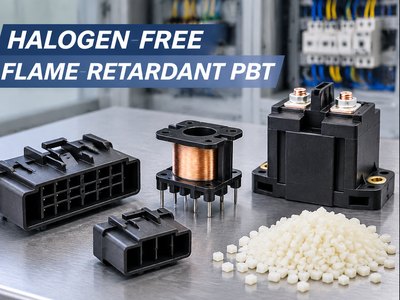
Industrial electrical components and halogen-free flame-retardant PBT concept.
Why Halogen-Free and PFAS-Free Flame-Retardant PBT Matters
PBT is a semi-crystalline engineering thermoplastic widely considered for electrical and electronic components because it offers a useful balance of stiffness, dimensional behavior, heat resistance and processability. Flame-retardant grades are used where the component design and end-product safety requirements call for controlled burning behavior.
Some flame-retardant PBT formulations have used halogen-containing packages. Envalior cites price volatility in bromine and antimony trioxide, alongside greater scrutiny of halogenated flame retardants around workplace safety, sustainability, recyclability and environmental impact. These factors have encouraged processors to assess alternatives.
A halogen-free formulation is not, by itself, proof of compliance with every environmental regulation or end-product requirement. Likewise, PFAS-free is a specific formulation claim and should be supported by the supplier's current declaration for the exact grade. Buyers should request the relevant technical data sheet, regulatory statements and change-control commitments rather than relying on a broad material-family description.
Pocan® BFN4135 is described by Envalior as both halogen-free and PFAS-free. The manufacturer says the grade is designed to narrow the mechanical-performance gap that previously limited some halogen-free flame-retardant PBT compounds in demanding applications.

PBT engineering resin pellets. Conceptual visual, not an Envalior product photograph.
What Envalior Reports for Pocan BFN4135
The published release identifies several performance points that are especially relevant to electrical component design:
- UL 94 V-0 at 0.75 mm: Envalior reports that the compound achieves V-0 in testing equivalent to the UL 94 flammability standard at a specimen wall thickness of 0.75 mm. This is an important data point for compact, thin-walled geometries. It should not be interpreted as blanket certification of a finished connector, bobbin or electrical assembly. The exact grade, color, minimum thickness, listing status and end-product requirements must be checked against the current official documentation.
- CTI A 450: The company reports a Comparative Tracking Index (CTI A) of 450 under IEC 60112. CTI is relevant to the resistance of an insulating material surface to the formation of conductive tracking paths under the specified test method. Actual electrical clearances, creepage distances and insulation coordination still depend on the equipment standard, voltage, pollution degree, material group and component geometry.
- Elongation at break of 2.4%: Envalior gives an elongation-at-break value of 2.4% measured according to ISO 527-1/-2. The release presents this as part of the improved mechanical profile and says it can help reduce susceptibility to stress cracking in finished components. It is not a guarantee against cracking: notch geometry, residual stress, assembly loads, chemical exposure and temperature cycling remain important.
- Mechanical-property balance: Envalior describes tensile modulus, tensile strength, Charpy impact strength, elongation at break and shrinkage behavior as comparable to conventional PBT compounds using halogenated flame-retardant systems. The press release does not provide a complete numerical table for all these properties. Engineers should obtain the grade-specific datasheet before making a quantitative comparison.
- Processing and shrinkage: Envalior says BFN4135 was engineered to replace certain conventional halogenated flame-retardant PBT grades containing 30% glass fiber, for example, without significant adjustment to injection molding parameters. The company reports virtually identical shrinkage behavior for the intended replacement context. This should be treated as a grade-to-grade replacement proposition, not a universal guarantee that existing tools can be reused without trials.
The CTI A 600 value mentioned in the release relates to other material variants under development. It is not the published CTI value for Pocan® BFN4135.

Representative molded connector, bobbin and contactor component forms.
Potential Applications in Industrial Electrical Components
Connector housings are one of the most direct application areas identified by Envalior. These parts may contain thin walls, terminal cavities, latches, ribs and mounting features. Flame performance, dimensional accuracy, snap-fit durability and resistance to assembly stress all matter. A material with a V-0 result at 0.75 mm may give designers another option when packaging space is limited, subject to validation of the actual part thickness and listing.
PBT coil bobbins are another potential application. They support wound coils and help maintain winding position relative to a core. Review wall integrity, winding loads, dimensional stability, insulation requirements and thermal exposure. CTI and flame data are useful inputs, but dielectric strength and the complete insulation system may also need evaluation.
DC contactors and related switching equipment contain insulating supports and housings around conductive parts. Envalior's release specifically illustrates DC contactors as a potential application. For these components, designers should consider heat generated during operation, electrical tracking, arc-related exposure, creepage and clearance distances, mechanical fastening and possible thermal cycling. The suitability of a resin cannot be decided from a single CTI or UL 94 value.
Other potential industrial uses include terminal supports, relay housings, sensor connectors and internal insulating carriers. Screen the grade where flame-retardant PBT and a halogen-free, PFAS-free formulation are specified.
What the Announcement Means for Injection Molders and OEM Buyers
For injection molders, the potential benefit is not simply a new resin option. If a candidate grade can replace a specified incumbent while retaining similar shrinkage and processing behavior, the transition may be less disruptive than a complete redesign. Envalior says BFN4135 is intended to support replacement of certain 30% glass-fiber-reinforced halogenated PBT grades with limited process changes.
Envalior also reports minimal viscosity fluctuations in hot-runner systems, which it links to stable processing, lower scrap, less tool maintenance and fewer interruptions. Molders should verify these benefits on the actual machine and tool.
For OEM procurement teams, the announcement creates an opportunity to review material specifications before a future product revision or sourcing change. The review should include the exact incumbent grade, color, glass-fiber content, approved flame classification, CTI requirement, mechanical limits, shrinkage data, regulatory declarations and availability. A resin substitution should be managed through formal engineering change control, not treated as a purchasing-only decision.
Where an existing product is already qualified, the OEM should determine whether the new grade requires renewed component testing, electrical evaluation, agency review or customer approval. Similar datasheet values do not automatically transfer the certification or qualification status of the original material.
Material Selection and Injection Molding Considerations
Start with the component's function and the applicable end-product standard. Identify the required flame classification and the minimum wall thickness at which it must apply. Confirm whether the requirement concerns a raw material specimen, a recognized material listing or a finished product test. Then review CTI, dielectric properties, thermal performance, mechanical loading and environmental exposure as separate requirements.
During design-for-manufacturing review, pay particular attention to thin sections, ribs, bosses, terminal cavities, snap features and areas around metal inserts. Flow length and gate position can influence filling and fiber orientation in reinforced grades. Wall-thickness transitions and cooling balance affect shrinkage and residual stress. The selected material's processing window and drying requirements should be taken from the supplier's current technical documentation; do not copy generic PBT settings onto an unfamiliar grade.
For a grade replacement, establish a controlled trial. Verify resin identity and batch traceability, follow the supplier's drying instructions, record key molding settings and hot-runner behavior, then inspect dimensions, appearance and assembly fit after agreed conditioning. Safety-critical parts may require additional flammability and electrical testing.

Industrial injection-molding equipment and electrical component context.
Performance Validation Before Production Release
Connect each material claim to a component-level check. Verify flame classification and thickness against the exact grade documentation; confirm CTI and evaluate dielectric performance, creepage and clearance in the intended assembly. Mechanical checks may include snap-fit retention, terminal retention, screw-boss integrity and resistance to assembly damage.
For bobbins, check winding assembly, core-interface dimensions and representative thermal exposure. For connector housings, evaluate terminal insertion, latch retention and fit with actual mating parts. For contactors, the equipment manufacturer must define electrical, thermal and safety validation.
The purpose is to avoid over-reading a resin announcement. Pocan® BFN4135 provides a promising published material profile, but component performance depends on geometry, processing, assembly and operating conditions. The final approval belongs to the OEM's engineering and compliance process.
How SWKS Can Support Custom Industrial Plastic Components
SWKS manufactures custom injection molded plastic components for industrial and OEM applications. Projects can be reviewed from drawings or samples, including material requirements, mold development, dimensional control, sampling and production planning.
For a connector housing, coil bobbin, insulating support or other industrial electrical part, SWKS can review manufacturability and the information needed for a project quotation. Any request for Pocan® BFN4135 must first be checked against resin availability, supplier documentation and customer approval requirements.
For custom industrial plastic injection molded components, please contact our team:
Email: amanda@tjswks.com
Source and Editorial Note
Primary source: Envalior press release, "Envalior closes performance gap with next-generation Halogen-free flame-retardant PBT," published 03 November 2026. https://www.envalior.com/en-us/insights/press-release/envalior-closes-performance-gap-with-next-generation-halogen-free-flame-retardant-pbt
All Pocan® BFN4135 performance figures in this article are attributed to Envalior's announcement. Application examples and validation recommendations are editorial/industry analysis, not claims of SWKS experience with this resin. Generated illustrations are conceptual and are not Envalior or SWKS production photographs.