


A High-Volume Connector Application Takes Center Stage
ENGEL is presenting an automated automotive connector molding application at Plastimagen 2026 in Mexico City, using the trade show to demonstrate how machine configuration, multi-cavity tooling and automation can work together in high-volume production. The exhibition runs from 10 to 13 November 2026 at Centro Citibanamex. ENGEL announced its programme on 28 October, describing four live injection molding applications across a 480 m² stand. The illustrations in this article are AI-generated concepts.
The automotive connector demonstration is built around the all-electric WINTEC e-win 1800. According to ENGEL, the production cell uses a 128-cavity mold and an eight-second cycle time. The company calculates a theoretical output of 57,600 connector components per hour. The cell is also presented as a coordinated solution with the new ENGEL viper 6 automation system.
For automotive suppliers, the example brings together several priorities: high output, repeatable molding, controlled unit cost and automated part handling. It also illustrates why connector production is not simply a question of selecting a molding machine with sufficient clamping force. Mold design, cavity balance, material behavior, cooling, ejection, robot timing and downstream handling all influence the performance of the complete production cell.
WINTEC e-win 1800: Electric Molding for High-Volume Production
ENGEL identifies the WINTEC e-win 1800 as an all-electric injection molding machine configured for the connector application. The manufacturer says the machine is sized to the requirements of the job and avoids unnecessary special equipment, with the aim of controlling both capital investment and operating costs.
The focus on an application-specific configuration is relevant to OEMs evaluating high-volume molded components. A machine that is oversized for the job can add unnecessary investment and operating expense, while a machine with insufficient capacity can restrict mold design, shot size or production flexibility. The right selection depends on the part, resin, projected shot weight, mold dimensions, required clamping force, process window and annual demand.
An all-electric drive platform can offer precise movement control and repeatable machine operation. However, the machine type alone does not guarantee connector quality. Dimensional consistency also depends on mold construction, temperature control, resin drying where required, gate design, cavity-to-cavity balance and process monitoring. The production cell must be evaluated as a complete system rather than by machine specifications in isolation.
What the 128-Cavity Mold and Eight-Second Cycle Mean
The headline production figures are a 128-cavity mold and an eight-second cycle. Based on those figures, 128 parts per cycle multiplied by 450 cycles per hour gives 57,600 parts per hour. This is the output calculation published by ENGEL for the demonstration.
A high cavity count can spread tooling and machine costs across a large number of parts, making it attractive for stable, high-volume applications. Yet it also raises the importance of cavity-to-cavity consistency. Small differences in filling, packing, cooling or venting can create variation in part weight, dimensions, flash or functional performance. A robust mold design must distribute melt evenly and maintain consistent conditions across all cavities.
The eight-second cycle should be understood as the stated demonstration cycle, not a universal cycle time for automotive connectors. Actual output in a commercial plant will depend on the exact connector geometry, resin grade, mold maintenance, material supply, robot sequence, quality checks, planned downtime and reject rate. For production planning, buyers should distinguish theoretical machine output from good parts per hour and overall equipment effectiveness.
For OEM procurement teams, the key questions are therefore not only how many cavities are used, but also what quality controls are applied, how cavity identity is traced, how process deviations are detected and how quickly a production cell can recover from a stoppage.
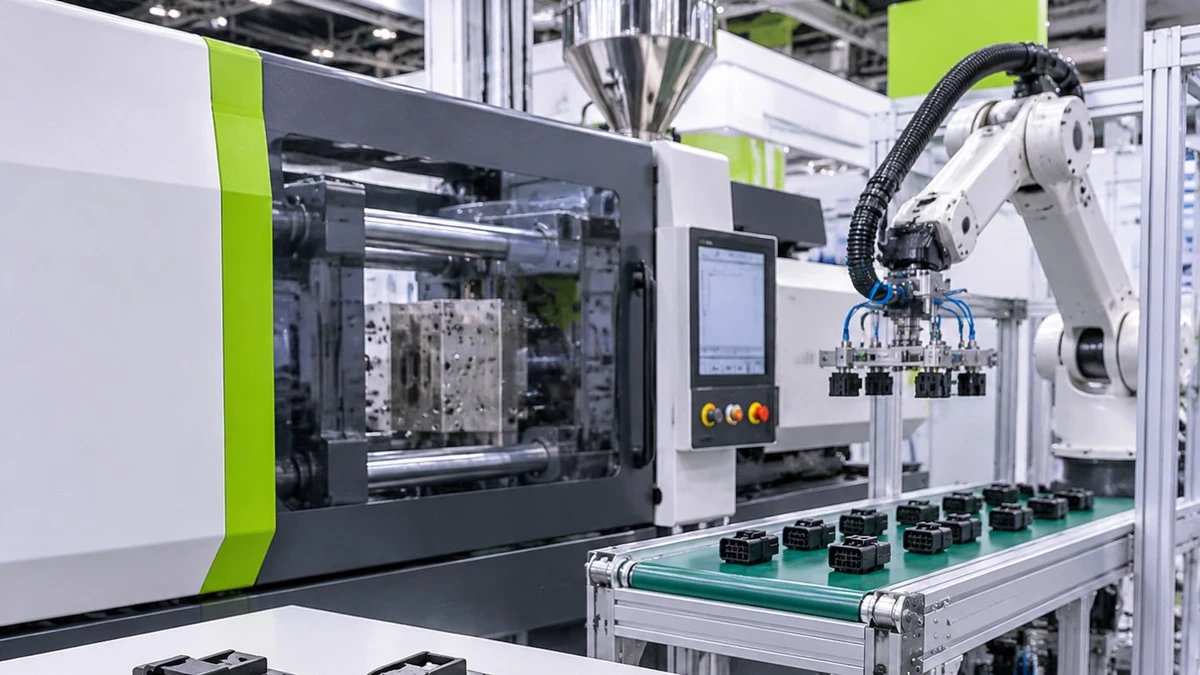
AI-generated illustration. Conceptual illustration of robotic part handling and conveyor transfer in an automotive connector molding cell; not a depiction of the actual ENGEL demonstration.
The Role of the ENGEL viper 6 Automation System
ENGEL describes the WINTEC e-win 1800 and the new ENGEL viper 6 as a coordinated injection molding and automation solution. In a high-volume connector cell, automation can support repeatable part removal and transfer while reducing the need for manual handling at the machine.
Robot integration must be designed around the mold opening sequence, available extraction time, connector geometry, gripping points and the downstream process. Delicate terminal cavities, sealing features and thin molded walls may require carefully selected grippers and controlled acceleration. The robot's task may also include orientation, separation, inspection, placement or transfer to a subsequent assembly station, depending on the product and cell configuration.
The robot cycle must fit within the overall machine cycle without creating a bottleneck. At the same time, safety guarding, access for mold changes, maintenance clearance and recovery procedures need to be considered during cell design. The best automation strategy is not necessarily the most complex one; it is the one that reliably performs the required handling tasks while protecting the part and maintaining production flow.
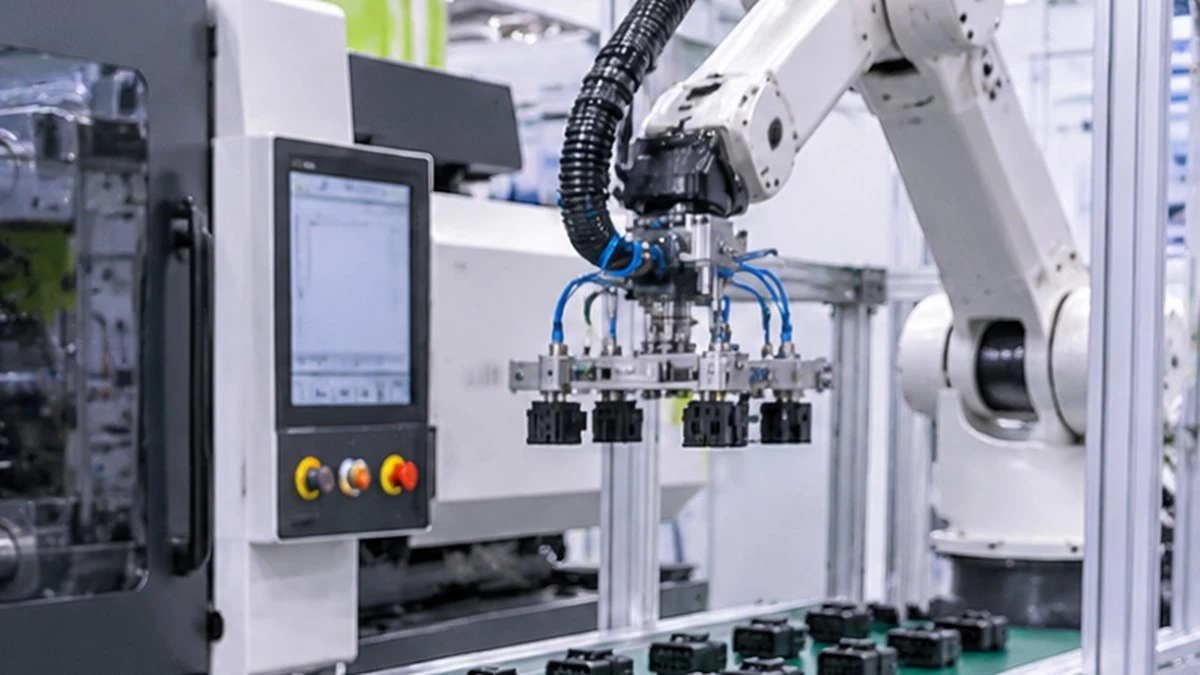
AI-generated illustration. Representative automotive electrical connector housings for industrial applications; not identified as parts produced by ENGEL at Plastimagen.
Other Live Applications at the ENGEL Stand
The automotive connector cell is one of four live applications described in ENGEL's Plastimagen announcement. For high-volume agricultural transport crates, the company is demonstrating the WINTEC t-win 6500, a standardized two-platen machine with a stated clamping force of 6,500 kN. ENGEL highlights short dry-cycle times, high availability, compact layout and accessible maintenance points as factors intended to support cost-effective production.
For liquid silicone rubber molding, ENGEL is showing an all-electric e-mac 165/110 LIM with a two-cavity mold supplied by KIPE Molds. The stated cycle time is 51 seconds. A cold runner is used to avoid sprue waste, and a viper 12 robot removes the parts within a safety enclosure and places them on a conveyor.
A fourth application uses the tie-bar-less victory electric 220 to mold a polypropylene syringe plunger for a medical application. ENGEL points to the accessible mold area and electric injection unit as features supporting precision processing and production-cell flexibility.
Together, the four applications show that the exhibition is not limited to automotive connectors. ENGEL is using different parts and machine configurations to discuss high-volume output, cost control, precision, automation and process consistency across several industrial sectors.
EVA and AI Support for Production Teams
ENGEL is also presenting EVA, its ENGEL Virtual Assistant, as part of its inject AI approach. The company describes EVA as a tool that allows operators to ask production-related questions in natural language, by text or voice. The assistant places the question in the context of the machine and production order, then connects available information with ENGEL's machine, process and service expertise.
For approved use cases, EVA can prepare proposed changes and transfer them to the machine control system only after operator confirmation. ENGEL says the underlying AI Interface uses the Model Context Protocol (MCP) to provide structured machine information to approved applications. The interface is available as an option for new ENGEL and WINTEC molding cells and can be retrofitted to existing machines with CC300 or C3 control systems.
In a connector production environment, contextual access to machine and process information could help operators investigate deviations and locate relevant guidance more efficiently. It should be viewed as a support tool, not a replacement for process engineering, operator training, quality procedures or controlled change approval.
Implications for Automotive Connector OEMs and Molding Suppliers
The demonstration highlights several factors that automotive OEMs and tier suppliers should evaluate when selecting a molding partner or developing a new connector program. First, the part design and mold must be suitable for the intended production volume. A high-cavity tool can be economical at scale, but it requires careful validation of filling balance, cooling uniformity, ejection and maintenance access.
Second, connector quality is defined by functional interfaces as much as external appearance. Terminal retention, mating geometry, sealing surfaces, latch features, dimensional stability and material compatibility may all be critical. Depending on the application, customers may also specify temperature exposure, vibration, chemical resistance, electrical insulation, flame performance or traceability requirements. These requirements must be tied to the exact resin grade and validated assembly; they cannot be inferred from the machine used to mold the part.
Third, automation should be evaluated against the whole process. Part extraction, orientation, inspection and packaging can influence labor requirements, cycle stability and damage risk. Buyers should ask suppliers how the cell handles rejected parts, machine stoppages, mold changes and quality checks, not only the nominal robot speed.
Finally, quoted capacity should be based on good parts, agreed quality limits and realistic uptime assumptions. The ENGEL demonstration provides a useful reference point for high-cavity production, but each new connector project requires its own feasibility study and production validation.
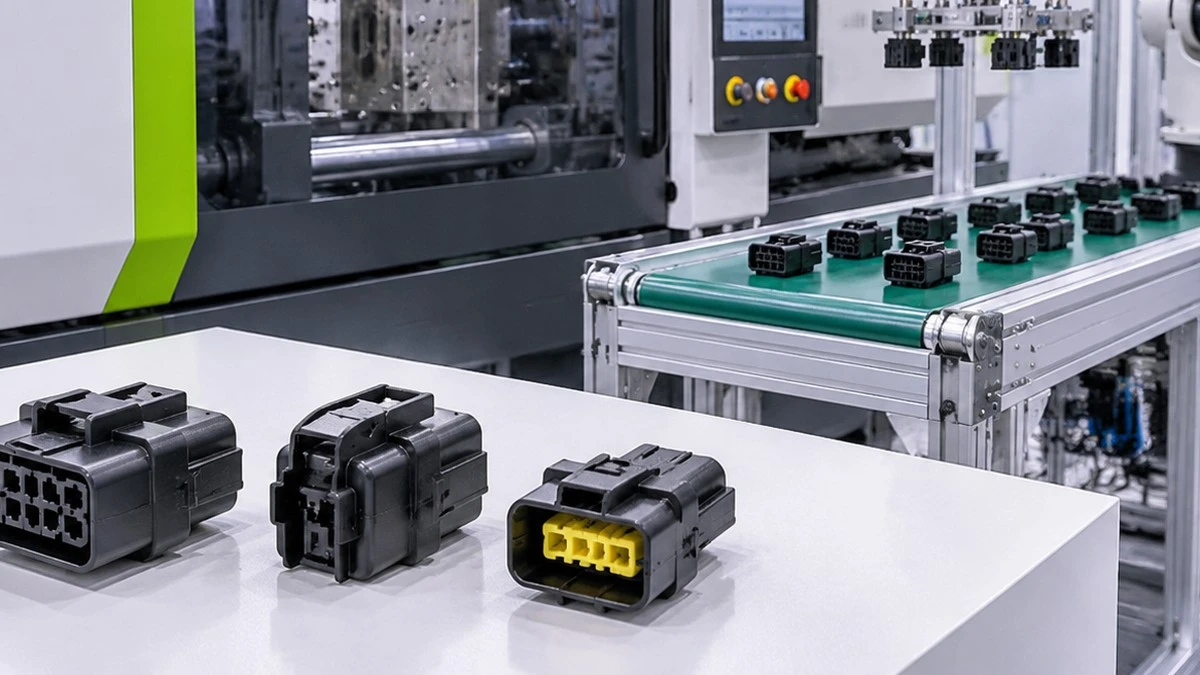
AI-generated illustration. Conceptual close-up of molded connector housings and automated production handling; not an official event photograph.
Custom Industrial Plastic Components from SWKS
ENGEL's Plastimagen demonstration illustrates the wider development of automated, high-volume injection molding. For industrial and automotive buyers, the central lesson is that a successful molded component depends on coordinated design, material selection, tooling, process control and assembly requirements.
SWKS supplies custom industrial plastic injection molded components based on customer drawings, CAD files and application requirements. Relevant product examples include custom injection molded electronic housings, PA66 industrial terminal block retaining clips and PA66 connector locking levers. These products illustrate SWKS's component focus; they do not imply that SWKS owns or uses the ENGEL or WINTEC equipment shown at Plastimagen.
For a new connector housing, retaining clip or electrical component project, buyers can share the 3D model, dimensioned drawing, material specification, annual demand and critical functional requirements for an initial review.
Primary Source and Editorial Note
Primary source: ENGEL, "Where Crates Meet Connectors: ENGEL at Plastimagen 2026 in Mexico," published 28 October 2026. https://www.engelglobal.com/us/company/media-center/news-press/where-crates-meet-connectors-engel-at-plastimagen-2026-in-mexico
Event dates and venue: 10–13 November 2026, Centro Citibanamex, Mexico City. ENGEL stand: 480 m², booth 813.
All technical figures in the article are attributed to ENGEL. The 57,600 parts/hour figure is the manufacturer's stated calculation based on 128 cavities and an eight-second cycle; actual saleable output depends on process conditions, uptime and reject rate.
The four visuals accompanying this article are AI-generated conceptual illustrations. They are not official ENGEL machine photographs, not photographs of the actual Plastimagen booth, and not evidence of SWKS production experience.
For custom industrial plastic injection molded components, please contact our team:
Email: amanda@tjswks.com