


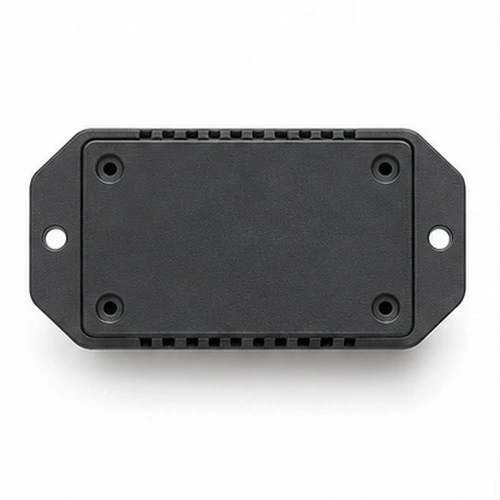
Tianjin SWKS Technology & Development Co.,Ltd is one of the most reliable manufacturers and suppliers of custom abs data center rack environmental sensor enclosure in China. If you're going to buy bulk cheap custom abs data center rack environmental sensor enclosure, welcome to get quotation from our factory. Quality products and low price are available.
Custom ABS Data Center Rack Environmental Sensor Enclosure
A temperature probe clipped near the rear doors of a rack can see different conditions from a sensor recessed in a protective housing. An opening hidden behind a support bracket can make the enclosure respond to a pocket of stagnant air. SWKS quotes this drawing-based injection molding with tooling and part quantities defined for the project.
Images are generated product illustrations in a photographic style. Final geometry, material grade and acceptance criteria follow the approved project drawing.
Contents
- Where the housing sits in the air path
- Vent openings and the electronic board
- Servicing a board behind cables
- Finish and rack trial records
- Inspection and equipment trials
- Planning repeated assembly
- From drawing review to a quote
Product specification
| Attribute | Drawing-based scope |
|---|---|
| Material | ABS grade to be confirmed |
| Process | Custom injection molding |
| Application | rack-mounted environmental sensor assemblies |
| Drawings | STP, STEP or IGS with dimensioned PDF |
| Quotation | Tooling, pilot samples and production quantities reviewed by project |
Where the housing sits in the air path
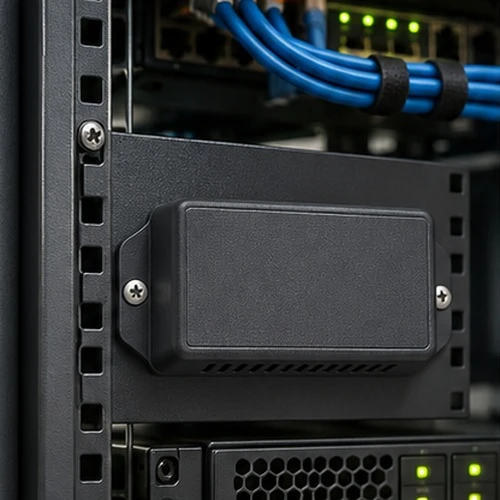
In a server rack, the same enclosure can face the cold aisle, the rear door or a narrow space between cables. A temperature or humidity sensor sees the conditions at its exposure point. A housing can protect the board and also change how readily air reaches the sensing area. A slot facing a blank wall may be technically open but of little use in the installed position. The rack drawing should show its highest and lowest acceptable positions, which side faces the aisle and whether a rail or tie mount can overlap the openings.
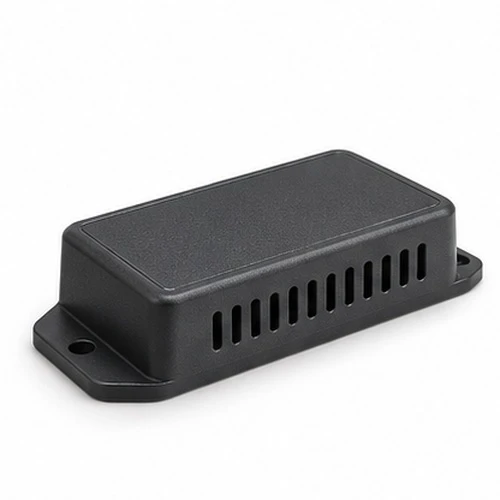
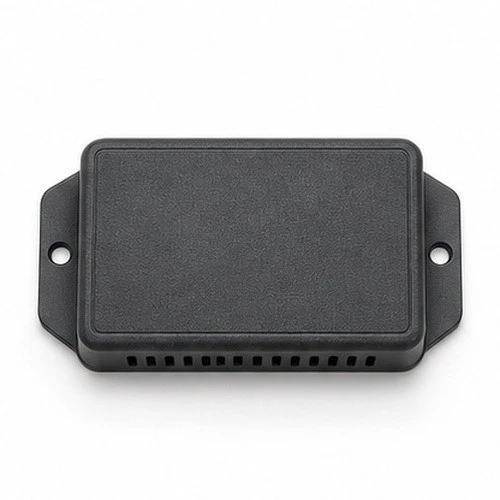
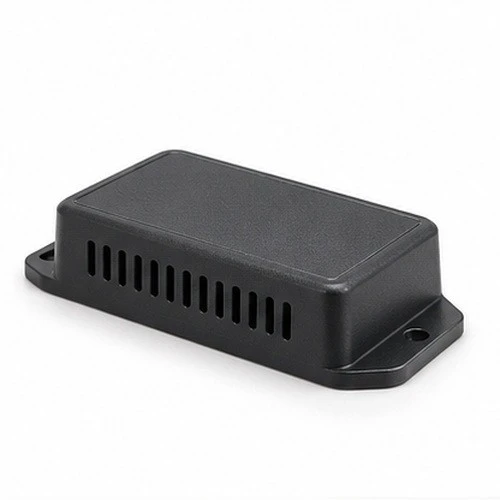
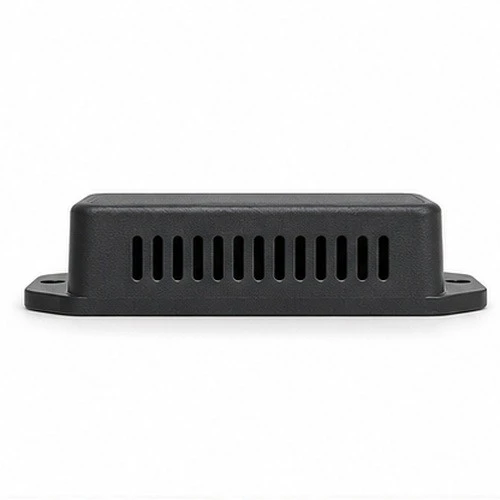
The custom ABS enclosure is the molded shell in that layout. The buyer supplies the PCB outline, the intended sensor position, the rack attachment and the orientation of cable connections. The sample-style image illustrates one housing arrangement. Sensor performance is determined from the assembled device in the equipment owner's validation; it depends on the sensor type and the available ventilation as well as the molded shape.
In a crowded cabinet, even a wide inlet can be screened by a cable bundle that moves when the rear door closes. Mark the perimeter that should stay free in the installed view. If the same enclosure is used on front and rear rails, note which side is ventilated and which direction the connector exits in both positions. The board can be fixed in the same place inside its shell while the sensor faces a substantially different local flow once the enclosure is moved.
Vent openings and the electronic board
Board standoffs set the distance between the assembled PCB and the inner edge of the shell. A connector on one board revision can force the board sideways or require extra separation from the lid. The position of the sensing element then changes relative to a louver even if the cage matches its exterior drawing. In the mechanical package show the height of any component that faces the vent, position its connector entrance and give the mounting method. A dimensioned board outline and a few heights often answer more questions than a photograph of a complete rack.
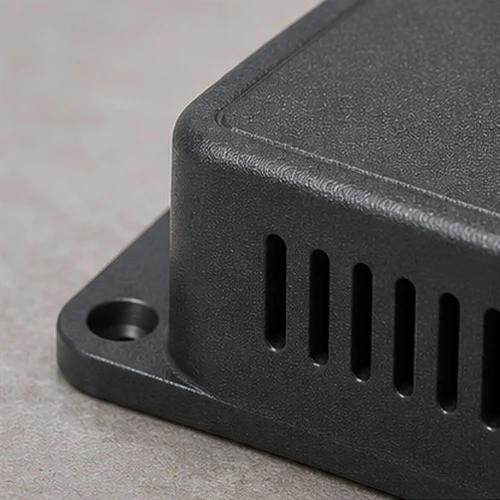
Before closing the lid, look for flash across the internal side of each relevant vent and verify that the board can be removed without dragging a connector past a rib. Louvers useful for keeping fingers away from the board can be formed differently from plain slots. Identify the design purpose of each area before changing the width or position of the openings during mold review.
Servicing a board behind cables
An installer may be able to remove an enclosure with the rack empty and lose the same access once patch cords fill the surrounding space. Work through the mounting order with the nearby cables present or shown in a fixture. See whether there is enough room to swing a latch, tilt the board out or reach the fastener that holds the back shell. A face cover that snaps on can reduce assembly time if there is room to reach its grip tabs. A remote enclosure next to a rail can put those tabs in difficult places.
Keep the cable bend and connector release in the sketch. Cables that turn immediately out of a side opening may cover a vent or limit how far the case can be moved away from the rail. Where the layout allows, position the service edge where it stays reachable. A product trial can record what the technician had to move to remove the housing, which is a useful supplement to an assembled photograph.
Finish and rack trial records
An ABS specification for this housing can name the grade and color, add a texture reference if needed and record the cleaner that the enclosure sees. Open vent edges and a face used for a label deserve separate treatment at the tool review. A gate mark behind the case may be acceptable while a protrusion near a cable entrance can obstruct assembly. Keep those areas visible on the drawing. If an assembly needs an application-specific flame or environmental classification, state the equipment requirement and the material documentation requested before a grade is chosen.
A sample enclosure can be fitted to the rack without powering the board to evaluate approach, ventilation obstruction and panel clearance. A functional validation can follow at the sensor owner's selected rack positions, using its prescribed hardware and layout. In the first-article paperwork record the rail or bracket used and whether the cables were installed. Photographs should distinguish the outer housing from the viewed sensor position.
Inspection and equipment trials
One useful observation for the first inspection is to mount the enclosure in the orientation used in service and check that cables and neighboring rails leave the intended vents accessible. If a trial builds up a gap unexpectedly, note whether the difference appears while locating the molding or only after a fastener, latch or neighbor is installed. Record the order of operations. When a second technician repeats the check, the same viewing angle, machine revision and position on the part help make the observations comparable. Notes that identify a part as simply tight or loose can be hard to act on without knowing where the recorded condition appeared.
The report can include the dimensions and alternatives that matter for acceptance, such as a functional gauge or a fixture that represents mating geometry. If a feature can be checked in more than one position, agree which position governs the result. A flexible part restrained during measurement may show less movement than it would before installation, while some installed checks require the part to be held just as it is held in service. Store the drawing revision and information about the setup with the measurements. That makes it possible to read the results of the pilot alongside any later tooling revision.
Planning repeated assembly
A first build is an opportunity to learn whether the person receiving the component can tell its orientation, identify the correct version and put it into the equipment using the planned sequence. It is worth deciding how the parts will be grouped on the inspection sheet and in the shipment, especially when pieces come from different cavities or more than one molding run. Include the inspection plan and any functional tests approved by the customer. If the team already uses a reference assembly or gauge, tell us whether it can be supplied for the trial or should remain available only for final verification at the site.
For repeat production, pack orientation and separation depend on which areas touch neighboring pieces in transit. Parts that nest neatly can be harder to separate by hand if the stack is packed under load. A thin edge and a small projection can look sturdy on their own and still take a mark where the two parts meet in a full carton. Specify any protected surfaces, label details and pilot shipment count early. Where the first order only covers engineering and assembly approval, later production quantities can be quoted against the agreed packaging and inspection scope.
From drawing review to a quote
Send the part file and a dimensioned PDF together with a cropped assembly section or a mating part file. The drawing package should identify board outline, sensor location, vents, cable entry, rack orientation and closure method. A photo of a current unit is most useful when it shows the direction of assembly or a feature that is hard to read on a print. If the quote is for a replacement, a sample can tell us about finish and practical handling. The sample should be accompanied by notes on any wear, damage or previous repairs, because the visible geometry may represent an already used part.
Share the approximate sample and production quantities, delivery destination and documentation needed at first article. If the drawing is still open to changes, identify which areas are fixed, which can be reviewed and who will clear any change to the assembly. Tooling, samples and production are priced separately to the extent the project requires. With the functional interface and quantities defined, the quote can also describe the intended inspection report and identify any hardware the customer plans to supply for a fit check.
See our range of custom plastic injection molded parts for additional OEM applications and molded component examples.
Request a quotation
Email the drawing package, sample quantity and estimated production volume to amanda@tjswks.com. Include the delivery destination and the machine or assembly revision that applies to the request.
Hot Tags: custom abs data center rack environmental sensor enclosure, China, suppliers, manufacturers, factory, bulk, cheap, low price, quotation


