


Tianjin SWKS Technology & Development Co.,Ltd is one of the most reliable manufacturers and suppliers of custom pa66 industrial cooling fan cable retention hub in China. If you're going to buy bulk cheap custom pa66 industrial cooling fan cable retention hub, welcome to get quotation from our factory. Quality products and low price are available.
Custom PA66 Industrial Cooling Fan Cable Retention Hub
A wire that snaps neatly into a clip on the bench may slide sideways when it is pulled through the fan frame. The retention hub gives the designer a way to route the cable near the stationary structure without using the cable jacket as a hard stop. SWKS quotes this drawing-based injection molding with tooling and part quantities defined for the project.
Images are generated product illustrations in a photographic style. Final geometry, material grade and acceptance criteria follow the approved project drawing.
Contents
- The hub retains the cable on the stationary side
- Two wire sizes can require different checks
- The entrance radius belongs in the tooling discussion
- From motor mockup to first-article inspection
- A sample worth checking twice
- From pilot quantity to repeat orders
- Drawing package and quotation
Product specification
| Attribute | Drawing-based scope |
|---|---|
| Material | PA66 grade to be confirmed |
| Process | Custom injection molding |
| Application | industrial fan cable retention assemblies |
| Drawings | STP, STEP or IGS with dimensioned PDF |
| Quotation | Tooling, pilot samples and production quantities reviewed by project |
The hub retains the cable on the stationary side
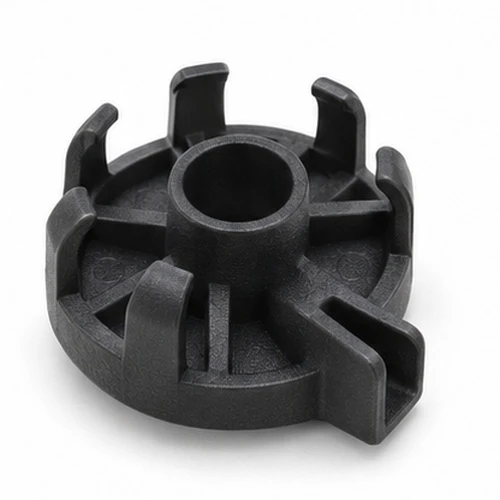
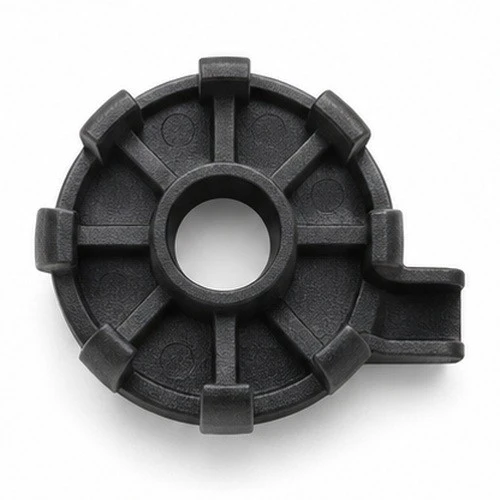
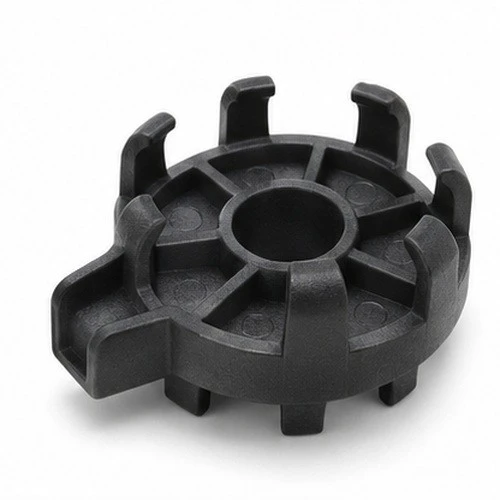
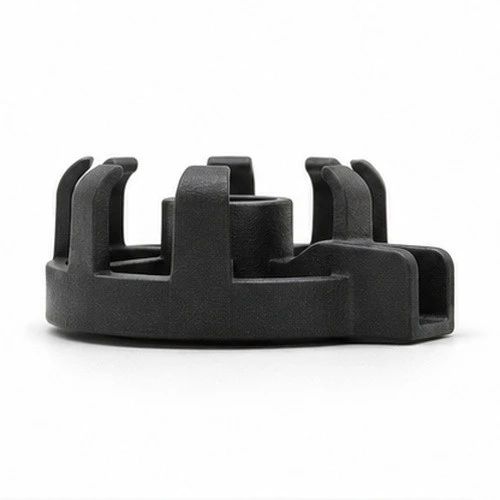
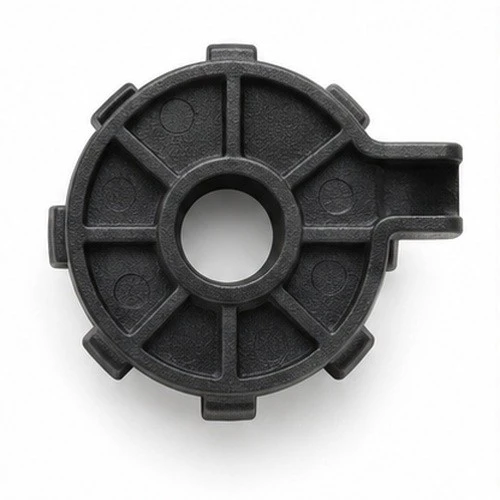
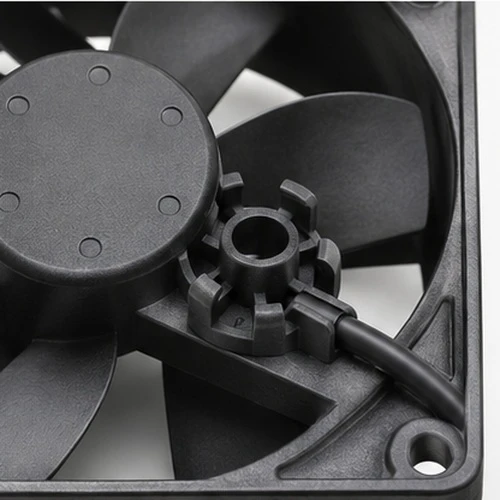
Follow the cable from the motor to the nearest part of the fan frame that supports it. That span is where a crossing wire can move under load or hang into a service opening. The PA66 retention hub is the molding around the stationary interface, shaped to capture the route that the fan designer provides. The illustrated hub shows an open channel and retaining fingers. The fan blade, motor and hardware form the mating assembly. Clearances and whether the wire can be removed depend on that assembly's design.
On one fan a harness exits toward an outer frame corner. Another routes the lead toward the rear, with a plug almost as wide as the mounting space. The guide shape must allow whichever wire and plug are inserted and give the operator a clear installation direction. A sectional view with the connector overlaid can show that a wire can fit in a channel while the connector that comes attached to it cannot reach that channel.
Two wire sizes can require different checks
Use the approved small and large cable limits when discussing retention. The small size can move if the lip barely reaches its jacket. A larger size may need more deflection to enter and may touch a sharp edge on the lead-in. Observe both on an unpowered representative fixture in the actual routing direction. Describe whether the route is intended to allow axial movement or whether another feature supplies strain relief. Retention of the route and strain relief near a connector should be spelled out separately in the drawing.
The routing check should also identify what sets the space to the rotating assembly. A local portion of the wire can bow between clips even if both ends sit in the intended position. A picture showing the mating housing, neighboring support and the contact area helps document the bow. The equipment owner can specify the movement boundary and a method to validate clearance using the designated cable parts and hardware.
Ask the wire supplier to describe the jacket in addition to its outside diameter. A soft jacket can show an impression after being held under a narrow finger, while a stiffer cable may spring against the adjacent wall as it is routed. Document the wire revision used for the trial so changes in the harness are not mistaken for changes in the molded part. Where a bundle has a sleeve, measure over the sleeve at the point the actual hub retains it.
The entrance radius belongs in the tooling discussion
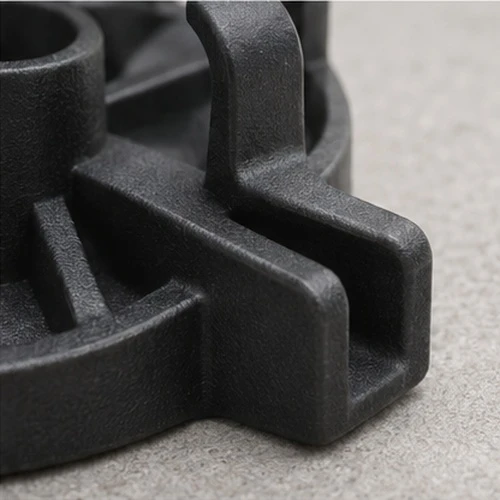
Finger roots and the curved part of the channel are relatively small features. A deep retaining tip can restrict mold withdrawal, and an edge that crosses the mold split can carry a witness into the cable path. Discuss gate position and tool pull with the cable-facing area marked in the CAD review. Where a finger is intended to deflect for insertion, the shape of its root and the space around it are features of practical interest. A prototype machined from another material can demonstrate where a wire sits and still feel quite different when it snaps into place.
Ask whether the design is evaluated as molded or after exposure to the intended humidity and operating environment. A PA66 grade used in a warm enclosure experiences a different condition from a loose part kept in its shipping bag. The manufacturing team should know the grade selected for the trial and the conditions under which the customer evaluates grip or removal. Color and any required material paperwork can be recorded alongside those conditions.
From motor mockup to first-article inspection
Fit the parts in order on a stationary fan mockup. Note where the harness is held while its connector is routed, where the clip engages and whether the cable has space to leave the last guide freely. If removal is permitted for service, observe how the installer releases the finger without pulling at the jacket or any connection. A blank copy of the customer's report can show which checks to record for the first molded articles.
The RFQ is easiest to review with the fan casing, hub position and cable envelope shown together. Include connector dimensions and intended assembly order, and mark the portions of the molding that are allowed to carry a gate or ejector witness. Provide sample and production quantities and identify whether a working fixture or approved fan samples are available for comparison. That allows fit evidence and mold dimensions to be quoted against the same revision.
A sample worth checking twice
One useful observation for the first inspection is to observe both cable sizes at the limits of the drawing and verify that the wire remains outside the designated movement envelope. If a trial builds up a gap unexpectedly, note whether the difference appears while locating the molding or only after a fastener, latch or neighbor is installed. Record the order of operations. When a second technician repeats the check, the same viewing angle, machine revision and position on the part help make the observations comparable. Notes that identify a part as simply tight or loose can be hard to act on without knowing where the recorded condition appeared.
The report can include the dimensions and alternatives that matter for acceptance, such as a functional gauge or a fixture that represents mating geometry. If a feature can be checked in more than one position, agree which position governs the result. A flexible part restrained during measurement may show less movement than it would before installation, while some installed checks require the part to be held just as it is held in service. Store the drawing revision and information about the setup with the measurements. That makes it possible to read the results of the pilot alongside any later tooling revision.
From pilot quantity to repeat orders
A first build is an opportunity to learn whether the person receiving the component can tell its orientation, identify the correct version and put it into the equipment using the planned sequence. It is worth deciding how the parts will be grouped on the inspection sheet and in the shipment, especially when pieces come from different cavities or more than one molding run. Include the inspection plan and any functional tests approved by the customer. If the team already uses a reference assembly or gauge, tell us whether it can be supplied for the trial or should remain available only for final verification at the site.
For repeat production, pack orientation and separation depend on which areas touch neighboring pieces in transit. Parts that nest neatly can be harder to separate by hand if the stack is packed under load. A thin edge and a small projection can look sturdy on their own and still take a mark where the two parts meet in a full carton. Specify any protected surfaces, label details and pilot shipment count early. Where the first order only covers engineering and assembly approval, later production quantities can be quoted against the agreed packaging and inspection scope.
Drawing package and quotation
Send the part file and a dimensioned PDF together with a cropped assembly section or a mating part file. The drawing package should identify fan housing datums, cable size range, jacket type, route and whether the cable must be removable. A photo of a current unit is most useful when it shows the direction of assembly or a feature that is hard to read on a print. If the quote is for a replacement, a sample can tell us about finish and practical handling. The sample should be accompanied by notes on any wear, damage or previous repairs, because the visible geometry may represent an already used part.
Share the approximate sample and production quantities, delivery destination and documentation needed at first article. If the drawing is still open to changes, identify which areas are fixed, which can be reviewed and who will clear any change to the assembly. Tooling, samples and production are priced separately to the extent the project requires. With the functional interface and quantities defined, the quote can also describe the intended inspection report and identify any hardware the customer plans to supply for a fit check.
See our range of custom plastic injection molded parts for additional OEM applications and molded component examples.
Request a quotation
Email the drawing package, sample quantity and estimated production volume to amanda@tjswks.com. Include the delivery destination and the machine or assembly revision that applies to the request.
Hot Tags: custom pa66 industrial cooling fan cable retention hub, China, suppliers, manufacturers, factory, bulk, cheap, low price, quotation


