


Why Is Cavity Pressure Monitoring Becoming a Key Trend in Smart Injection Molding in 2026?
Published: November 4, 2026 | Category: Industry News | Topic: Injection Molding, Process Monitoring and Custom Plastic Parts
Injection molding technology is moving beyond machine-setting repeatability toward a more direct measure of what happens inside the mold. An industry report published on November 3, 2026 highlighted how cavity pressure feedback is being used to evaluate molding variation, support automated inspection decisions and enable more adaptive process control. For manufacturers of custom plastic components, this development is relevant because a stable-looking machine does not always produce dimensionally consistent parts.
The latest discussion, reported by Plastics Engineering, focused on cavity pressure sensing and the evolution of closed-loop processing systems. It described how pressure data from the mold can help processors identify differences caused by resin viscosity, gate behavior, cooling conditions and machine performance. The technology is not a guarantee of defect-free parts, and its value depends on proper sensor placement and validated process limits. Nevertheless, it points toward an increasingly data-driven approach to precision injection molding.
For OEM purchasers, the practical question is not simply whether a factory uses AI or an automated injection molding machine. It is whether the supplier can connect process control, tooling design, material variability and finished-part inspection to the actual requirements of the drawing.
What Was Reported in November 2026?
On November 3, Plastics Engineering published an article examining the role of cavity pressure in increasingly autonomous injection molding. It covered developments discussed by RJG at the 2026 SPE Injection Molding Innovation Summit, including in-mold sensors, cavity pressure profiles, quality monitoring and feedback-based process adjustments.
The report explained that the machine may follow the same programmed cycle even while the melt behaves differently inside the cavity. Changes in polymer viscosity, recycled material content, equipment wear or packing behavior can alter pressure conditions. Tracking the in-mold pressure curve therefore provides additional evidence about the process experienced by the plastic itself.
The important industry shift is from observing press parameters alone to observing conditions closer to the molded product. This is especially relevant to engineered parts where dimensional fit, warpage, assembly performance or batch-to-batch consistency matters more than the appearance of the machine's control screen.
How Does a Cavity Pressure Sensor Work?
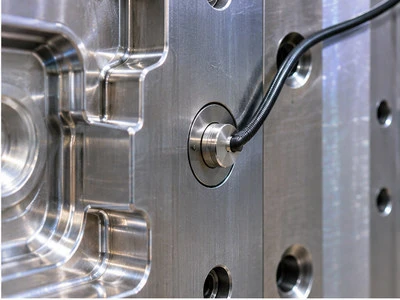
A cavity pressure sensor detects pressure changes during the molding cycle. Depending on its design and installation, it measures pressure directly or through a mechanical transmission path. The recorded pressure curve follows the material as it fills, packs and cools in the mold. Engineers can compare the resulting profile with an established process window.
A typical curve can provide information about melt arrival, the pressure reached during filling, the packing phase, pressure decay and the relative behavior of multiple cavities. It is most useful when the factory has first established which pressure patterns correspond to acceptable parts using actual measurements and approved production samples.
Sensor position matters. A sensor near the gate may be helpful for observing packing behavior, while a location further along the flow path may help detect incomplete filling or certain filling imbalances. A single sensor cannot automatically diagnose every defect. The correct monitoring arrangement depends on the mold layout, material, gate position and critical part characteristics.
Why Are Machine Settings Alone Not Enough?
Injection molding machines record information such as injection speed, screw position, barrel temperature and hydraulic or injection pressure. These values are important, but they describe the machine's operating conditions, not necessarily the complete state of the polymer inside every mold cavity.
Two cycles can have similar programmed settings yet produce different parts because of material batch variation, residual moisture, changes in the non-return valve, blocked vents or unequal cooling. A pressure measurement taken closer to the cavity provides a second layer of process evidence. Combining machine-side data with in-mold data can help a technician distinguish a gradual trend from a one-off event.
This approach is particularly useful for suppliers producing custom industrial components in PA66, POM, ABS, PC and PP. These material families differ in moisture behavior, viscosity response, shrinkage and sensitivity to processing conditions. The correct resin grade, drying conditions and mold design still need to be selected first; sensors do not replace material engineering.
For a wider view of available manufactured components, visit our custom plastic injection parts category.
What Types of Defects Can Pressure Monitoring Help Investigate?
Cavity pressure monitoring may support investigation of short shots, inconsistent packing, flash, dimensional variation, sink marks and selected types of warpage. It can also help reveal differences between cavities in a multi-cavity tool. However, a pressure deviation is an indicator to investigate, not proof of a particular defect.
Short shots and incomplete filling: A missing or unusually low pressure response at a monitored location may suggest that material has not reached the expected region of the cavity. Venting, gate design, melt temperature and flow restrictions should still be evaluated.
Sink marks and local shrinkage: Inadequate packing can contribute to sink, especially around thick features. Monitoring pack pressure may help detect changes, but large ribs, bosses and heavy sections should also be addressed during DFM. Our existing guide on ribs and bosses in injection molded plastic parts explains why part geometry remains essential.
Trapped air and burn marks: An unusual filling pattern may justify an inspection of the last-to-fill areas, but a pressure sensor is not a substitute for correct vent design. See our practical article on mold venting, air traps and burn marks.
Assembly fit and dimensional stability: An injection molded housing can meet visual requirements but still fail because snap features or locating surfaces do not fit. Stable processing helps, while the actual joint should still undergo assembly verification. Related design considerations are covered in our snap-fit joint design article.
How Is Closed-Loop Control Different From Basic Monitoring?
Traditional monitoring records data and alerts an operator when conditions fall outside a predetermined range. Closed-loop control uses measured feedback to adjust selected process variables within permitted limits. For example, in an appropriately configured system, cavity pressure can contribute to decisions about transfer or packing instead of relying entirely on a fixed machine setting.
This does not mean that the software designs a perfect molding process by itself. Engineers must establish suitable target conditions, verify the relationship between the signal and part quality, define allowable adjustments and decide when an alarm should stop production rather than correct the process automatically.
The industry report discussed RJG's approach as an example of feedback-based control, rather than evidence that every injection molding plant has adopted autonomous molding. For OEM sourcing teams, this distinction matters: a vendor's statement that it uses smart manufacturing should be supported by process records and inspection results relevant to the specific part.
Why Does the Trend Matter for Recycled and Alternative Resins?
A significant challenge in recycled-content molding is variation between lots. Changes in contamination, molecular characteristics, additive content or melt behavior can influence filling and packing, even when the polymer family on the label is unchanged. In-mold feedback may help reveal such differences sooner than an end-of-line visual check.
That does not remove the need to qualify recycled resin. Material traceability, mechanical property testing, color stability and relevant compliance requirements remain critical. For safety-related, electrical or food-contact parts, the selected grade and documented application requirements must be reviewed separately before use.
The same reasoning applies when manufacturers evaluate alternative suppliers for virgin engineering plastics. A nominally equivalent PA66 or POM grade may still require new sampling, adjustments to the process window and reapproval of dimensions. Sensors can support the comparison, but they cannot establish chemical or regulatory equivalence on their own.
What Does This Mean for Custom Mold and Part Design?
Better monitoring cannot compensate for a fundamentally unsuitable design. A thin wall far from the gate may still be difficult to fill. A thick boss may still produce sink marks, and an unbalanced cooling layout may still create warpage. Pressure information becomes more effective when engineers use it alongside conventional design-for-manufacturing work.
For custom OEM projects, a useful development sequence starts with the drawing and application, followed by material selection, DFM analysis, mold-flow and venting considerations where appropriate, tooling trials, dimensional inspection and production validation. The purpose of digital monitoring is to make that sequence more traceable and repeatable, not to eliminate necessary engineering checks.

Which Data Should Buyers Request From an Injection Molding Supplier?
Buyers do not need to insist on cavity sensors for every low-risk molded component. The monitoring method should match the value, tolerance and risk of the project. For a critical industrial plastic part, a supplier may be asked to explain how it establishes the process window, how it controls resin batches, what measurements it records and how it handles nonconforming shots.
Useful information includes the approved drawing revision, material identification, sampling plan, key dimensions, inspection instruments, process change-control procedure and traceability expectations. Where cavity monitoring is used, the supplier should also explain how thresholds were validated and how abnormal parts are contained.
For a multi-cavity mold, it may be important to identify parts by cavity during sampling. For a functional assembly, inspection should go beyond a caliper reading and consider actual fit, insertion force, leakage, electrical insulation or wear performance as applicable.
Is Smart Molding the Right Investment for Every Project?
The business case depends on production volume, scrap cost, quality risk, tool complexity and the difficulty of detecting defective parts later in assembly. A sensor-based system may be more valuable for demanding multi-cavity applications than for a simple low-volume cover with generous tolerances.
Investment also includes maintenance, calibration, staff training and reliable use of the recorded data. Data collection without an actionable response plan can create additional cost without improving customer outcomes. A simpler process supported by sound tooling and disciplined inspection can be entirely appropriate for many projects.
For manufacturers and buyers alike, the right question is whether the chosen controls reliably achieve the agreed product requirements, not whether the production line has the greatest number of digital features.
What Comes Next for Smart Injection Molding?
The direction of development suggests tighter integration between in-mold sensors, machine data, process analysis and quality records. More capable software can help engineers recognize recurring patterns and recommend or execute bounded corrections. Digital process knowledge may also support faster mold transfers, troubleshooting and comparison between material lots.
However, decisions about resin suitability, tool geometry, sampling acceptance and end-use compliance still require engineering judgment. The strongest outcome will come from combining production data with tested part performance and clear communication between molders and OEM customers.

How Can SWKS Support Your Custom Plastic Parts Project?
Tianjin SWKS Technology & Development Co., Ltd. provides custom plastic molding and OEM/ODM component support for applications involving engineering plastics such as PA66, POM, ABS, PC and PP. When planning a new molded component, customers can share their 2D drawings, 3D models, material expectations, estimated annual volume and key functional requirements for review.
Our project discussions focus on manufacturability, material selection, mold design, sample verification and practical production requirements. Specific inspection and process-monitoring arrangements should be confirmed for each quotation and project; this article does not claim that every SWKS tool is fitted with cavity pressure sensors.
Request a quotation: Email amanda@tjswks.com with your drawing, material, quantity and application details.
News basis: Plastics Engineering, November 3, 2026, "How Cavity Pressure Supports Autonomous Injection Molding." This independent SWKS article provides an original interpretation for OEM plastic component sourcing and manufacturing; the referenced report is not reproduced.