


As machinery builders refine conveyor, packaging and automated handling equipment, engineering plastics remain practical candidates for selected functional parts. POM, PA66, ABS and PP each bring different design considerations. This application update reviews where these polymers may fit and what buyers should check before requesting custom injection molded components.
Why small plastic components matter in automation
Automation systems depend on many components that rarely appear in equipment brochures: guides, retaining clips, sensor guards, brackets and electronic housings. These parts help organize moving assemblies, protect sensitive equipment and keep machinery practical to maintain. Although each item may be small, its material and geometry influence fit, wear, service access and production consistency. For machine builders, selecting the right engineering thermoplastic is therefore an important design decision rather than a purchasing detail. Custom injection molding offers a way to reproduce complex part features when volumes, tooling requirements and part design make the process suitable.
POM for guides and sliding components
Polyoxymethylene (POM, also called acetal) is commonly considered for parts that move against other surfaces. Its combination of relatively low friction, wear resistance and dimensional stability can make it a useful candidate for conveyor guide blocks, positioning features and selected machine mechanisms. However, a successful design still depends on the mating material, operating load, speed, temperature, lubrication and dimensional tolerances. Engineers should evaluate the chosen POM grade using its actual technical data sheet and, where needed, application-specific wear testing. Not every POM grade delivers the same sliding performance.

Illustration: Example positioning of a polymer guide component.
PA66 for clips, supports and protective parts
Polyamide 66 (PA66) is another established choice for machinery components such as retaining clips, brackets and protective guards. Appropriate grades can offer strength, stiffness and heat resistance, while reinforced variants can meet different mechanical demands. Moisture absorption must be considered because it can change dimensions and mechanical behavior. Snap-fit geometry, repeated assembly, chemical exposure and local stress concentrations also require attention. For a pneumatic tube clip or cable-retaining feature, a material selection review should consider both how the part will be installed and how it will perform throughout its service life.
ABS and PP for enclosures and selected equipment parts
ABS is often evaluated for injection molded electronic housings, covers and operator-interface components where appearance, rigidity and impact behavior matter. Polypropylene (PP) may suit certain covers, fluid-handling accessories and other parts where chemical resistance and low density are useful. Neither material should be treated as universally suitable. Flammability requirements, outdoor exposure, temperature, chemical compatibility and assembly method can narrow the options considerably. Electrical enclosures in particular may require a specific flame-retardant grade and verified compliance with the customer's relevant standard.
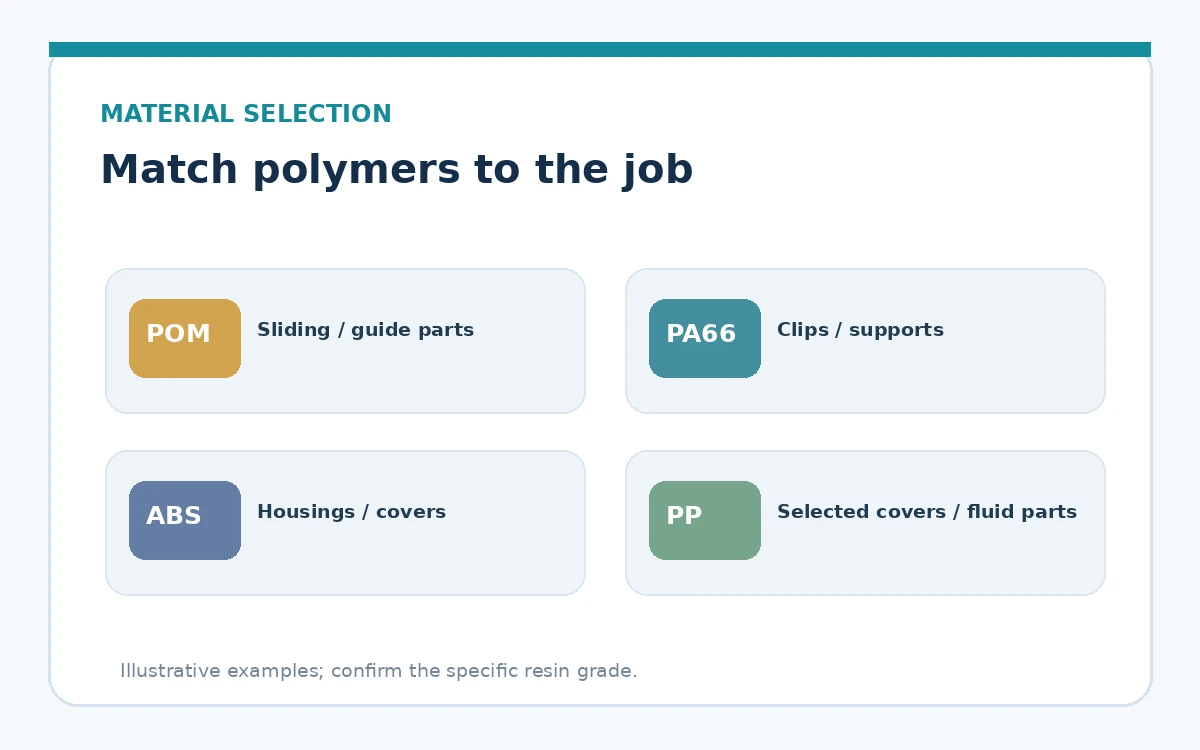
Illustration: Example application areas, not a substitute for grade-specific testing.
Design details that influence manufacturing
Material choice is only one part of the decision. Wall thickness transitions, ribs, bosses, draft angles, gate locations and expected shrinkage can affect filling, warpage, dimensional consistency and the final appearance of an injection molded component. Designs that replace metal components also require a careful evaluation of creep, stiffness, fastening and long-term loading. During development, a clear drawing package and a discussion of critical dimensions can help identify manufacturability issues before tooling. Prototype sampling and inspection against agreed acceptance criteria remain important before any volume commitment.
What buyers should include in a custom-part RFQ
A useful RFQ starts with a 3D model or drawing and specifies the working environment. Buyers should share anticipated annual demand, operating temperature, mechanical load, required tolerances, color and appearance expectations, and any chemical or regulatory exposure. If a component works in a sliding assembly, the contacting material and movement pattern are also relevant. For parts near food, medical devices or electrical systems, the intended use and required certifications must be confirmed instead of assuming a general-purpose resin is compliant. These details support more accurate material recommendations and tooling discussions.
Connecting component design with sourcing
SWKS presents a range of custom plastic injection molded parts for industrial applications. Its plastic-parts catalog provides a starting point for buyers comparing component styles and manufacturing options. Companies developing conveyor equipment, packaging machinery or automated handling systems can discuss drawings, resin options and target quantities with the SWKS team. A suitable final material and manufacturing route should be agreed after reviewing the actual part requirements. For custom-part inquiries, contact amanda@tjswks.com with STP, STEP or IGS files and any available drawings.
Related SWKS resources
Have a component drawing to discuss? Email the SWKS team or call +86-15222707659.