


Tianjin SWKS Technology & Development Co.,Ltd is one of the most reliable manufacturers and suppliers of custom pom food packaging machine pusher finger in China. If you're going to buy bulk cheap custom pom food packaging machine pusher finger, welcome to get quotation from our factory. Quality products and low price are available.
Send your custom POM food packaging machine pusher finger drawing to amanda@tjswks.com for a quotation review.
Move the Pack Through a Controlled Contact Face
A pusher finger transfers motion from a packaging machine carriage or chain attachment to the item being advanced. Its shape determines where that force reaches the pack and how the finger clears the surrounding guides. A custom POM food packaging machine pusher finger is developed around the product envelope, stroke and mounting arrangement of the line.
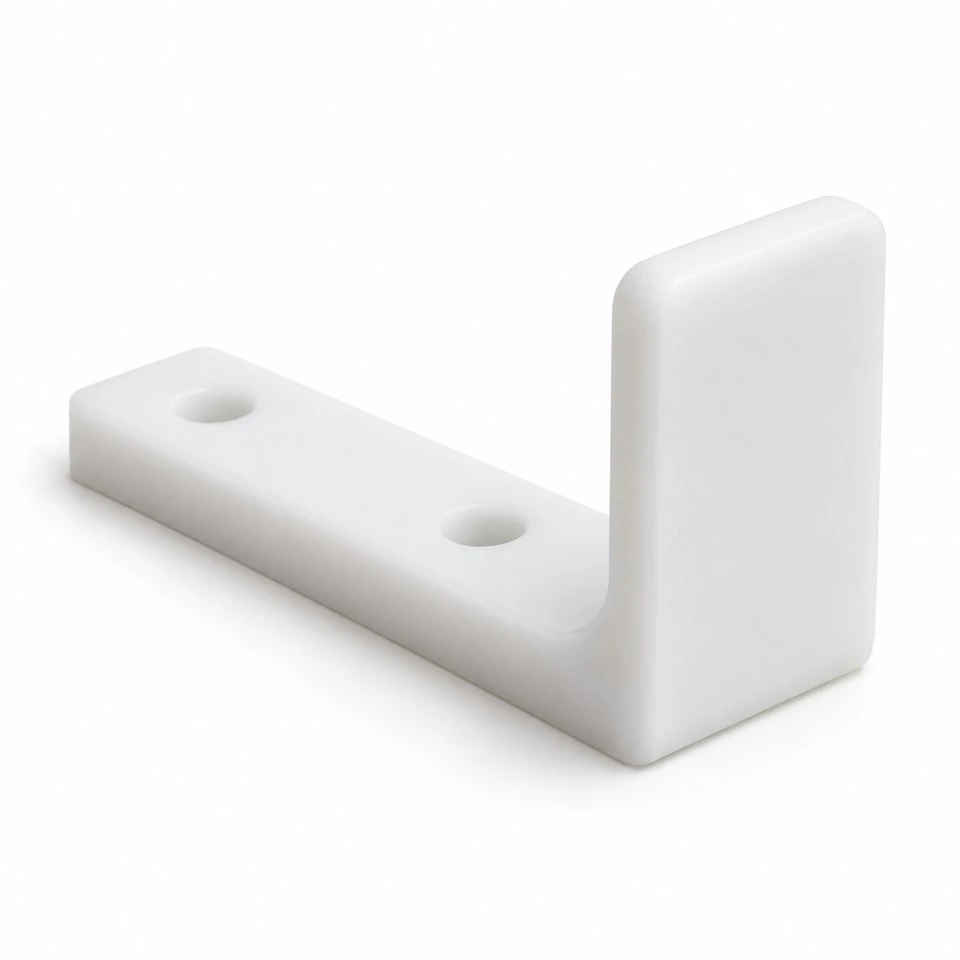
The illustrated concept uses a mounting foot and an upright pushing face with rounded edges. It represents a configurable molded component rather than a replacement for a particular machine model. Hole pattern, contact height, face width and clearance features follow the approved drawing. The product name describes its equipment application and does not establish food-contact compliance.

Identify the Surface Being Pushed
Start with the item the finger actually touches: a carton, wrapped product, tray or another carrier. The contact face should suit that surface without catching a flap, pressing into a seal or concentrating force on an unsupported area. A broad face can spread contact, but it also needs space to pass between guides and return through the mechanism.
Show the pack in its expected range of positions. Small variations in height or alignment can change where the pushing edge makes first contact. Define the acceptable contact zone and the position of any fragile packaging features. Where the process requires a shaped nose, recess or offset face, include those details in the model and the functional drawing.
Check the Forward and Return Paths
A finger that clears the pack during its working stroke can still collide on the return movement. Review the full path relative to the conveyor surface, guide rails, adjacent fingers and machine guards. State whether the finger rises, rotates or travels below the transfer surface after pushing.
Pitch and timing belong in the assembly review. The molded part does not set the machine timing by itself, but its contact position affects when force reaches the pack. Reference the working face to the mounting datums so that the installed location can be checked consistently. If multiple fingers operate together, define the permitted difference between their contact positions.
Mount the Finger Without Distorting It
The mounting foot should match the receiving carriage or attachment plate. Provide the fastener size, hole spacing, available support area and any locating shoulder. Clearance holes provide a bolt path; they do not necessarily prevent the finger from shifting under repeated load. A locating feature may be needed when the working face must return to a precise position after replacement.
Fastener loading should be reviewed with the plastic section and the supporting surface. Tightening a bolt against an unsupported area can distort the foot and change the contact-face angle. Specify the assembly procedure and consider a compression limiter or a revised load path where appropriate. Metal hardware and inserts are separate supply items unless agreed otherwise.
Choose the POM Grade for the Duty
POM, also called acetal, is a candidate for rigid moving machine components where surface contact and dimensional control matter. The selected grade must still be reviewed against load, impact, temperature and the cleaning environment. A general material designation does not establish a wear life or a maximum operating speed.
Explore our custom POM parts category for related drawing-based components. Material selection remains specific to each part and its application. Color, additives and any requirement for material documentation should be included in the quotation information.
Confirm Food-Contact and Cleaning Requirements
If the finger directly contacts food, specify the applicable food-contact requirements before material approval. The exact resin grade, additives and colorant system need supporting documentation for the intended use conditions. Compliance cannot be inferred from a white appearance, the word POM or installation on a food packaging machine.
Describe the cleaning agents, concentration, temperature and exposure duration. Also identify whether food residue can collect at the base-to-face transition or around mounting hardware. The geometry should allow the cleaning access required by the equipment design. Sterilization suitability and compatibility with a particular wash routine require confirmation rather than a general assumption.

Review the Molded Transition and Contact Edges
The change from mounting foot to pushing face is a useful focus for tooling review. Local thickness, fillets and any supporting ribs affect how the part can be molded and how it responds to bending. A heavy transition can influence shrinkage, while an overly thin section may not suit the required load. Agree the geometry around the actual operating force.
Mark the working face and mounting datums on the drawing. Gate vestige, ejector marks and parting lines should be located with these surfaces in mind. Define acceptable flash and edge condition where the finger touches packaging. A small projection at the wrong location can affect handling even when the overall dimensions appear correct.
Approve Samples on the Intended Mechanism
Inspect the hole pattern, mounting-foot seating, face position, contact width and overall envelope. Then evaluate samples through the complete machine movement under an agreed trial procedure. Check for pack damage, mounting movement, unintended contact and permanent deformation after the required loading sequence.
For repeated duty, define a representative cycle test and the permitted change in geometry or surface condition. Reassess the assembly after the specified cleaning exposure. Establish acceptance criteria before sampling so that cosmetic variation is distinguished from a defect that changes timing, clearance or contact with the pack.
Information for a Custom Quotation
Provide a STEP, STP or IGS model with a dimensioned drawing, mounting details and the pack outline. Include the stroke, working-face position, loads, POM grade if selected, color and expected quantity. State direct food-contact requirements and cleaning conditions separately so that material documentation and validation can be included in the review.
For a custom POM food packaging machine pusher finger made to your design, contact amanda@tjswks.com with your drawing and application details.
Hot Tags: custom pom food packaging machine pusher finger, China, suppliers, manufacturers, factory, bulk, cheap, low price, quotation, pom electronic parts, pom packaging parts, pom parts, pom pedestals, pom threading parts, pom wheels


