


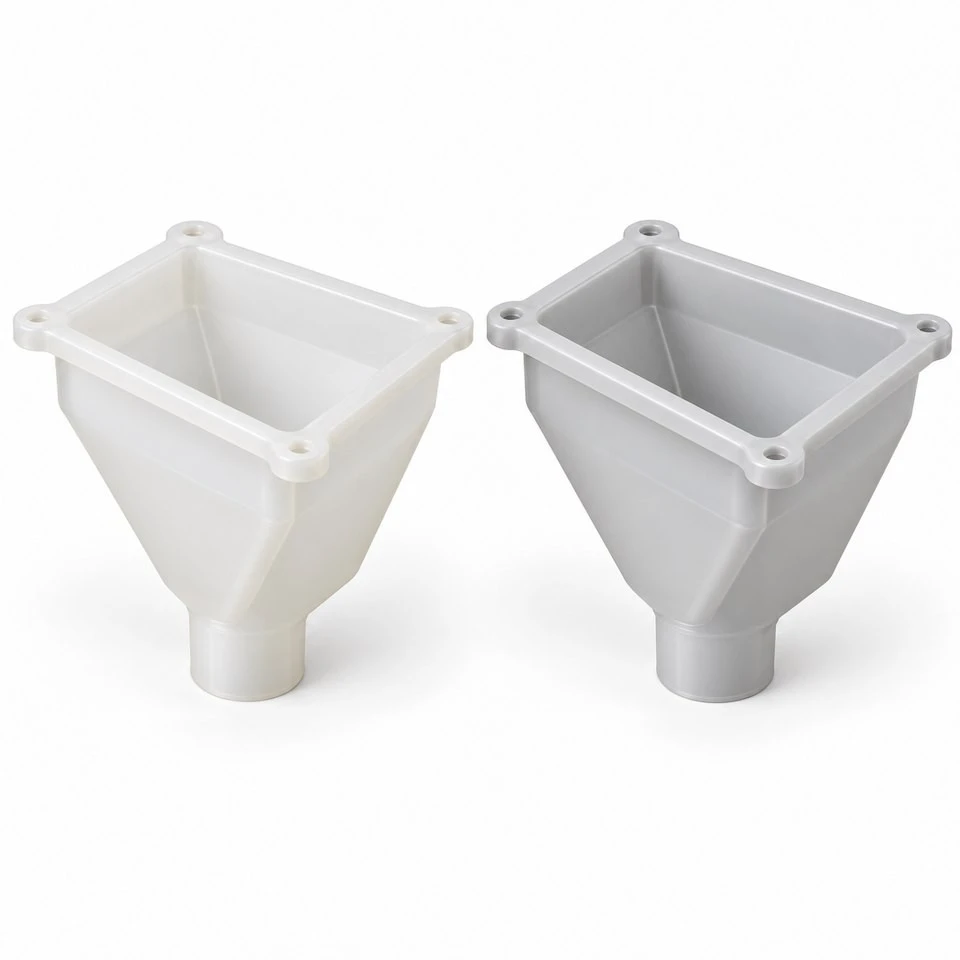
Tianjin SWKS Technology & Development Co.,Ltd is one of the most reliable manufacturers and suppliers of custom pp powder dosing funnels in China. If you're going to buy bulk cheap custom pp powder dosing funnels, welcome to get quotation from our factory. Quality products and low price are available.
Custom PP Powder Dosing Funnels
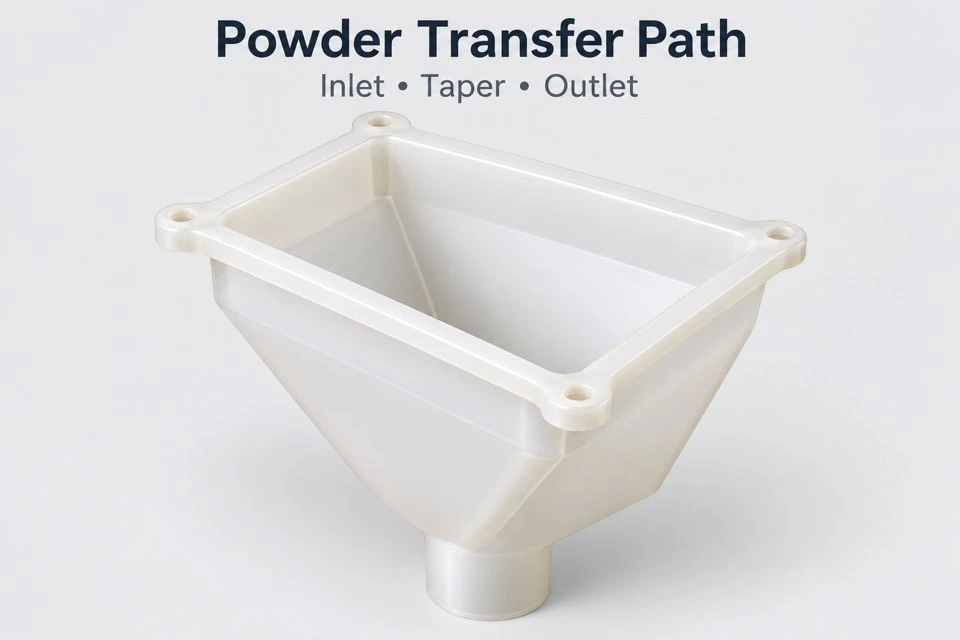
Powder transfer often fails at a short connection that receives less attention than the feeder itself. A ledge catches material, an outlet misses the receiving throat, or a funnel holds residue after a batch change. SWKS develops custom injection molded polypropylene funnels around these practical interfaces. A rectangular inlet, tapered chamber and round outlet can be combined into a single component sized for the machine. Discuss your layout with amanda@tjswks.com, including the powder characteristics and the surrounding equipment.
Material: ABS/POM/PA66/PP/PC/PA/PU/TPE/TPU etc.
Processing Service: Injection
Drawing: STP/STEP/IGS
Contact: amanda@tjswks.com / 0086-15222707659
What role does the funnel play in a dosing system?
This component receives material from an upstream feeder and directs it into the next opening. It can bridge a rectangular discharge window to a circular tube while keeping the transfer path within a restricted space. The funnel itself is not a weighing device, screw feeder or flow controller. Its geometry supports the process, but the accuracy of each dose depends on the complete feeding arrangement, controls and material behavior. Treating the funnel as a passive transfer component keeps the specification clear.
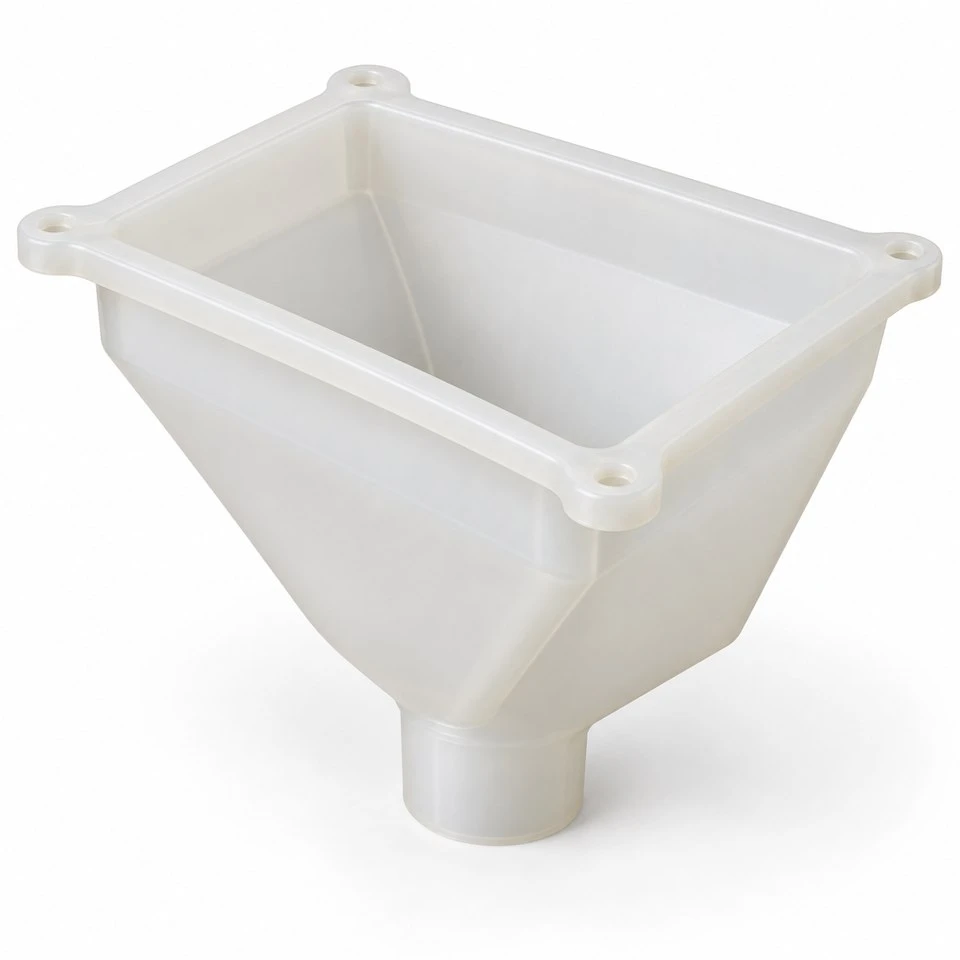
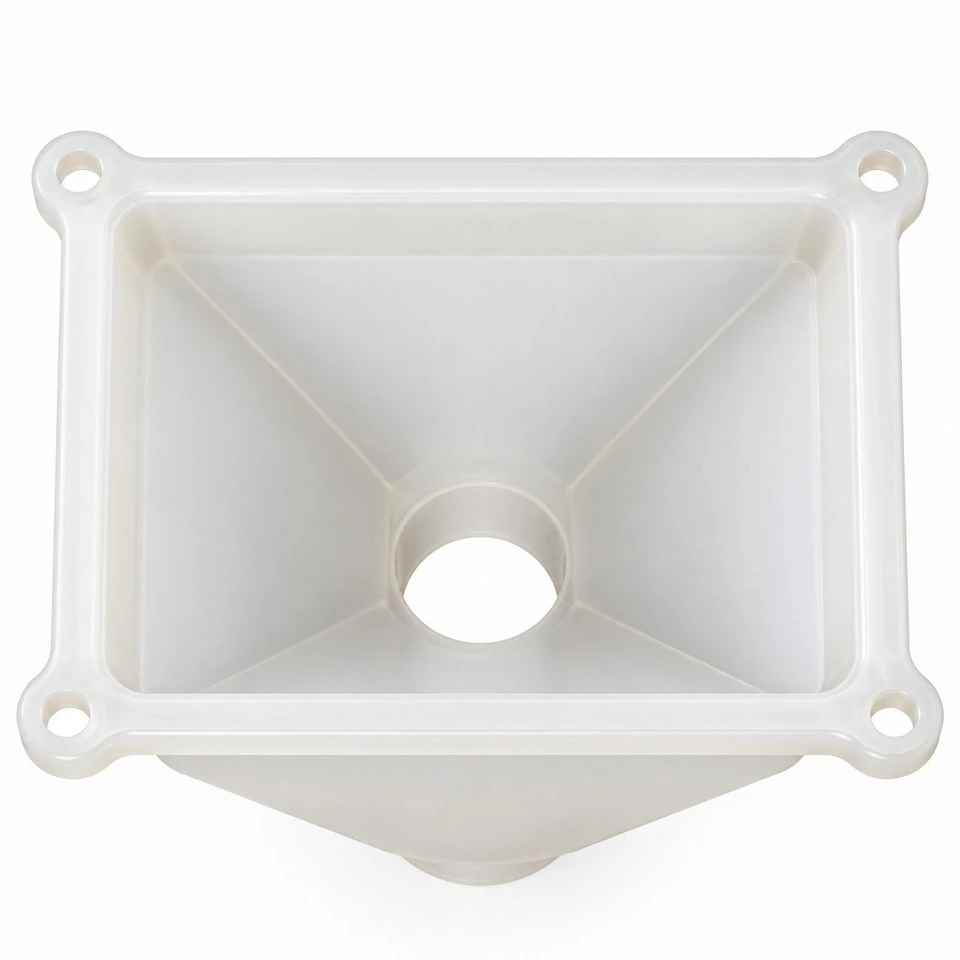
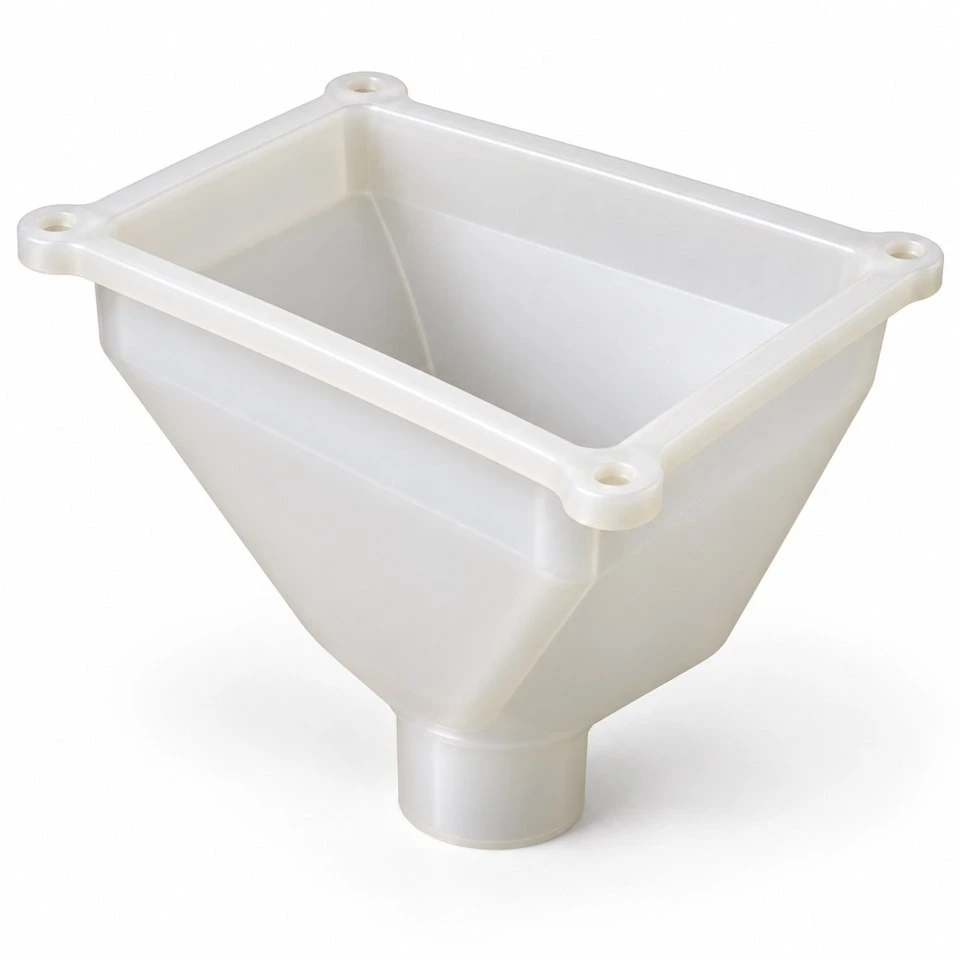
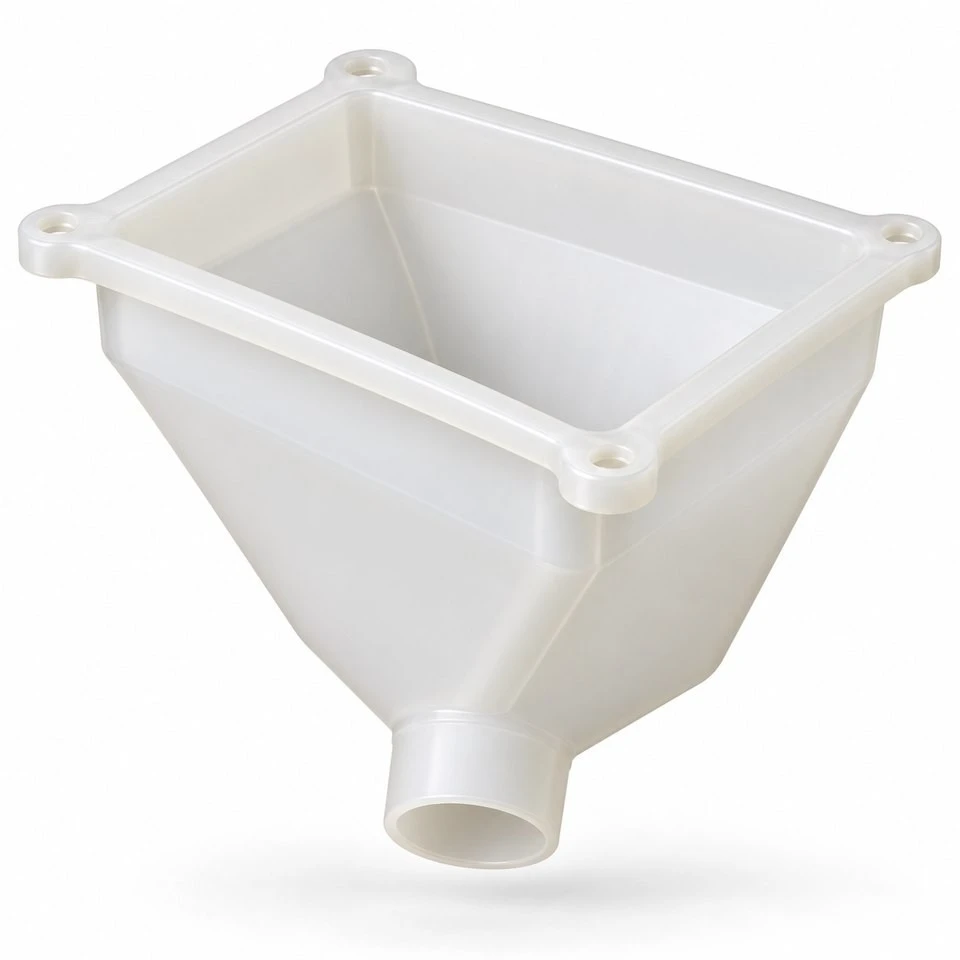
Potential installations include enclosed equipment handling dry powders or small granules, subject to application review. A dosing funnel may be fixed beneath a hopper or removable for cleaning. It may also need an offset outlet to clear a frame member. The concept images show one possible form with mounting ears and a smooth chamber. They do not establish a standard capacity, a food-contact approval or suitability for a hazardous powder.
Which powder information changes the proposed shape?
Particle size alone does not explain how a powder will move. Supply the bulk density, approximate particle distribution, tendency to absorb moisture and whether the material packs or clings to nearby surfaces. Fine cohesive powders can behave differently from free-flowing granules even when both pass through the same nominal outlet. If you have production observations, describe when a bridge develops, where deposits remain and whether the problem changes after the machine has stood idle.
Also identify the transfer method. Material falling from a small vibrating tray enters the funnel differently from material pushed out by a screw. A concentrated stream can strike one wall and build a deposit, while a wider curtain may need a larger inlet. Photographs or a short operating video can help locate the actual impact zone. The geometry should follow that observed path instead of assuming that every particle arrives centrally and falls vertically.
How should the inlet match the upstream discharge?
The useful receiving area is the clear opening inside the flange, not the outside flange size. Show the upstream discharge outline and its position relative to the mounting holes. Allow for assembly variation and the full spread of material leaving the feeder. A flange that visually covers the discharge can still leave a narrow ledge exposed inside the machine. Those hidden ledges are easy to miss in a top view and deserve a section through the interface.
Where a gasket or overlapping chute is required, identify which component carries the seal and which surfaces contact it. Fastener force should be distributed without pulling the inlet out of shape. A removable funnel also needs enough access for the operator to release it safely. These requirements determine whether corner ears, a continuous flange or another locating arrangement makes sense. The preferred attachment should be settled alongside the cleaning procedure rather than added after the chamber is finalized.
Why does outlet geometry need more than a diameter?
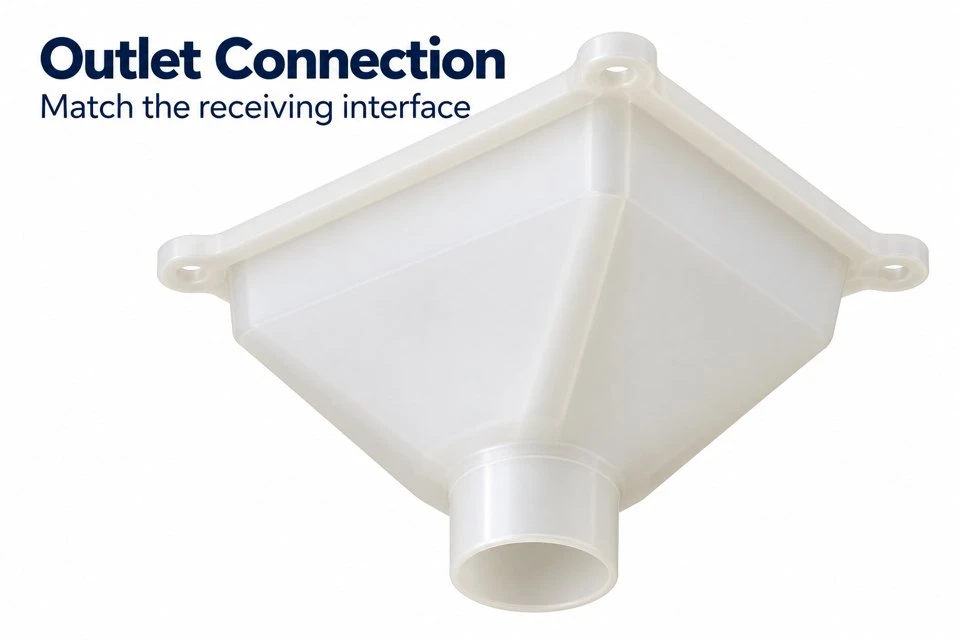
Specify the receiving tube's internal opening, outside envelope and insertion depth. Then define whether the funnel spigot enters that tube, sits above it or connects through a flexible sleeve. Each arrangement gives a different tolerance stack. A tight external fit can distort a thin outlet, while an oversized gap may allow powder to escape. The drawing should distinguish a locating fit from a sealing fit and show any clamp or sleeve used in service.
The transition into the outlet matters as much as the straight spigot. A sudden step can retain powder even when the outlet diameter appears generous. An offset outlet introduces unequal wall lengths, so inspect the shallower side for places where material may pause. The required outlet size must be evaluated with the real powder and transfer rate. No universal throat diameter or minimum wall angle can guarantee discharge across every material and operating condition.
Can polypropylene solve sticking or static by itself?
Natural PP is a material option for a lightweight molded transfer component, but it should not be described as automatically antistatic or suitable for every chemical. Surface charging, powder adhesion and cleaning behavior depend on the application. A plain polymer funnel is not a substitute for a reviewed static-control system. If the process involves combustible dust, define the equipment safety requirements before selecting a conventional insulating plastic component or an alternative material approach.
Disclose solvents, cleaning solutions and any warm product passing through the funnel. The local exposure includes both the process and the wash cycle. A grade chosen for room-temperature dry transfer may not match a hotter or chemically different cleaning routine. Where a regulatory declaration or a specific resin grade is required, state that requirement in the enquiry. Compliance must be tied to the agreed material and intended use rather than inferred from the letters PP.
How can the internal path be made easier to clean?
Start by identifying the surfaces that operators can actually reach. A broad upper opening may allow direct wiping, while a long narrow spigot may need a dedicated brush or a different cleaning method. Avoiding unnecessary internal shelves can reduce places where residue collects. Internal transitions should be considered together with access, not treated as a cosmetic smoothing exercise. A surface that looks clean from above can still hold powder on its underside or behind an overlap.
Ask whether the funnel will be removed between batches, washed in place or wiped while installed. Removal introduces handling and storage requirements: the outlet should not become the resting foot if damage there affects fit. Washing introduces drainage and drying questions. Inspect the part in its actual cleaning orientation, because a pocket that empties during production may hold rinse water when the component is turned over. The final cleaning validation belongs to the user's process.
What supports the flange without stressing the chamber?
Mounting ears provide convenient access for fasteners, but their position should distribute the assembly load. A thin ear pulled against an uneven frame can bend the flange or twist the outlet away from the receiving tube. Provide the supporting surface and the intended tightening method. If metal washers, sleeves or spacers are used, include them in the assembly model. Their contact area can change the local deformation significantly compared with a screw head bearing directly on plastic.
Consider the weight of retained material as well as the component's own weight. A blocked outlet can leave more powder in the chamber than normal running conditions suggest. Nearby vibration can add repeated motion at the attachment points. The design review should identify these loads without assigning an unsupported load rating. Prototype installation checks can reveal rubbing, movement or flange lift that a standalone visual inspection would not show.
Which details influence injection mold construction?
A hollow tapered body needs an opening direction that allows its internal core to withdraw. Draft, outlet position and the relationship between the chamber and mounting flange should be reviewed together. A convenient mounting feature can create an undercut if it hooks behind the mold opening direction. Where possible, discuss open features and accessible shutoffs early. The aim is a repeatable molding arrangement that preserves the functional passage, not simply a low part count.
Uniform wall sections help manage cooling, but the flange and ears often need a different local treatment from the chamber. Thick isolated sections may cool differently and affect flatness. Ribs may be considered externally where they do not obstruct cleaning or mating hardware. Gate and ejector locations also need attention: a raised vestige inside the material path could collect residue or interfere with wiping. Mark these functional restrictions explicitly on the drawing.
How should samples be checked before production approval?
Measure the clear inlet, mounting-hole pattern, flange seating face, outlet dimensions and outlet position against agreed datums. A simple assembly fixture can confirm whether the part fits the real equipment envelope. Flatness should be evaluated in the relevant mounting condition. Measuring an unsupported flexible flange and measuring a correctly supported installed flange can produce different observations, so the acceptance method needs to be defined rather than left to individual judgement.
A transfer trial should use representative powder, realistic humidity and the actual feeding pattern where practical. Observe the first discharge, steady operation, stopping and restart. Record residue after a defined quantity has passed through, and inspect what happens when the machine pauses. If cleaning is part of the acceptance, repeat the agreed cleaning sequence and inspect the hidden transitions. These trials establish application evidence; a water-pour demonstration cannot stand in for a cohesive-powder test.
What documents help us quote the correct custom funnel?
Send a three-dimensional model with a sectioned drawing showing the chamber, outlet and mounting interface. Include the equipment space claim, the mating discharge and receiving tube, and any zones that must remain accessible to the operator. State the resin requirement, color, trial quantity and expected order quantities. If the geometry is still being developed, identify the dimensions that are fixed by existing equipment and those that can change during the moldability review.
For a replacement funnel, explain the reason for replacement rather than sending only a worn sample. Cracked mounting ears, accumulated powder and a damaged spigot point to different issues. Photos of the installed component and residue pattern can make the discussion more specific. Tooling scope, sample evaluation and production supply can then be quoted around a defined version. Contact amanda@tjswks.com with your drawings, powder description, material requirements and quantities for a custom project review.
Hot Tags: custom pp powder dosing funnels, China, suppliers, manufacturers, factory, bulk, cheap, low price, quotation, pp cold resistant parts, pp dimensionally stable parts, pp oil resistant parts, pp plastic assembled parts, pp plastic finishing parts, pp semi rigid parts


