


Hot runner and cold runner injection molding differ in what happens to the plastic inside the feed channels. A cold runner solidifies and is removed from the mold with each shot. A hot runner keeps plastic molten in a heated delivery system between cycles. For an OEM buyer, the useful question is which arrangement fits the resin, order pattern and total project cost.
This guide concerns thermoplastic injection molding. It does not cover silicone cold decks or thermoset processing. For a drawing-based review, contact amanda@tjswks.com.
What Is a Cold Runner Mold?
In a cold runner tool, channels machined into the mold carry plastic from the sprue toward the cavities. The feed network cools into a solid runner that must be separated from the molded parts. Depending on gate and tool design, separation may be automatic or require an additional operation.
The relatively simple construction can suit projects where initial tooling expenditure and straightforward maintenance matter. However, the quote should account for runner handling and the material used outside the finished parts. A runner is not automatically reusable in the same product: the purchasing specification must establish whether regrind is permitted.
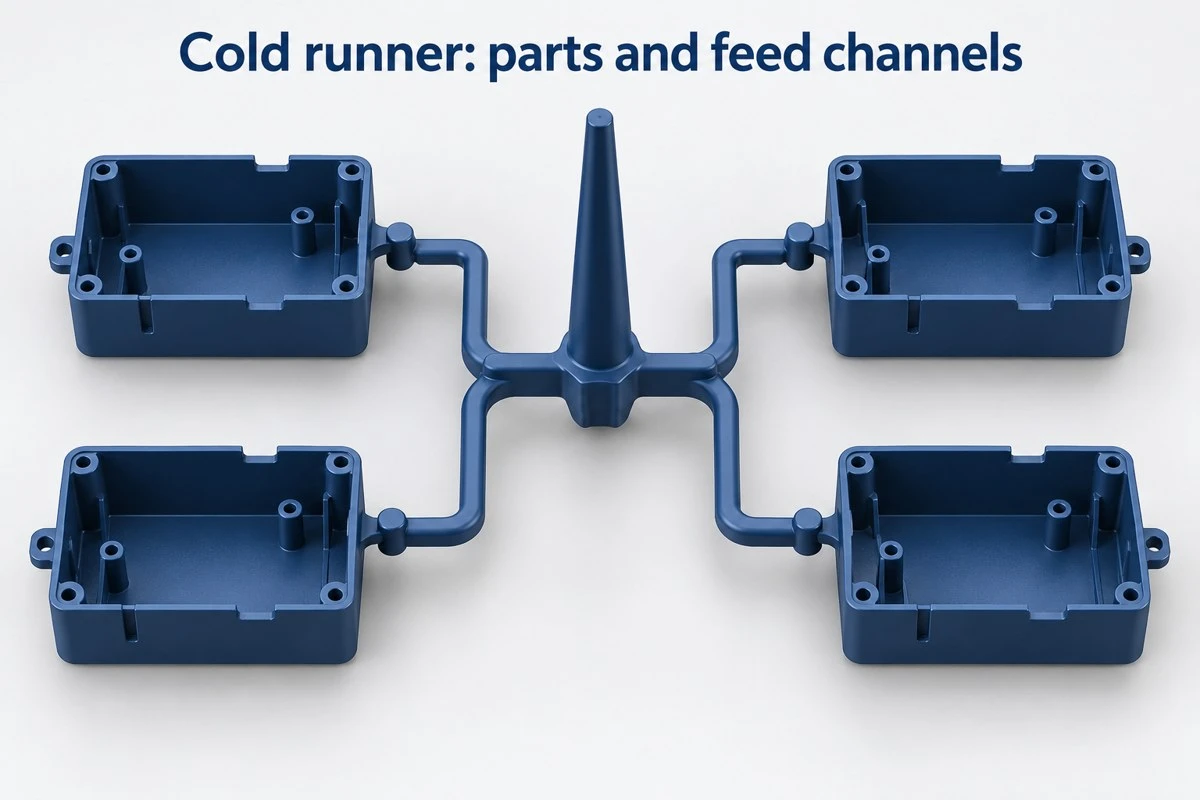
Concept illustration of a cold-runner shot; geometry is illustrative.
What Is a Hot Runner Mold?
A hot runner uses a heated manifold and nozzles to deliver molten plastic to the cavities. The cavity still cools so that the part can be ejected; the melt-delivery channels are controlled separately. Direct hot gating can remove the solid cold-runner network from the normal shot, although some tools combine a hot runner with a smaller cold sub-runner.
This adds equipment and maintenance requirements, including heaters, temperature sensing and a controller. Potential savings in resin and handling must justify the investment. Hot runner does not mean zero start-up scrap, zero purge material or guaranteed defect-free parts.

Concept illustration of heated melt-delivery equipment, not a SWKS machine photograph.
Hot Runner vs Cold Runner: A Buyer Comparison
| Decision point | Cold runner | Hot runner |
|---|---|---|
| Initial tooling | Generally simpler feed system | Additional manifold, nozzles and controls |
| Feed-channel material | Solid runner removed each shot | Melt retained in heated channels; sub-runners may remain |
| Color changes | Often simpler feed-system clean-out | Changeover depends on flow-path design and purge procedure |
| Maintenance | Runner, gate and separation features | Also heaters, sensors, wiring and nozzle components |
| Production planning | Consider for short or frequently changing batches | Evaluate for stable repeat demand and runner savings |
| Part quality | Requires suitable filling, packing and cooling | Still requires suitable filling, packing and cooling |
Compare Cost per Accepted Part, Not Only Mold Price
Ask both proposals to use the same drawing revision, resin, cavity count, inspection scope and order schedule. Otherwise, a lower piece price may simply reflect different assumptions. Separate tooling investment from recurring production charges.
A useful worksheet has rows for finished-part material, runner material that cannot be reused in the agreed process, machine time, separation work, start-up losses and planned maintenance. Avoid counting the same saving twice. For example, if the quoted unit price already includes runner separation, do not add a second independent separation allowance without checking the quote.
Simplified break-even quantity = additional hot-runner investment / net saving per accepted part. Use comparable currencies and a positive net saving. This screening calculation does not include financing or the time value of money.
An Illustrative Calculation
Suppose two hypothetical quotations differ by USD 4,800 in initial investment. Assume the hot-runner option saves a net USD 0.04 for each accepted part after the recurring costs included in the comparison. The arithmetic break-even is 4,800 / 0.04 = 120,000 accepted parts.
At 20,000 accepted parts a year, that equals six years of demand; at 200,000 a year, it equals 0.6 years. Neither result is a promised payback. The example uses invented planning inputs, not SWKS prices, measured cycle data or a customer case. Buyers should replace every input with project quotations and realistic demand.
Then test sensitivity. If net savings fall to USD 0.02, the same investment needs 240,000 accepted parts. If a design revision ends the program after 60,000 parts, the original 120,000-part calculation no longer supports recovery within that program. This is why the expected drawing life matters alongside annual volume.
Why Batch Size and Color Changes Matter
Annual demand does not describe the production schedule by itself. A single long run and dozens of small color-specific runs can have different start-up and changeover burdens. Give the toolmaker the planned quantity per batch, number of colors and expected material changes.
Hot-runner suitability also depends on the exact resin and its processing limits. Residence time, channel layout and temperature control need review with the material guidance and system supplier. Do not assume that every grade in ABS, PP, POM, PA66 or PC can use the same feed-system configuration.
Will a Hot Runner Always Shorten Cycle Time?
No. Eliminating a solid runner can help where runner cooling or removal constrains the cycle. The finished part may still govern cooling time. Ask for an estimate based on the proposed part, runner and tool layout, followed by confirmation during trials. Avoid applying a universal percentage reduction.
Gate appearance also needs its own acceptance criteria. Thermal and valve gates have different arrangements, and either system needs a suitable gate location. See our guide to injection molding gate location for the separate design discussion.
What Should You Ask Before Approving the Runner System?
- Does the quotation state the exact resin, cavity count and runner arrangement?
- What are the estimated part and runner weights, and is regrind allowed?
- Which quantities, colors and batch sizes support the unit price?
- What gate vestige and cosmetic limits are included in sample approval?
- Who supplies the controller, replacement components and maintenance instructions?
- Which estimates will be verified at the mold trial?
Request the cold-runner and hot-runner assumptions side by side when both are feasible. For broader budgeting, read how much custom plastic injection molding costs, or explore our custom plastic injection parts.
Email amanda@tjswks.com with your STP, STEP or IGS drawing, resin specification, expected program volume and batch schedule to discuss a suitable tooling proposal.