


PP or Nylon: How Should You Choose Materials for Agricultural Plastic Parts?
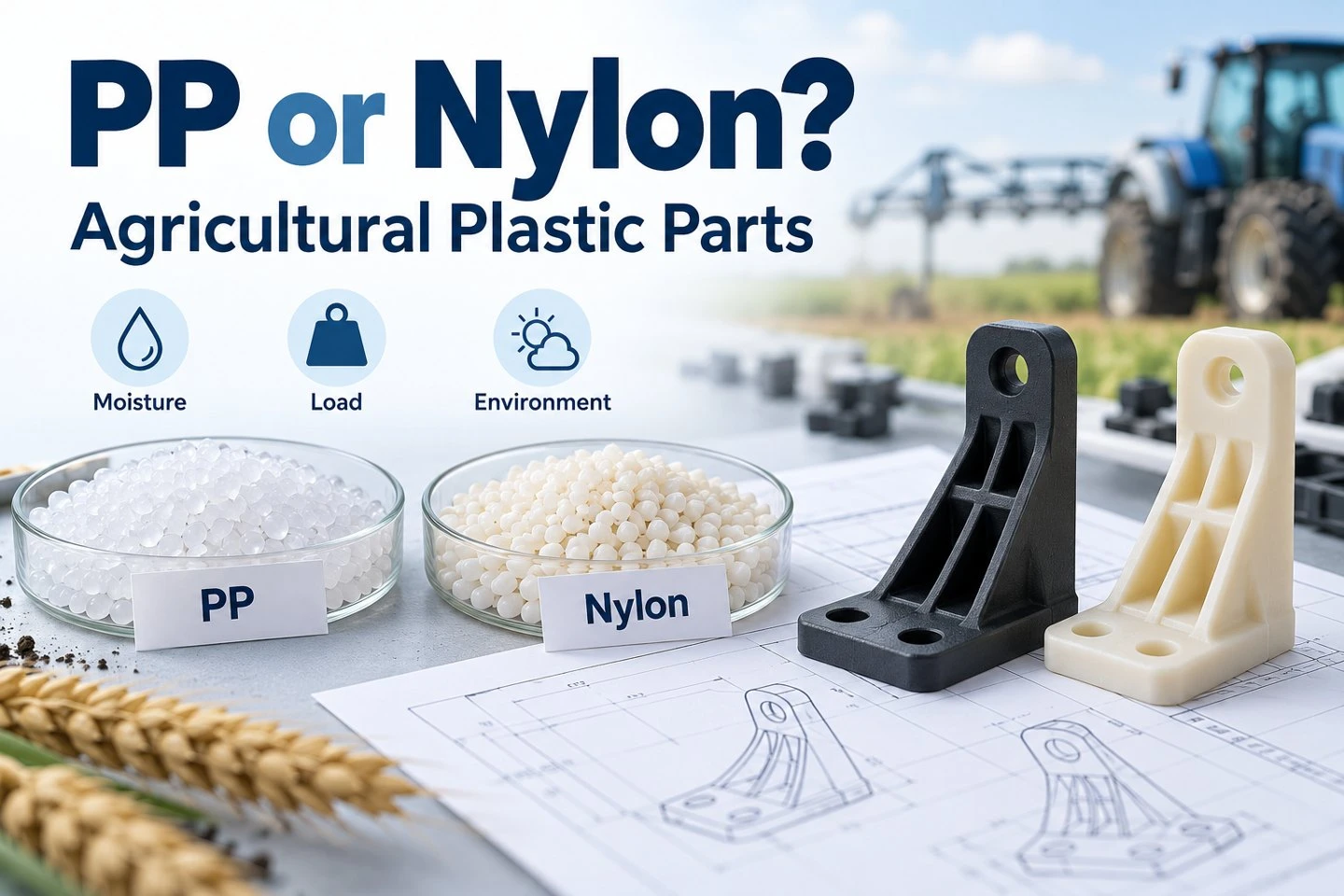
A plastic component on an agricultural machine rarely works in one controlled environment. It may be assembled in a dry workshop, stored outdoors, washed after use, and then exposed to soil, vibration and changing weather. Choosing a resin by its family name alone can overlook the conditions that determine whether the finished part fits and functions.
Polypropylene (PP) and nylon are useful candidates for many custom molded components, but neither is a universal answer. A seed cup, protective cover, pipe clamp and locating bracket can require very different behavior. This guide explains how to compare the candidates through practical engineering questions, define the information needed for a quotation, and approve a material together with the actual molded part.
What must the component do before you compare materials?
Start with the job of the component. Does it guide an item, protect a moving mechanism, locate another part, retain a hose or carry an assembly load? Identify the surfaces that actually perform that job. A cover may tolerate visible movement while a sensor mount may fail its purpose after a small change in position. Both can appear equally robust in a photograph.
Write down normal operation, assembly and foreseeable service conditions separately. Include fastener tightening, maintenance removal, accidental knocks and storage. Specify what failure means: cracking, excessive movement, loosening, loss of clearance, interference or unacceptable wear. These definitions make the material discussion much more useful than a request for a strong plastic.
Also identify the consequence of failure. A cosmetic cover and a component near a moving drive need different approval effort. If the part performs a safety function, its requirements and validation should be established by the responsible machine designer. Do not infer suitability from a similar-looking component used elsewhere.
When is PP worth evaluating, and when should nylon enter the shortlist?
For many unfilled grades, PP offers low density, low moisture uptake and a relatively flexible response compared with common engineering nylons. It can be worth evaluating for covers, guides and other components where the design benefits from those characteristics. However, PP grades differ: homopolymer, copolymer, filled and modified grades should not be treated as interchangeable materials.
Nylon also describes a family rather than one specification. PA6, PA66 and modified or reinforced grades can behave differently. Nylon is often considered when stiffness, mechanical loading or a sliding interface is central to the application. That initial shortlist still requires grade data, environmental review and tests of the proposed geometry.
Use the following questions to organize a comparison. The table is a decision aid, not a ranking or a substitute for a material datasheet.
| Requirement | Question for the material review | Evidence to request |
|---|---|---|
| Weight and flexibility | Does the part need to deflect or remain accurately located? | Grade density, stiffness data and an assembly trial |
| Moisture-sensitive fit | Will humidity or water change a critical clearance? | Conditioning requirements and dimensional checks |
| Repeated or sustained load | How long is the force applied, and at what temperature? | Relevant long-term data and a functional test |
| Outdoor service | Which weather, fluids and cleaning conditions apply? | Grade-specific information and exposure testing |
| Manufacturing repeatability | Can the critical interfaces be produced consistently? | Mold review, sample inspection and process records |
Why can moisture change a nylon part's fit?
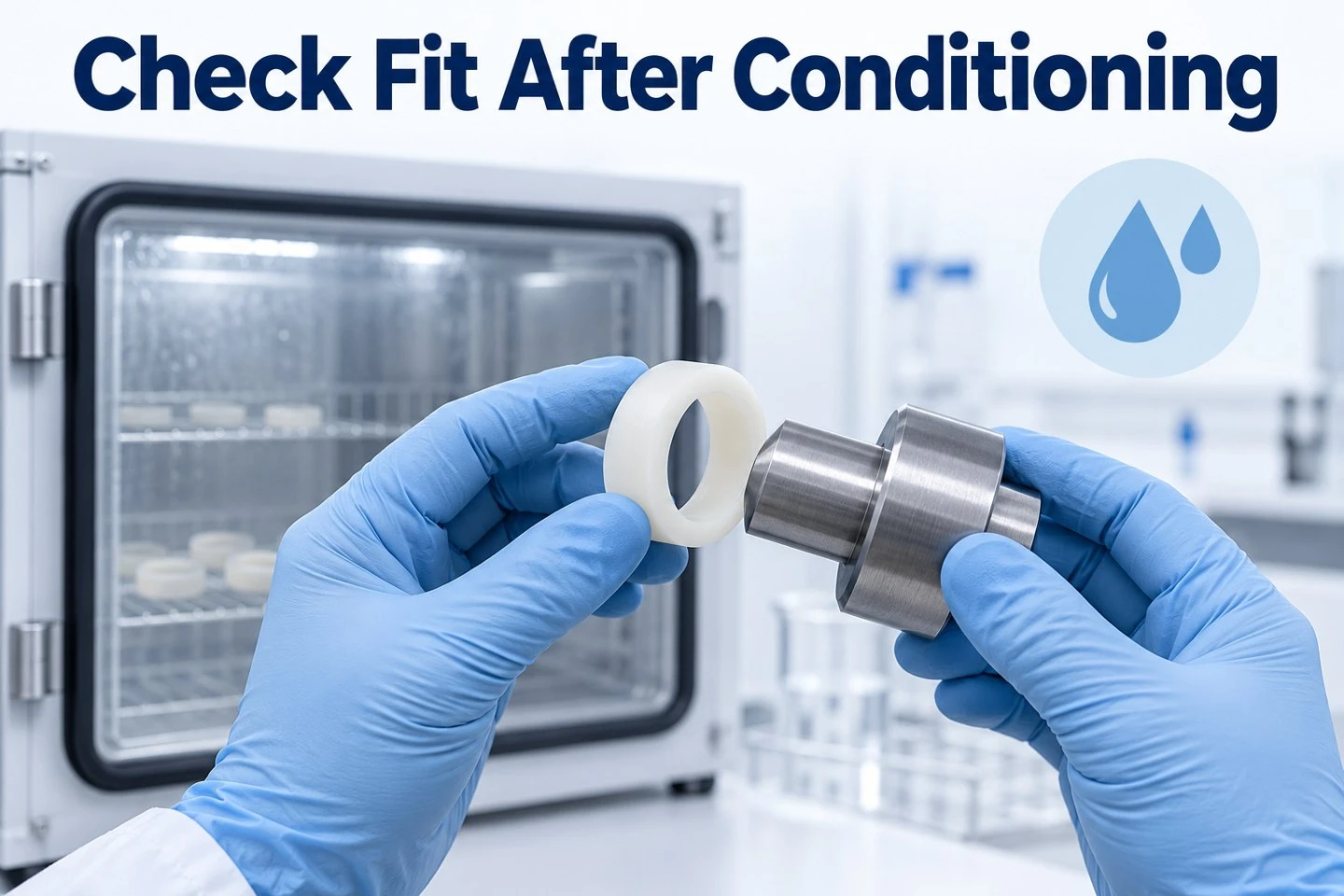
Common PA6 and PA66 materials absorb moisture. The resulting change can affect dimensions and mechanical behavior, so a measurement immediately after molding may not represent the condition in service. The amount and rate depend on the grade, geometry and exposure. A single generic swelling allowance is therefore a poor basis for every nylon design.
Consider a ring fitted over a shaft or a clamp assembled around a tube. The drawing must define which dimension matters, the mating component, the allowable fit and the condition at inspection. Agreement on a nominal bore alone leaves an important question unanswered: is that bore being checked in a dry state or after an agreed conditioning procedure?
Ask the material supplier and molder to define a suitable conditioning and measurement plan. Record temperature, humidity, exposure duration and the point at which measurements are taken. Where both dry storage and wet operation are credible, evaluate those conditions as part of the application review. Do not compare a dry nylon sample with a differently conditioned alternative and assume the results describe only the resin choice.
PP generally has much lower moisture uptake than common PA6 and PA66, but that does not eliminate the need to assess temperature, molding variation or assembly effects. Low moisture uptake answers one question; it does not establish the complete dimensional capability of the finished part.
Are stiffness, strength, impact resistance and creep the same thing?
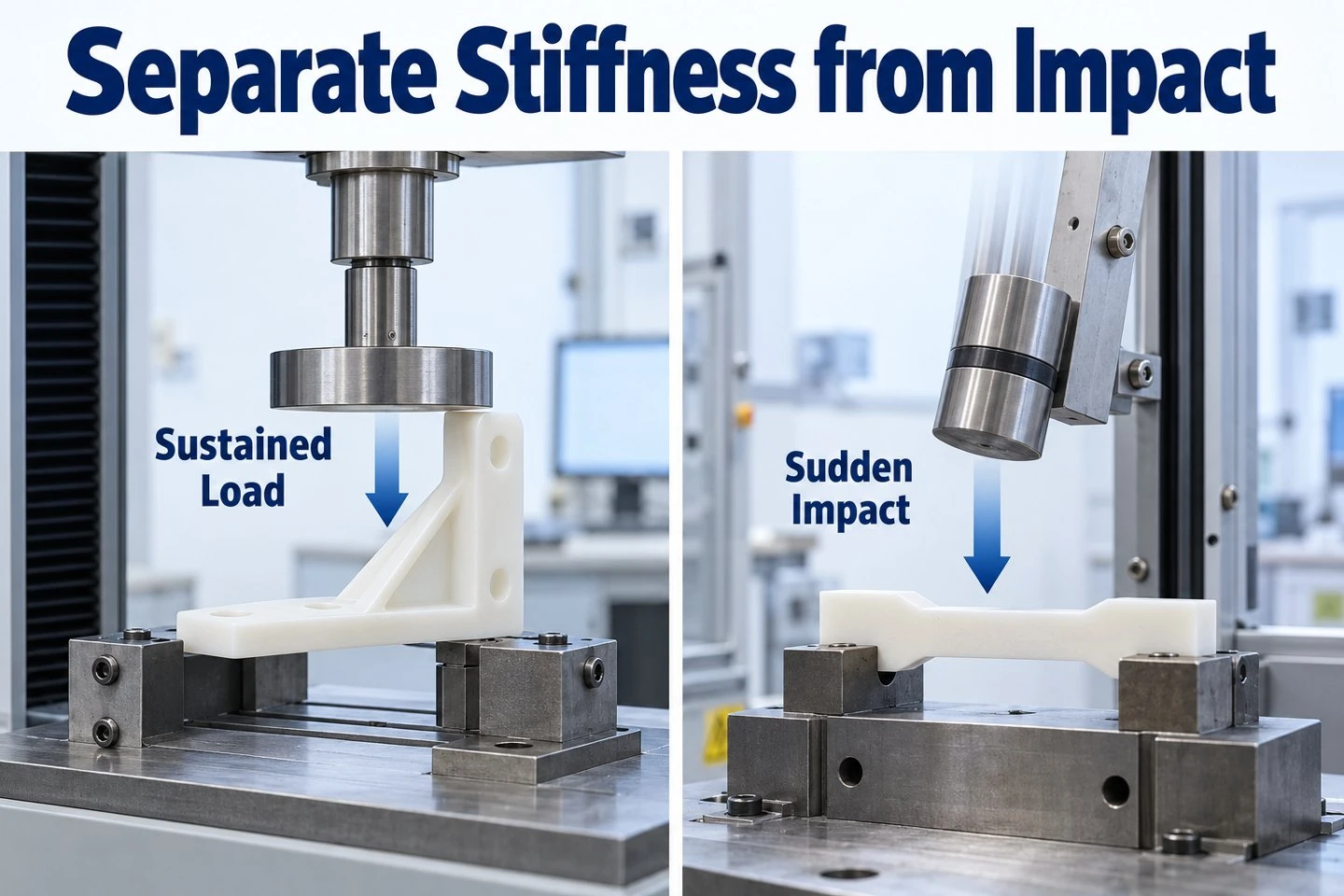
These terms describe different behavior. Stiffness concerns how much a part deflects under load. Strength concerns the stress associated with a defined failure or yield condition. Impact behavior concerns a sudden event. Creep concerns deformation developing over time under sustained load. A material that looks attractive in one comparison may still require careful review in another.
For an agricultural bracket, begin with the actual force path. Identify where the load enters, where the component is supported, and whether the force is steady, cyclic or occasional. Include the operating temperature and the duration of loading. A short bench pull cannot by itself demonstrate that a bolted support will retain its position through an extended working period.
For a protective cover, the more relevant event may be a knock during maintenance. Test the part with its real supports and attachment method. A freely held sample can behave differently from one restrained by screws. If cold-weather operation matters, include that condition in the agreed evaluation rather than relying only on a room-temperature demonstration.
Where fastener clamping is important, review the joint as an assembly. The designer may need to consider bearing surfaces, washers, controlled tightening or other joint details. A resin substitution alone may not solve loosening or local deformation. Establish an acceptance criterion such as retained clearance or allowable movement, rather than recording only whether the sample broke.
Does glass reinforcement automatically make a better component?
Glass reinforcement can increase stiffness and strength relative to the corresponding unfilled resin, but it also changes other behavior. Impact response and molding shrinkage need fresh review. Fiber orientation can make properties and shrinkage depend on direction. A reinforced grade should therefore be evaluated as a specific material choice, not described simply as an upgraded version of the original.
Discuss the load direction, gate location and critical interfaces before finalizing the tool. A hole, rib or change in section can influence flow and local fiber orientation. The mold designer and material specialist should consider these effects together. No single reinforcement percentage guarantees that a complicated geometry will meet its requirements.
If a part must flex during assembly, test that operation using the selected grade. Repeatedly bending a prototype made from another material provides limited evidence. Record insertion force, visible damage and retention after the intended number of assembly cycles. The same principle applies to features that operators regularly remove for cleaning.
How should water, chemicals, sunlight and dirt be assessed?
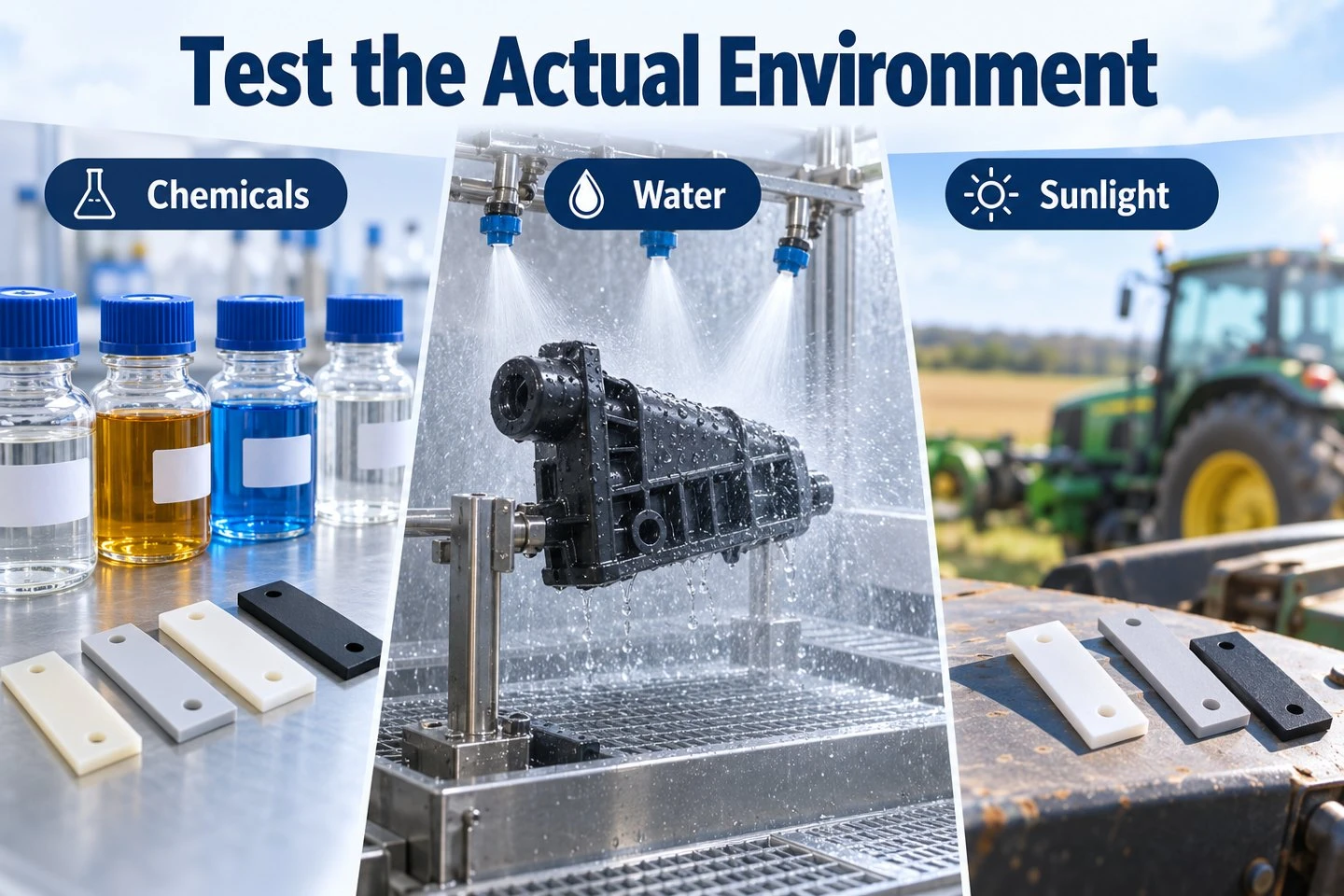
List the actual exposure rather than writing outdoor resistant or chemical resistant on the drawing. Agricultural service can involve wash water, cleaning agents, fertilizers, lubricants and other fluids, but not every component encounters all of them. Identify the substance, concentration, temperature, contact duration and whether the component is simultaneously loaded.
Ask for compatibility information for the exact grade and relevant conditions. If the available data does not match the application, agree on a representative test. Check function after exposure as well as appearance. A sample that still looks normal may have changed in fit, stiffness or retention. Record the fluid used so future batches can be compared against the same procedure.
For sunlight exposure, specify the required service conditions and review a suitable stabilized grade. Color alone is not proof of outdoor durability. Nor does a general statement about the polymer family establish a service life. If accelerated exposure testing is used, agree on the method and interpretation with the responsible specialists; avoid claiming that a short demonstration represents years in every climate.
Dirt adds another practical question. A sliding interface tested clean and dry may behave differently with soil trapped between the surfaces. Evaluate the mating material, movement, contamination and cleaning method together. Design choices such as access for cleaning or a replaceable wear component may matter as much as the initial resin shortlist.
Can one drawing be molded in either PP or nylon without changes?
A material change should trigger a design and tooling review. Different grades can require different processing conditions and shrinkage allowances. Features such as ribs, bosses, transitions and assembly interfaces must be checked against the selected material and the available process. Do not promise that an existing tool will produce the same dimensions after a direct resin substitution.
Begin the review with the functional datums and interfaces. Mark the dimensions that control assembly and explain why they matter. Separate these from general dimensions that allow more variation. This helps the molder focus inspection and any necessary tool adjustment on the features that determine performance.
Prototype methods also need to be identified. A machined or printed model is useful for checking access, overall form and assembly sequence, but it does not fully reproduce injection-molded material behavior. State which questions each prototype can answer. Reserve final production approval for samples made from the agreed grade using a representative manufacturing process.
What validation sequence gives a useful production decision?
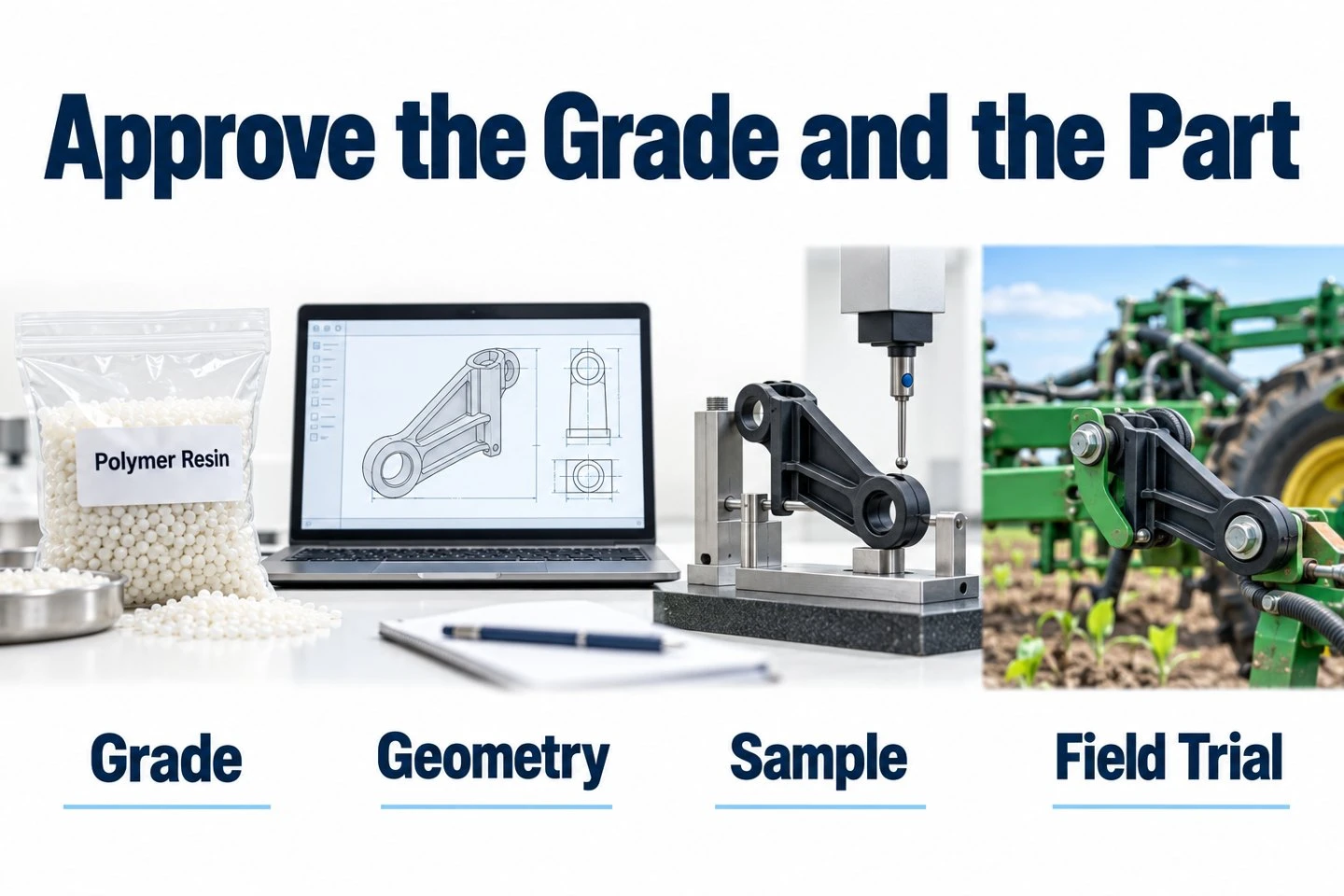
First, approve the written requirements and candidate grades. Retain the full grade designation, reinforcement, color and any required stabilizing package. Next, review the geometry and mold approach. Resolve critical fits, fastening details and inspection conditions before treating a quotation as a finished engineering decision.
Then inspect representative molded samples and perform assembly checks. Record the sample condition, measurement method and resin identification. Test the most demanding credible operating conditions against defined acceptance criteria. Where field use is part of approval, document the machine configuration, duration and observations so the results can inform a repeatable decision.
Finally, connect the approved sample to production controls. Agree on how material substitutions, formulation changes and process changes will be reviewed. Keep the approved drawing revision and inspection plan together. A successful first sample becomes far more useful when later deliveries can be compared with a clear, traceable specification.
What should you send when requesting custom agricultural plastic parts?
Send the 3D model, a dimensioned drawing, the mating-part information and the expected order quantity. Identify the application, loads, operating conditions and critical fit requirements. If the material has already been approved, provide the full grade designation. If selection is still open, describe the performance requirements and ask for candidate grades with their limitations clearly stated.
For a replacement component, photographs and a physical sample can help explain the geometry, but appearance and weight cannot reliably identify the original resin. Ask how the material will be verified or selected rather than labeling an unknown sample as PP or nylon. Separate confirmed facts from assumptions in the request.
The most useful choice is the grade that meets the component's documented requirements in its intended assembly. PP and nylon can both belong on the shortlist; the final decision should come from grade information, manufacturing review and relevant testing. This approach gives the buyer and manufacturer a shared basis for approving a custom component and controlling subsequent orders.
Illustrations are conceptual educational visuals. They do not represent test results, certified equipment or verified performance of a specific component.
Welcome to send your drawings, material requirements and quantity for a custom plastic part review. Contact: amanda@tjswks.com