Digital mold validation is changing how precision injection molding projects are prepared for production. In 2026, improved simulation workflows, richer material data, virtual tool reviews and connected production information are helping engineers identify filling, cooling, shrinkage and warpage risks earlier. This article explains how these technologies support mold design, improve trial planning and strengthen communication between OEM buyers, moldmakers and injection molding suppliers.

Why Is Digital Mold Validation Becoming More Important?
Precision injection molded parts must fit, move, seal and perform consistently across production batches. A small design or process issue can become expensive when it is discovered only after a mold has been manufactured. A housing may show sink marks around thick bosses, a long bracket may warp after cooling, or two flow fronts may create a weak or visible weld line near a functional feature.
Digital mold validation moves part of this problem-solving work earlier. Engineers use 3D part data, material information and process simulation to evaluate how the cavity is likely to fill, pack and cool before relying on a physical mold trial. It does not guarantee that every defect will be eliminated. It provides a better-informed basis for tool design, trial planning and engineering decisions.
In 2026, simulation is increasingly connected with CAD design, mold construction, process setup, inspection data and digital-twin concepts. This broader workflow is relevant to industrial OEM projects, where custom components may have several critical dimensions and long service lives.
How Does Mold-Flow Analysis Support Earlier Risk Detection?
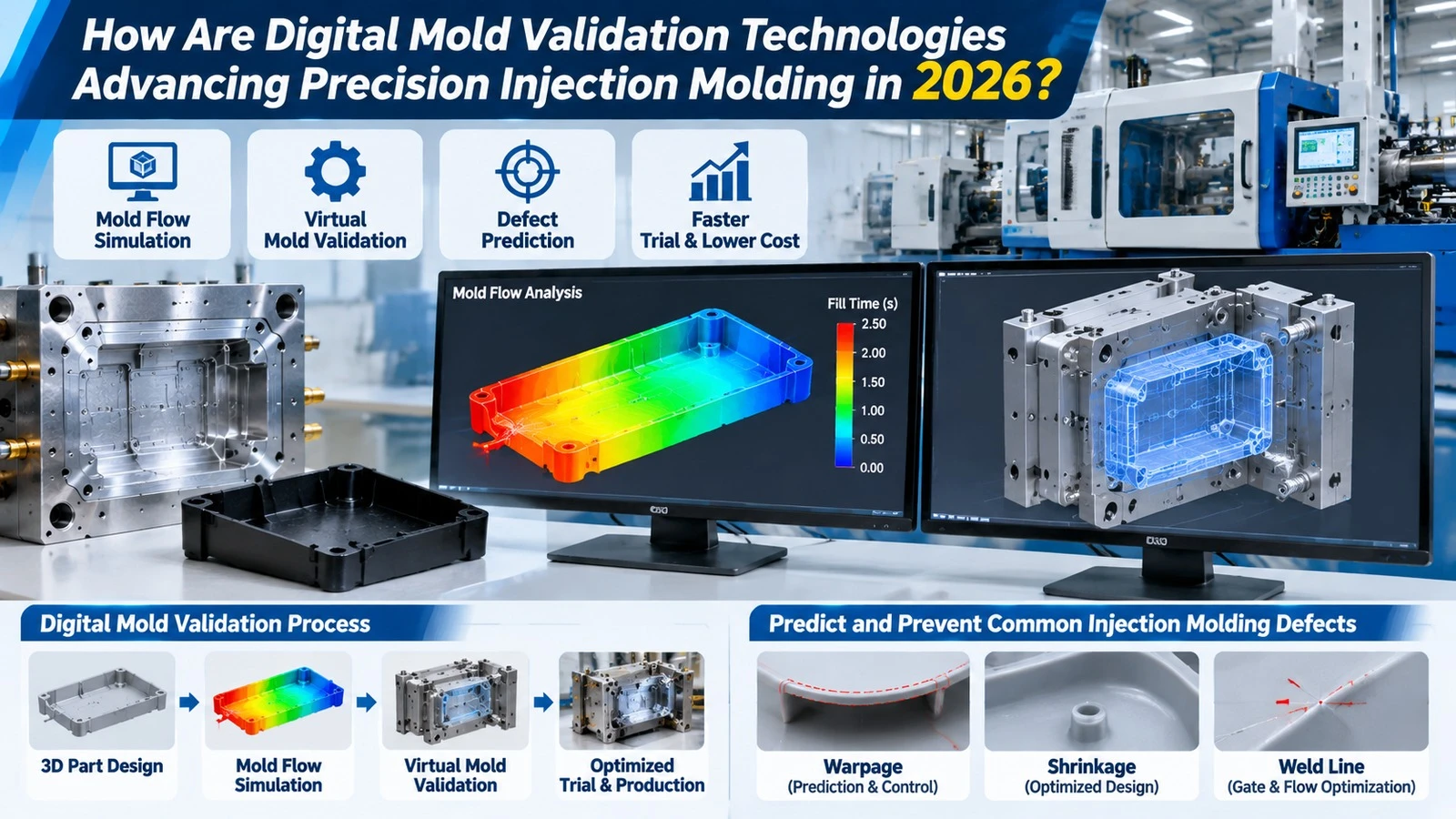
Mold flow analysis uses a digital model of the part, proposed mold and selected resin to estimate how molten plastic moves through the cavity. Depending on the software, material data and analysis setup, engineers can review filling time, flow-front progression, pressure requirements, temperature distribution, air traps, weld-line locations and packing behavior.
This helps answer practical questions before steel is cut. Will a thin rib fill reliably? Is the gate likely to create a weld line near a screw boss? Could a long flow path require excessive pressure? Will a thick section cool much later than the surrounding wall?
A simulation is only as useful as its inputs. Resin grade, shrinkage data, fiber-orientation modeling where relevant, part geometry, gate and runner design, cooling layout and processing assumptions all affect the result. Generic material data or an incomplete mold design can make the output less representative of the real project.
The Autodesk Moldflow Insight 2026 solver validation report describes improvements in accuracy, speed and functionality, including changes to 3D warp prediction and shrinkage modeling. This shows how simulation platforms are refining the link between material characterization and predicted part deformation. It does not mean every resin or part will automatically achieve a tighter tolerance; the specific material data and model assumptions still matter.
Virtual Mold Validation and More Efficient Trials
Digital validation can review the mold itself, not just the plastic part. Engineers can examine the cavity and core, parting line, slides, lifters, ejector positions, cooling channels, runner layout and maintenance access. A 3D assembly review can help identify interference, difficult assembly sequences or areas that may be hard to inspect or service.
A mold may be manufacturable yet difficult to maintain or modify. A virtual review lets the engineering team discuss these issues before the tool is completed. It can also make the first trial more focused: which dimensions should be measured, which defects should be watched, and which process variables should be recorded?
Research published in 2025 on combined virtual and augmented reality environments for injection mold design validation explored how immersive visualization can support reviews of complex mold structures, including interference and assembly or disassembly access. In 2026, virtual-commissioning and digital-twin research is also examining how engineering models can remain useful after initial design validation and support later production activities.
Geometry review should also consider undercuts in injection molded plastic parts, since side actions and release features influence the proposed mold structure.
The virtual model does not replace the physical T1 trial; it helps the team arrive with clearer expectations and a focused checklist.
How Can Engineers Predict Warpage, Sink Marks and Weld Lines?

Three common defects show why digital validation matters.
Warpage occurs when regions of a molded part shrink or cool unevenly, or when residual stresses are released after ejection. Simulation can help identify unbalanced cooling, directional shrinkage, fiber-orientation effects and geometry that may increase deformation risk. Engineers may review wall thickness, gate location, rib layout, cooling channels or material selection.
Sink marks are surface depressions often associated with thick sections, bosses and heavy ribs. Simulation can help identify areas where packing may be insufficient or where a thick region remains hot longer than the surrounding wall. Design responses may include reducing local mass, improving rib proportions, adjusting gate location or reviewing holding pressure and cooling time.
Weld lines form where separate melt fronts meet. Their location and quality can be influenced by gate position, flow path, melt temperature, injection speed, venting and geometry around holes or openings. Simulation can estimate where flow fronts meet, helping designers decide whether a weld line is acceptable or should be moved away from a highly stressed or visible area.
Predictions should guide engineering review, not replace inspection. Actual results can differ because of material-lot variation, machine behavior, tool temperature, vent condition, process settings and model simplifications. Molded samples must still be checked against the drawing and functional requirements. For a practical review of common defects, see How to Prevent Defects in Custom Plastic Parts and What Causes Short Shots in Injection Molding?.
Connecting Simulation with a Digital Thread
Digital mold validation becomes more valuable when project information stays connected. The part revision, resin grade, simulation assumptions, mold revision, trial parameters and dimensional results should be traceable to the same project.
This is related to the digital-thread concept: connected information that follows a product from design through tooling, sampling and production. A 2026 NIST report identifies interoperability, model verification, uncertainty quantification and cybersecurity as important challenges for manufacturing digital twins.
For injection molding, a detailed-looking digital model is not automatically authoritative. Engineers need to know which material data were used, whether the model was compared with trial results, and how revisions are recorded.
What Does This Mean for Industrial OEM Custom Parts?
Digital mold validation is especially useful when an OEM component has complex geometry, several mating parts or functional dimensions that are difficult to adjust after assembly.
For a plastic housing, the team may focus on flatness, boss position, cover fit and sink marks on visible surfaces. For a POM guide or bushing, bore size, concentricity, clearance and sliding performance may matter more than cosmetic appearance. For a PA66 structural bracket, rib layout, fiber orientation, strength and warpage may need to be considered together.
The buyer can help by providing more than a 3D model. A useful RFQ package includes a 2D drawing with critical dimensions and tolerances, the exact material or approved alternatives, mating-part information, operating temperature, expected load, annual volume and the function of each critical feature. If a dimension controls assembly or motion, identify it clearly rather than applying the tightest tolerance to every surface.
Our plastic injection molding tolerance guide explains how geometry, material and measurement conditions influence achievable dimensional limits.
Simulation helps prioritize risks, but it does not remove physical validation. The project workflow from drawing review to mass production is explained in From CAD Drawing to Mass Production: How Custom Injection Molded Plastic Parts Are Made. T1 samples should be measured under agreed conditions, and critical fits should be checked with the actual mating component or a representative gauge. If the material, gate, cooling layout or mold structure changes, relevant dimensions may need to be rechecked.
What Should Buyers Ask Their Molding Supplier?
OEM buyers can ask:
- Is mold-flow analysis appropriate for this part's geometry and tolerance requirements?
- Which resin grade and material data will be used?
- Have filling, cooling, shrinkage, warpage and weld-line risks been reviewed?
- Can the proposed gate, runner and cooling layout be reviewed before tooling?
- Which dimensions will be checked during the first mold trial?
- How will predictions be compared with actual sample measurements?
- How will design and mold revisions be documented?
A supplier should explain the purpose and limits of the analysis. Simulation alone cannot guarantee zero defects or a specific tolerance without reviewing the material, drawing and application.
Conclusion: Better Decisions Before the First Mold Trial
Digital mold validation is advancing precision injection molding by giving engineers more opportunities to evaluate part geometry, material behavior and mold design before production tooling is finalized. Improvements in simulation, virtual reviews and digital-twin workflows can help identify risks related to filling, cooling, warpage, sink marks and weld lines earlier.
For industrial OEM projects, the greatest benefit is often better preparation: clearer design decisions, more focused mold trials, more meaningful dimensional checks and improved communication between buyer, designer and manufacturer. The physical mold trial remains essential, but it can become a confirmation and optimization stage rather than the first time the team discovers major design risks.
SWKS supports custom plastic injection molded projects from drawing review and material evaluation through mold development, sample inspection and mass production. Explore our custom injection molded parts and plastic molded components. If you are developing a precision plastic component, send your 3D model, 2D drawing, material requirement, quantity and application details for an engineering review.
Welcome to send an inquiry with your drawings and project requirements.
Contact our team: amanda@tjswks.com


