


Table of Contents
- What WITTMANN presented in Friedrichshafen
- A production record that extends beyond the press
- How energy figures become useful at lot level
- Roles, live data and ERP integration
- What a subscription changes for the buyer
- What precision injection molding buyers can verify
- From the Fakuma launch to a sourcing discussion
WITTMANN debuted TEMI Next at Fakuma 2026. The AI-ready manufacturing execution system brings process, quality and energy data together and introduces a subscription model for the platform.
What WITTMANN presented in Friedrichshafen
WITTMANN introduced TEMI Next, its new manufacturing execution system, at Fakuma 2026. The company's event material describes software that connects machines and multi-stage production processes in one system. Trade coverage of the launch adds that the platform was built to support current and future AI applications and will be offered through a software subscription. The introduction brings a practical factory question into focus: can a molder follow a production order through the press, post-molding operations and the checks that determine whether the finished lot is accepted?
An MES sits between the production plan and the work taking place on the shop floor. For a molding program, this can include identifying which order is running, recording equipment and job events, and linking them to the operations that complete the product. AI-ready is a description of how the underlying information is organized for present and future applications. The announcement should be evaluated in terms of available data, configured functions and the decision a production team needs to support.

Illustrative manufacturing scene.
A production record that extends beyond the press
TEMI Next links molding machinery with other manufacturing stages in a common production model. Trade coverage reported additional equipment interfaces intended to cover processes such as assembly, filling and packaging alongside molding. Using a shared production record can help operators see where an order was delayed or held. For example, a component may leave the press on time but wait for a second operation or an inspection before it can be packed. Those events belong to different steps and should be identifiable in the data.
For an OEM molding order, identify what follows the shot. Is the part removed and placed into a tray, checked in a fixture, or assembled with hardware on a separate station? Decide whether each operation should be recorded by piece, batch or work order. A finished lot may include parts from different times of day and more than one machine setup. Keeping the order, tooling revision and inspection sample related can make a later quality review easier to interpret. Ask what each connection actually captures before assuming all equipment produces equivalent data.
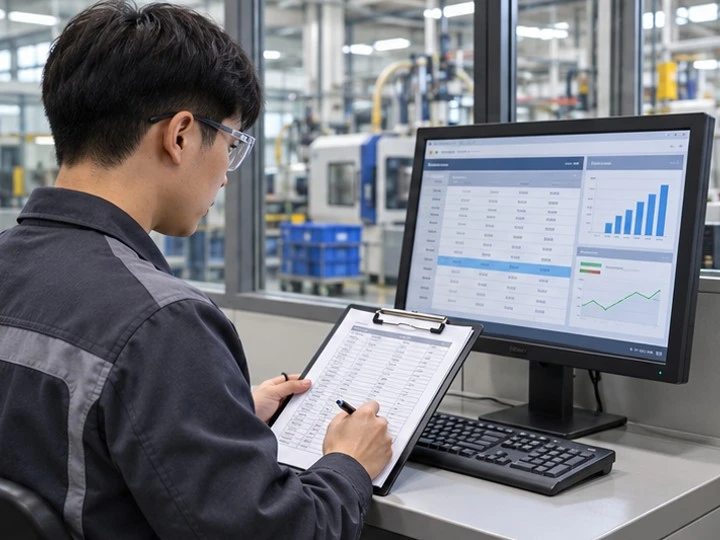
Illustrative manufacturing scene.
See our guide to optimizing injection molded parts for automation equipment.
How energy figures become useful at lot level
WITTMANN places TEMI Next alongside iMAGOxt in its digital manufacturing portfolio. Reporting on the debut describes an integrated iMAGOxt energy module that can associate consumption with a machine, part or lot, depending on the available setup. If a shop uses energy per accepted part as a comparison, the team has to decide what is included in the numerator and which output counts are used for the calculation. Power on the press is one boundary; a complete production cell may also include drying, handling or cooling equipment.
A useful pilot compares the consumption assigned to a real order with a record of cycle count, operating time and accepted output. Explain how the software treats startup, scrap and downtime, and whether equipment shared by several cells is measured separately. If the buyer needs a carbon figure, agree on the source and boundary for the applicable conversion factors. The point of a production record is to make the assumptions visible enough that two runs can be compared on the same basis.

Illustrative manufacturing scene.
Roles, live data and ERP integration
Trade reporting describes role-based views and live data in the updated interface, as well as connections with enterprise systems such as SAP and Odoo. These details matter because a planner and a production operator may need to see different information about the same job. The floor may need the current order and a clear reason why the machine stopped. Planning may need the completed quantity and when the next assembly step can begin. A quality reviewer may need to find the record of which samples were taken and which revision governed their inspection.
In a trial, walk one representative order from release to completion. Identify which system owns the job reference and how the completed quantities return to production planning. Check what happens when an order is interrupted or moves to a second machine. A planned job number is useful only when everyone can connect it to the event record on the equipment. If part and tooling revisions change during the program, agree how each revision will be identified without relying on an operator to interpret an old description.
What a subscription changes for the buyer
The launch introduced subscription-based delivery for TEMI Next. When evaluating software as a service, compare which integrations, migration steps, update services and support are included in the proposed scope. A molding plant may already have order records, machine interfaces or local reporting that it needs to carry forward. Identify who will configure the live connections and how the plant can retrieve historical information for its own quality or customer records.
Subscription costs are easiest to compare after a small, representative pilot. Have the team identify the records it already trusts and select one operation that would benefit from better visibility. Check how job and inspection information is accessed during the trial, and document what happens if a machine connection is unavailable. If a site plans to add another line or downstream process later, record which parts of the agreed scope carry over and which require a separate integration effort.
What precision injection molding buyers can verify
The strongest case for a production data system starts with an actual molded item and an approval problem. A sensor bracket may need dimensional evidence tied to a drawing revision. A gear or cam may need an inspection tied to its mating geometry and cavity number. The production system can help associate those records with a work order, while the drawing and sample inspection establish what was actually measured. Decide which evidence the customer needs for first articles and which should be available for repeat supply.
Use a mold trial or pilot run to agree on the data that should be retained. A purchaser can request the revision used, the accepted grade, the sample identification and the check performed on a working face. If a downstream gauge or assembly check contributes to acceptance, make it part of the defined release record. This also helps when a later lot uses a different machine or tooling setup. A record is valuable when it shows which conditions changed and whether the buyer's critical characteristics still met the specified limits.

Illustrative manufacturing scene.
| Area | What to review | Evidence to request |
|---|---|---|
| Order tracking | Follow job from press to release | Work order, tool revision and downstream events |
| Energy allocation | Compare equivalent production runs | Metering boundary, downtime and accepted output |
| Equipment and ERP links | Verify exchange on the pilot line | Machine interfaces, order ownership and completion feedback |
| Quality records | Connect acceptance checks to the right lot | Sample ID, part revision and drawing criteria |
For an application example, read the SWKS guide to designing molded gears, cams and transmission components.
From the Fakuma launch to a sourcing discussion
For buyers developing a custom molding project, a software announcement is an opportunity to ask better questions about production evidence. Send the intended component drawing, mating part details, forecast volume and the acceptance checks that apply to the project. Ask the supplier to describe where tooling, process information and physical sample results meet. A short written description of the pilot run can make it clear which checks the molder will perform and which belong to the machine or product owner.
Initial setup, normal production, a changeover and a repeat order can each leave a different record. Agree which of those situations need documented evidence when quoting a part. For a repeat industrial order, keep the accepted drawing and sample references with the production lot rather than relying on generic descriptions in purchase records. The same clarity is useful whether the molding team operates one cell or connects several processes using an MES.
Explore SWKS custom plastic injection parts for your next tooling program.
Discuss your molding project with SWKS
Send your STEP, STP or IGS drawing, assembly requirements and expected quantity to amanda@tjswks.com or call 0086-15222707659.
Reporting based on WITTMANN's Fakuma 2026 event material and launch coverage from CPRJ and Plastech.