


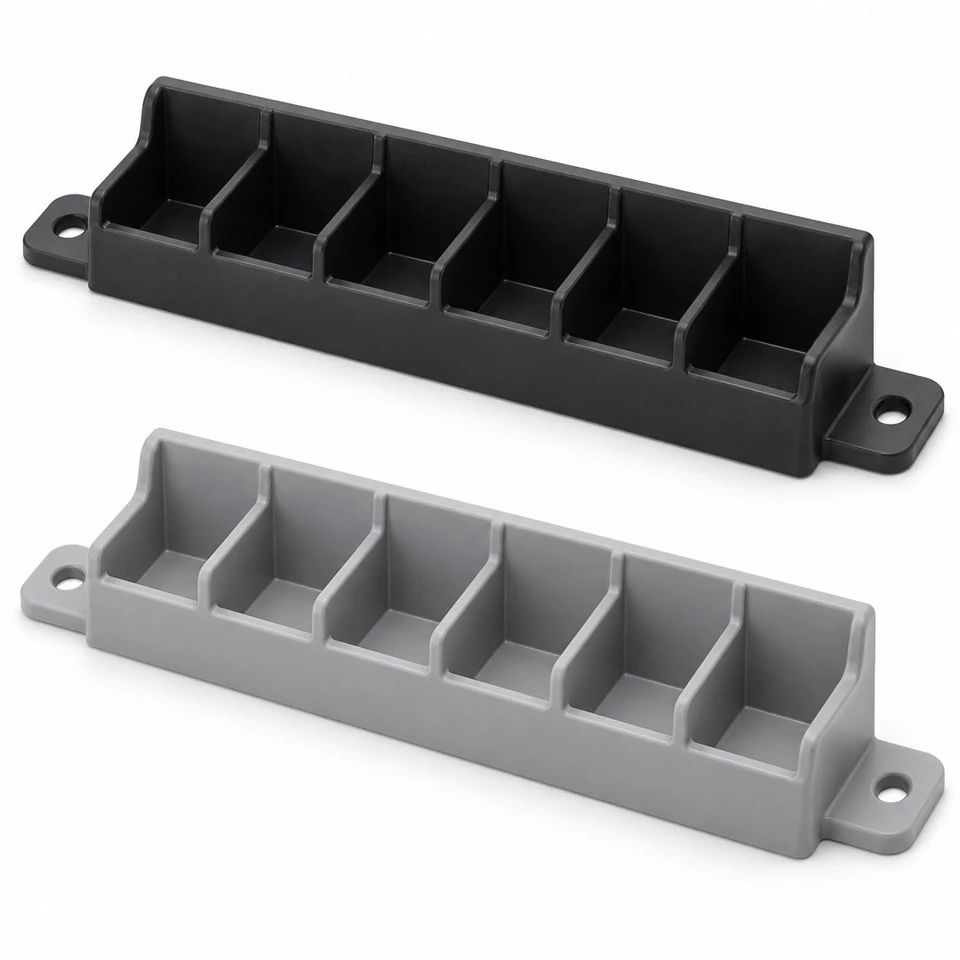
Tianjin SWKS Technology & Development Co.,Ltd is one of the most reliable manufacturers and suppliers of custom abs spare blade fuse storage racks in China. If you're going to buy bulk cheap custom abs spare blade fuse storage racks, welcome to get quotation from our factory. Quality products and low price are available.
Custom ABS Spare Blade Fuse Storage Racks
Keeping the correct spare fuses near a maintenance point can simplify a service task when each item has a defined storage position. SWKS develops custom injection molded ABS spare blade fuse storage racks around the selected fuse bodies, handling access and equipment mounting space. The illustrated six-pocket organizer is intended for unused spares and has no electrical contacts. Send the fuse drawings, mounting layout and quantity requirements to amanda@tjswks.com for quotation.
Material: ABS/POM/PA66/PP/PC/PA/PU/TPE/TPU etc.
Processing Service: Injection
Drawing: STP/STEP/IGS
Contact: amanda@tjswks.com / 0086-15222707659
What is stored in this molded rack?
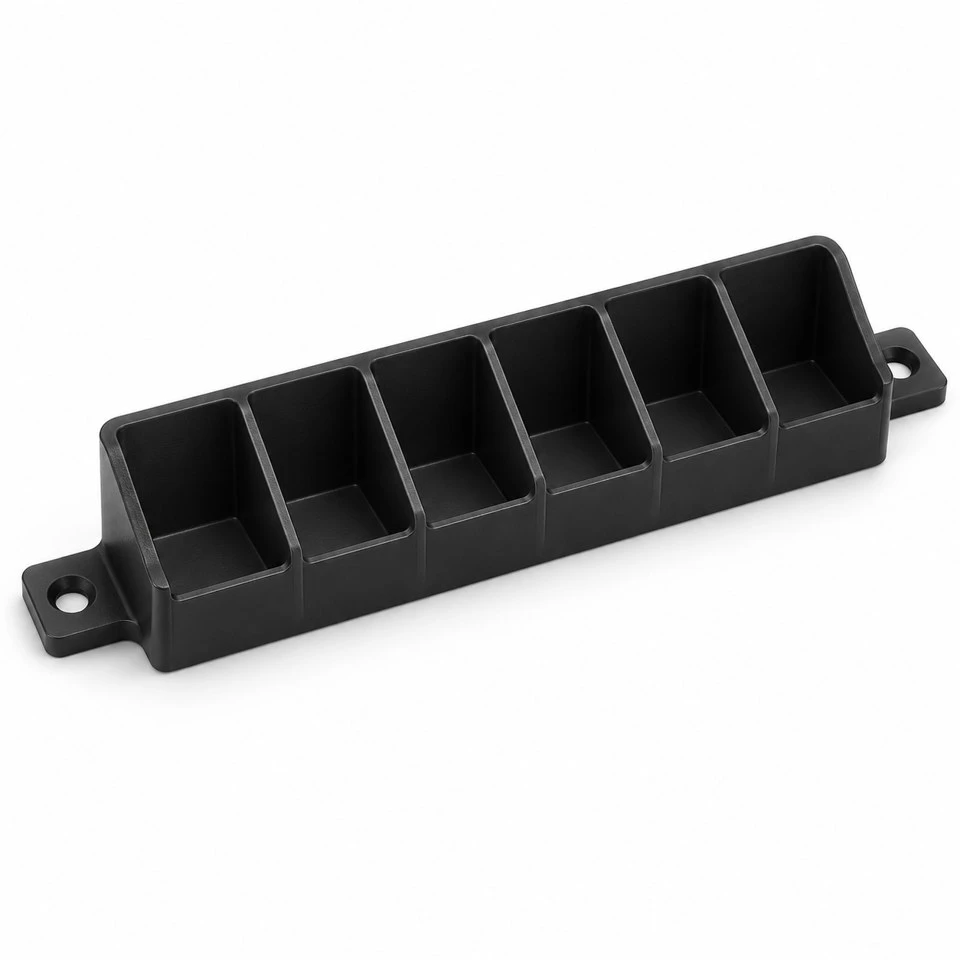
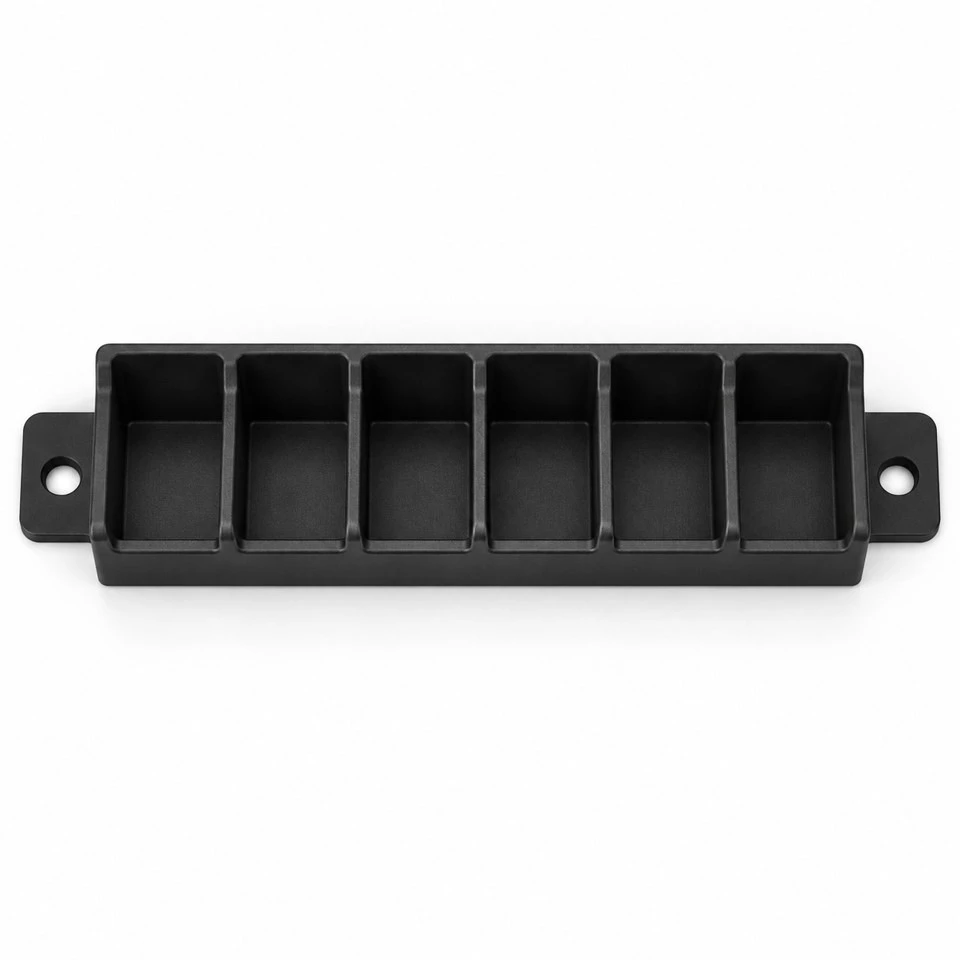
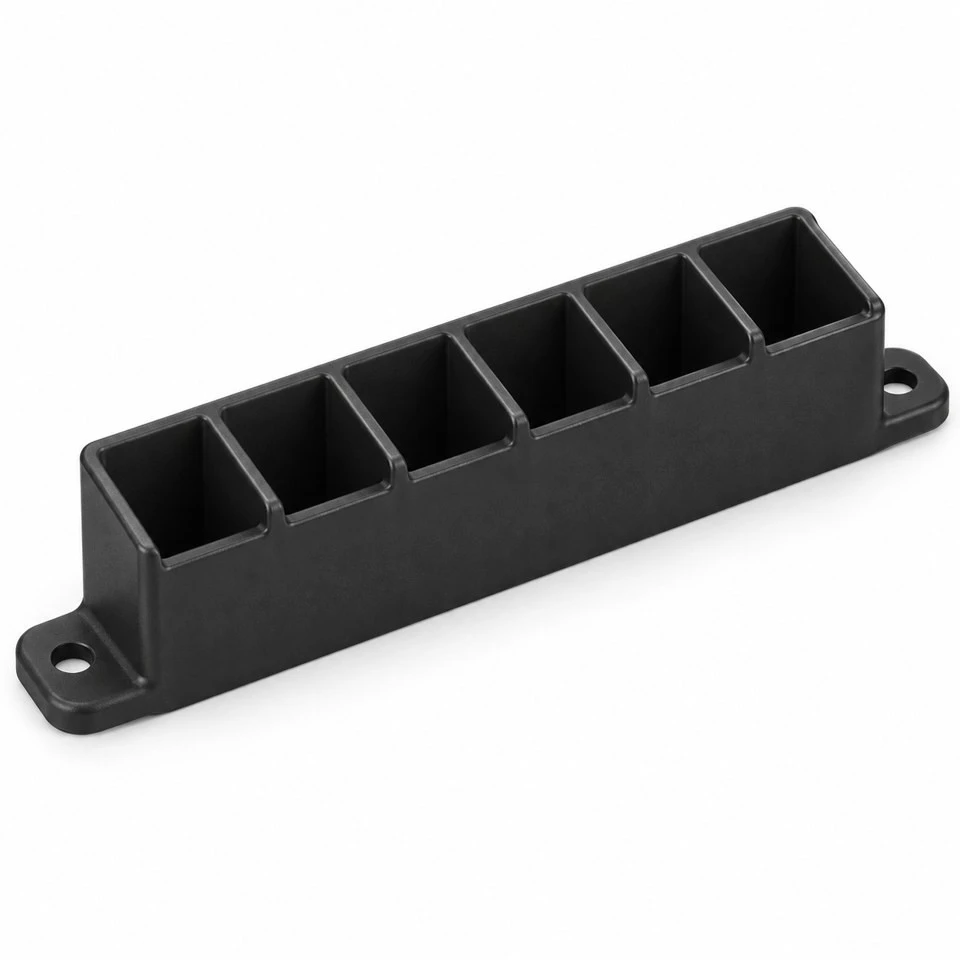
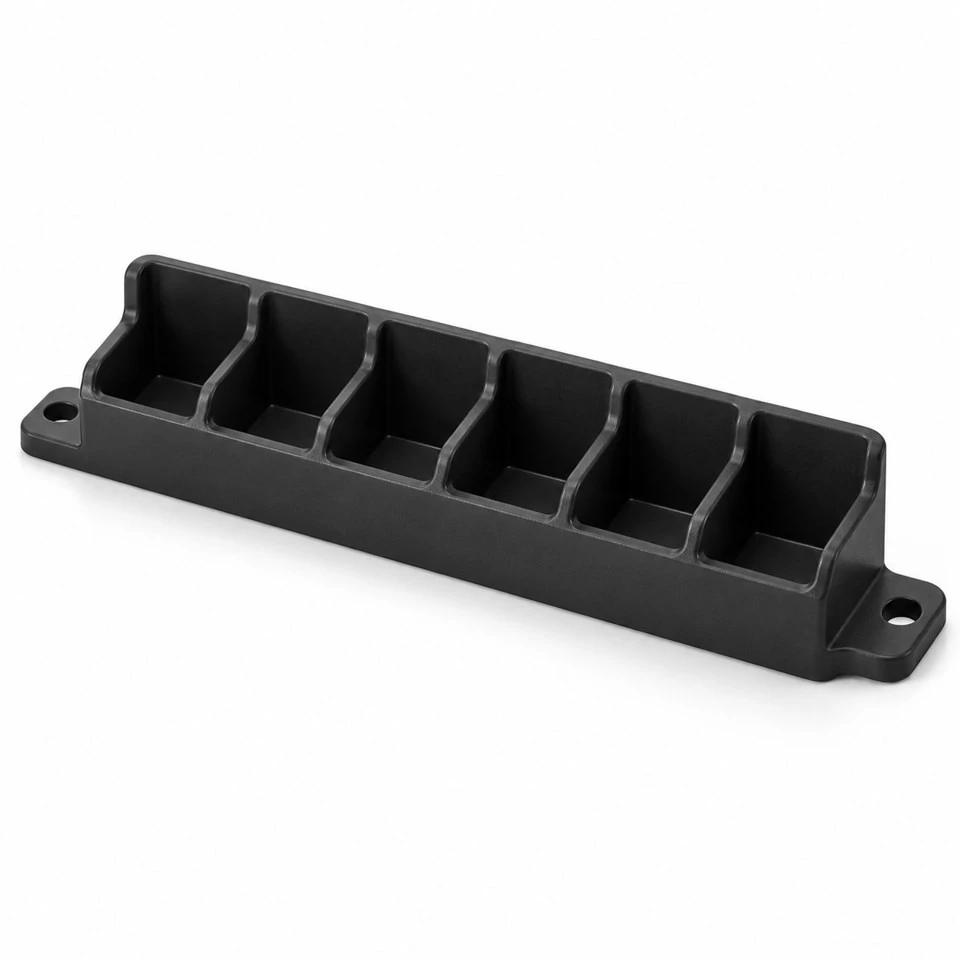
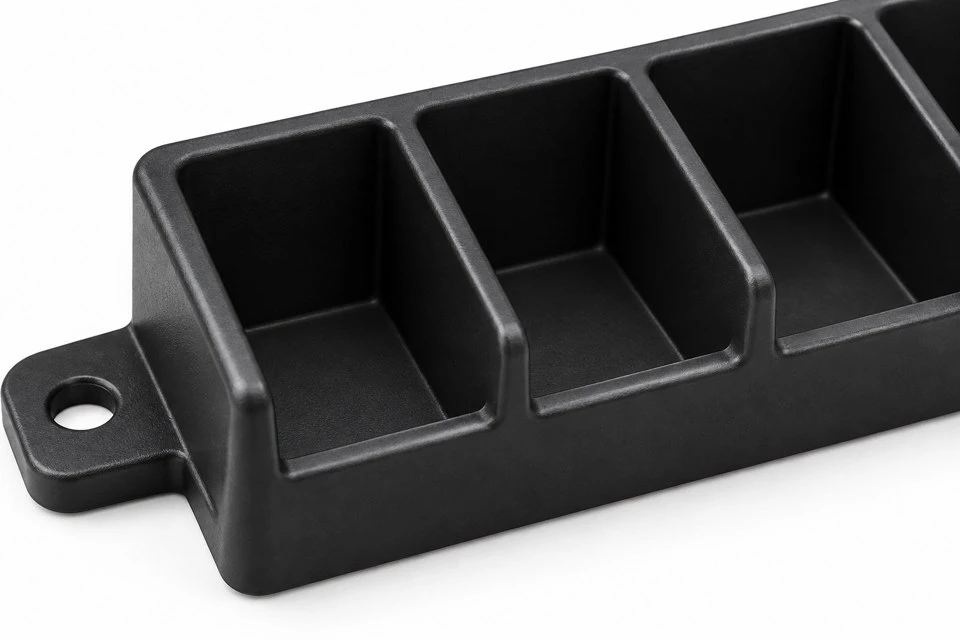
The rack provides separate positions for unused replacement blade fuses kept near an equipment maintenance point. It can organize a defined set of spares so the person servicing the machine can find and remove the required item. The illustrated concept has six adjacent open-top pockets with divider walls and two end mounting ears. Pocket count and dimensions are developed around the customer's chosen fuse bodies and available mounting area.
This is an unpowered storage component. It contains no electrical terminals, conductive clips, wiring connections or switching function. A fuse placed in the organizer is a spare, not part of an operating circuit. The rack should not be confused with an electrical fuse socket or assigned a voltage or current rating. Its purchasing specification concerns mechanical storage, accessibility and the environment where those spare parts will be kept.
Which fuse dimensions determine the pocket layout?
Supply the exact fuse family and the manufacturer's drawing or representative samples. Blade fuses come in different body and terminal arrangements, so a general description such as automotive size does not adequately define a pocket. Include the body width, thickness, exposed blade envelope and any protrusions that may contact the organizer. State whether several sizes must be accommodated or whether every position holds the same defined part.
The pocket should support the intended area of the fuse without forcing fragile or unintended features against an edge. Show the insertion orientation and the preferred exposed portion for removal. If the blades enter the pocket, their clearance and protection need to be considered explicitly. If the body rests above a relieved space, define that arrangement. The final drawing should make the storage interface clear rather than leave it to an operator's interpretation.
How should a technician grip and remove a spare?
Decide whether removal is performed by fingers or with the specified fuse puller. Leave enough access above and around the stored body for that method. A close row can look compact while making the middle positions difficult to reach. Show any neighboring covers, wiring ducts or enclosure walls that restrict the approach. The rack layout should be reviewed in its installed position with the actual maintenance access.
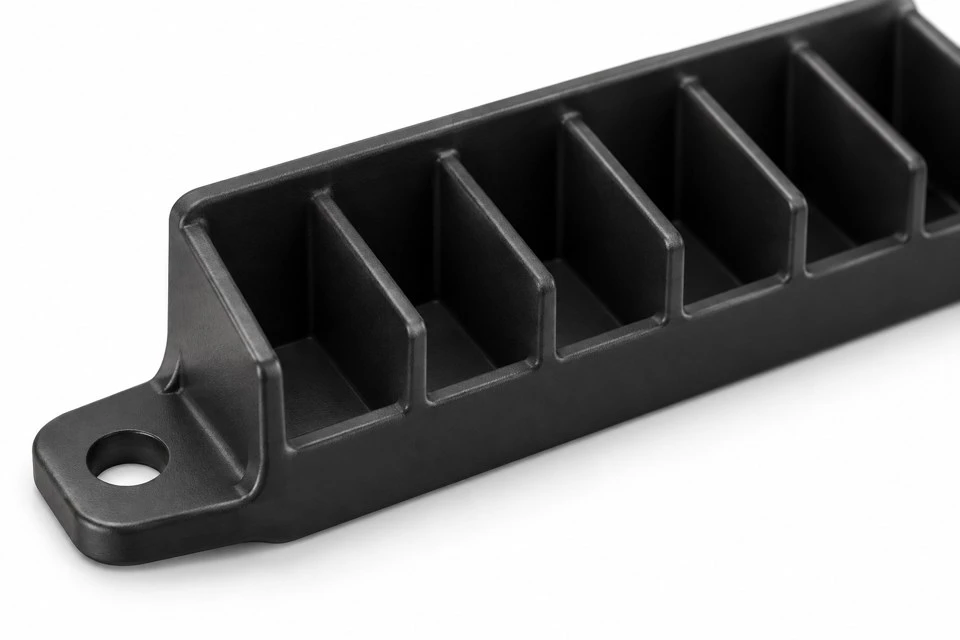
The low front lip and taller rear wall shown in the concept are possible ways to provide support while retaining access. Their final heights depend on the fuse and the grip area needed. Rounded divider edges can reduce snagging during placement, but the shape still needs a practical trial. If gloves are used during servicing, include that requirement when samples are checked. A successful bare-hand demonstration may not represent the intended handling procedure.
Does a storage pocket need positive retention?
State the rack orientation and the movement expected around it. An organizer fixed horizontally inside a stationary cabinet has different retention needs from a carrier mounted vertically or on a moving cover. The concept uses open pockets and does not include a qualified snap latch. If positive retention is required, describe the removal force and conditions that the design must meet before a revised retaining feature is developed.
Avoid specifying a tight fit as the only acceptance requirement. Too much interference can make a spare hard to remove or place unwanted stress on its plastic body. Too little restraint may allow it to rattle or leave its position. Use representative fuse samples spanning the relevant dimensional variation, and agree an insertion and removal method. Any vibration or transport check should reflect the actual installed orientation and agreed service conditions.
Where are the mounting ears attached?
The illustrated rack has a flat ear with a round through hole at each short end. Provide the support material, hole spacing, fastener details and available tool access. Identify the surfaces that should sit against the support and any clearance required under the pockets. If another bracket or adapter is used, include its drawing. A two-hole rack should not be described as directly compatible with every enclosure or rail.
Review the support beneath the ears and the tightening method. An unsupported mounting tab may bend as a screw is tightened, changing pocket alignment or stressing the adjacent wall. Include washers or other hardware if the assembly requires them. The organizer should be positioned where it is accessible without interfering with the equipment's intended components. The mounting specification belongs to the complete installation and should be confirmed with representative hardware.
How can different spare fuse ratings be identified?
Separate positions can be assigned to different spare parts, but the labeling arrangement must be defined. A molded plain rack does not automatically identify the electrical rating of the items stored in it. If the equipment uses fixed locations, specify the information and placement for a label, molded identifier or another agreed method. The required characters and their legibility should be reviewed at the actual component scale.
Keep identification associated with the approved spare part list. A similar-looking fuse should not be assumed to have the same rating or characteristic. The organizer's function is to keep a defined set of spares accessible; it does not verify the electrical selection. The main product images deliberately show unmarked empty racks. Any production marking, label recess or color assignment is a separate feature to be agreed on the released drawing.
When is ABS suitable for the storage environment?
ABS can be considered for a rigid molded organizer when the required temperature, impact behavior and exposure conditions suit the chosen grade. Provide the normal and maximum temperatures near the installation, including any heat generated by neighboring equipment. Identify oils, cleaners or other substances that can reach the rack. A generic ABS material description does not establish suitability for every cabinet, vehicle or industrial maintenance environment.
If a specified flame classification, color or documentation is required, state the complete requirement during material selection. The appearance of a black or light gray concept view does not establish a material classification. Resin formulation, additive package and color need to be agreed together. Where outdoor exposure or an unusual chemical environment is expected, explain it before tooling is released so the proposed material can be reviewed against those conditions.
What should the pocket bottom and divider roots look like?
The concept has closed pocket bottoms that separate each stored spare from the support surface. Define whether that closed arrangement is appropriate for the installation. Dust or debris can accumulate in a pocket, so explain the cleaning access and any requested drainage or clearance feature. Do not assume an opening can be added later without considering its effect on the stored fuse and the mounting interface.
Divider walls should have transitions appropriate for both molding and handling. Review wall thickness, root radii and the intersections with the base and rear wall. Abrupt thick areas may affect cooling and the opposite surface. Mark pocket-contact regions where flash or a raised gate vestige would interfere with placement. The mold designer can then select parting, gating and ejection arrangements with those functional surfaces in mind.
Can pocket count and spacing be customized?
The six-position concept is a starting layout. A custom rack may use fewer or more pockets, mixed pocket sizes or spacing that follows a specific maintenance kit. Provide the complete spare list and installation envelope rather than a requested overall length alone. A longer row can change the available access, support requirements and relationship between mounting points. Those effects should be reviewed as part of the full organizer.
If the assembly needs a separate space for a fuse puller, describe its geometry and retention requirement. That feature is not included in the illustrated empty rack unless it is added to the drawing. Other options can include another mounting pattern, a label area or a revised front opening. Each change should be reflected in the model and inspection information so the quoted scope matches the part the customer intends to install.
Which checks help approve the first molded samples?
An inspection plan may cover pocket width and depth, divider spacing, mounting-hole positions, seating surfaces and overall shape. Identify the dimensions that control fit with the selected fuses and the mounting support. Use an agreed measurement method and record the relevant sample condition. Visual checks should also address incomplete filling, flash and sharp handling edges in the pocket openings and around the mounting ears.
Functional approval should use the intended spare items, mounting hardware and installation orientation. Confirm loading, removal and any agreed retention check through the defined handling cycle. If a dimensional change is accepted during sampling, update the drawing rather than relying only on a marked physical sample. Keep the approved spare part reference connected to that revision so a later change of fuse supplier can trigger an appropriate fit review.
What information should accompany a quotation request?
Send an STP, STEP or IGS model and a dimensioned drawing where available, together with the selected fuse drawings or samples. Include pocket assignments, mounting details, handling method, working environment and identification requirements. State the preferred ABS grade and color, first order quantity and expected repeat demand. If development begins from a sketch, identify the critical fit and access requirements that must be established before tooling.
Agree packaging and labeling so similar racks or mixed kit versions are not confused during assembly. Packaging should protect the divider edges and keep the pockets free of debris before loading. Specify inspection records or material traceability needed for the supply. The images are design visualizations of a custom mechanical storage rack, with final production based on the buyer's approved drawing and the agreed sample acceptance criteria.
Contact amanda@tjswks.com to discuss a custom ABS spare blade fuse storage rack for your equipment.
Hot Tags: custom abs spare blade fuse storage racks, China, suppliers, manufacturers, factory, bulk, cheap, low price, quotation, abs blue components, abs blue parts, abs glossy fittings, abs gold parts, abs purple components, abs white components


